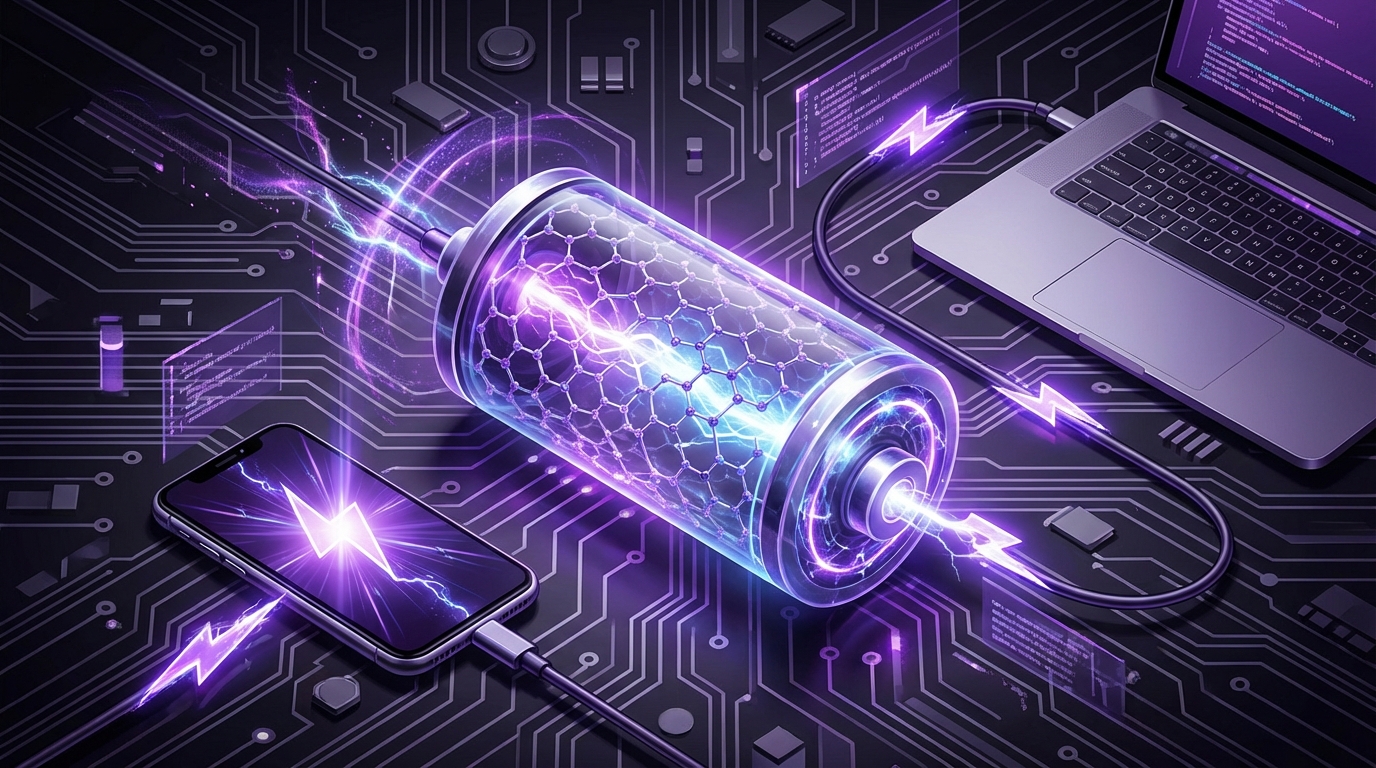
I used to roll my eyes every time someone said graphene would change everything. I had heard the same thing about fuel cells, solid state, you name it. Most of it never left the lab.
So here is the short answer: graphene batteries will not kill slow charging overnight, but they will make fast charging a lot more common, safer, and easier to pack into small devices and some vehicles. Right now they are more of an upgrade to lithium-ion than a total reset, and the biggest hurdles are cost, manufacturing, and trust from big battery buyers.
What people mean when they say “graphene battery”
When a company says “graphene battery,” they usually are not talking about a pure graphene miracle cell that breaks every rule of physics.
Most of the time they mean one of three things:
- A lithium-ion battery that uses graphene mixed into the anode (and sometimes cathode) to improve performance.
- A lithium-ion battery that uses graphene in the current collector or separator to improve conductivity and stability.
- In rare cases, a lithium-sulfur or supercapacitor-style device that heavily uses graphene structures.
So the chemistry under the hood is still mostly lithium-based. Graphene is playing the role of “super material” that helps electrons and ions move faster and more safely inside a battery that still looks and behaves like the ones you already know.
Graphene batteries today are more like “graphene-enhanced lithium-ion” than a new physics product that replaces everything on the shelf.
This matters, because it keeps expectations grounded. If you picture your phone charging from 0 to 100 percent in 5 seconds, you are setting yourself up for disappointment.
Why graphene is such a big deal in theory
Graphene is a single layer of carbon atoms arranged in a hexagonal lattice. It has a few properties that sound almost unfair:
| Property | What it means for batteries |
|---|---|
| Extremely high electrical conductivity | Electrons can move through an electrode with very low resistance, which reduces heat and voltage drop at high charge rates. |
| Huge surface area (per gram) | More surface area means more reaction sites for lithium ions, which can improve charge speed and possibly capacity. |
| High mechanical strength | Electrodes can better handle expansion, contraction, and cycling stress, which helps lifespan. |
| Good thermal conductivity | Heat spreads out instead of forming hot spots, which helps safety and stable fast charging. |
At a very simple level: if you make parts of a battery out of a material that moves electrons and spreads heat very well, you can push more current in and out without frying it.
That is the theory. The practical challenge is how to put graphene inside a battery at scale without turning it into something ordinary along the way.
How graphene can speed up charging in practice
Now let us talk about the part everyone cares about: does it really charge faster?
Fast charging is limited by three main bottlenecks inside a battery:
- How fast lithium ions can move through the electrolyte and into the electrode.
- How quickly electrons can move through the electrode material itself.
- How much heat builds up and whether that triggers degradation or safety systems.
Graphene mostly helps with the second and third points.
Graphene in the anode: the core of the speed story
Most current lithium-ion batteries use a graphite anode. Graphite can store lithium in its layers, but it has limits:
- It accepts lithium at a certain rate; push too hard and you get lithium plating, which is bad for safety and lifespan.
- It is not a great conductor compared with graphene.
When manufacturers add graphene to the anode (often blended with graphite or silicon), they get:
- Lower resistance, so electrons move more freely.
- More complex internal structure with more pathways for ions.
- Better tolerance of rapid charging cycles.
Real-world claims you see from companies are usually in this territory:
Graphene-enhanced lithium-ion cells that charge from 0 to 80 percent in 10 to 20 minutes, with cycle life around 2 to 3 times longer than traditional fast-charging cells.
Notice something: 10 to 20 minutes is fast, but it is not magic. You still need:
- A charger that can push that much power.
- Thermal management in the device.
- Careful control logic to avoid damage.
Graphene gives the battery more headroom. It does not remove the need for power electronics, cooling, and good software.
Heat: the silent enemy of fast charging
Every time you fast charge, you are doing a trade:
- You shorten charging time.
- You stress the cell with more heat and higher current.
This is where graphene’s thermal and electrical properties make a quiet but serious difference.
Instead of hot spots that cook part of the electrode, heat spreads across a larger area. The total temperature rise can be lower for the same charging power. That means:
- Less risk of thermal runaway at very high charge rates.
- Longer cycle life even with frequent fast charges.
- Slightly simpler or lighter cooling in some designs.
Graphene does not only make charging faster; it makes “fast” feel closer to “normal” from the battery’s point of view.
You may still see a 30-minute fast charge label. The win is that the cell can survive many more of those cycles without bloating, losing capacity, or triggering safety incidents.
Where graphene batteries are already showing up
You cannot walk into any phone store and pick from 20 “graphene phone” models yet, but there are already real products in the market.
Consumer electronics
This is the easiest beachhead for any new battery tech:
- Lower total energy than a car, so risk is easier to manage.
- Shorter lifecycles, since people upgrade devices fairly often.
- High competition on charging speed and battery life in marketing.
Examples you see or are starting to see:
- Power banks marketed with graphene-composite cells, promising faster charging and cooler operation.
- Smartphones that use “graphene-based thermal layers” around the battery and chipset to manage heat during fast charging and gaming.
- Laptops or tablets that offer higher charge speeds on USB-C with slightly better cycle life.
In many of these, graphene shows up in two ways at once:
- Inside the cell, in the anode or other internal parts.
- Outside the cell, in heat spreaders to pull heat away from the battery and processor.
One honest point here: marketing teams are not always very clear about which of these they are talking about. You might see “graphene battery” on a box when it is actually a lithium-ion battery plus a graphene cooling film, which helps but does not change the core chemistry.
Electric vehicles (EVs)
EVs are the real prize. If you can safely charge a battery pack to 80 percent in 5 to 10 minutes, road trips feel a lot closer to refueling a gas car.
Right now:
- Some battery suppliers are piloting graphene-enhanced cells for EV packs.
- Lab and pilot results often show higher charge speeds, better cycle life, and better low-temperature performance.
- Car makers are cautious because of cost, long qualification cycles, and concern about long-term safety data.
A more realistic near-term path for EVs looks like this:
| Feature | Current EV packs | Graphene-enhanced target (near term) |
|---|---|---|
| Fast charge (to ~80%) | 20 to 40 minutes (typical) | 10 to 20 minutes at similar or slightly better degradation |
| Cycle life to 80% capacity | 1,000 to 2,000 cycles | 2,000 to 3,000+ cycles under similar or heavier fast charge use |
| Temperature window | Fast charge often restricted in cold weather | Better tolerance in colder conditions because of better conductivity |
Those numbers are directional, not promises. But they show the pattern: improved charging time and lifespan, not instant 5-minute full charges for any car on any charger.
Graphene in EVs looks less like “gas-station speed” in one step and more like a steady push toward faster, kinder charging cycles.
Energy storage and niche uses
Outside phones and cars, graphene batteries are also tested or used in:
- Drones, where weight, peak power, and charge time matter a lot.
- Grid storage projects that value long cycle life and safety under frequent cycling.
- Wearables, where thinner form factors and stable charging help design freedom.
These areas usually move faster than cars, because they can accept more experimental chemistry with lower regulatory friction.
How much faster can graphene batteries really charge?
Let us try to put some numbers around the promise. There is a wide range, because every product and test is different, but you can think in rough tiers.
Short term (already visible)
In the current wave of graphene-enhanced batteries, these ranges are common in claims and some independent tests:
- 0 to 50 percent charge in 5 to 10 minutes for small devices.
- 0 to 80 percent in 10 to 20 minutes for larger packs (power tools, some laptops, pilot EV cells) under heavy chargers.
- Cycle life improvements of 1.5x to 3x under aggressive fast charge conditions compared with non-graphene peers.
The main point: graphene helps lift the ceiling on how fast you can charge without killing the battery quickly.
Medium term (what labs are chasing)
Research labs have shown more aggressive numbers:
- Cells that handle extremely high C-rates (charging in a few minutes) for hundreds or thousands of cycles.
- Graphene-supercapacitor hybrids that can almost instantly charge but hold less total energy.
Those are promising, but not yet mass-produced for mass-market devices. The gap is usually:
- Cost per kWh is too high.
- Manufacturing repeatability is not mature.
- Safety data over many years is still thin.
If you are hoping for “0 to 100 percent in under 5 minutes” on a full-size EV battery with 60 to 100 kWh capacity, that is pushing the limits of current charging infrastructure, wiring, and grid capacity, not only the battery chemistry.
So the reasonable outlook:
Graphene can help make 10 to 20 minute fast charging acceptable, routine, and less punishing for batteries, instead of promising universal 5-minute miracles.
What is slowing graphene batteries down?
If graphene looks so good on paper, why are we not all using it already?
Production quality and cost
The first issue is simple: not all graphene is the same.
There are different production methods:
- Chemical vapor deposition (CVD) for high-quality, large-area graphene films.
- Liquid-phase exfoliation to peel layers off graphite.
- Reduction of graphene oxide.
For batteries, you often need large quantities of graphene powder or flakes with consistent:
- Layer thickness.
- Purity.
- Surface chemistry.
That is harder than it sounds at the scale of gigafactories. If the structure or purity varies, battery performance and safety can also vary. That is not something car makers or phone makers like.
On top of that, high-quality graphene is still relatively expensive compared with traditional carbon materials. Price has been falling, but battery profit margins are thin, and any cost bump must be justified by clear performance gains.
Integration into existing manufacturing lines
A working lithium-ion production line is a complex asset:
- Coating, drying, calendering equipment tuned for certain slurries.
- Existing supply chains for graphite, binders, separators.
- Quality control routines tuned to known behaviors.
If you tweak the anode recipe to include graphene, you might need:
- New mixing processes.
- New coating speeds and drying conditions.
- New quality control metrics.
That is not impossible, but it takes time, capital, and a willingness to slow down production while everyone learns the new behavior.
Some manufacturers will accept this for high-margin, flaghsip devices. Fewer will do it for low-cost segments until the methods are very well proven.
Hype fatigue and trust
Battery buyers have also become cautious. They have seen many promises:
- Miracle nanomaterials.
- Breakthrough chemistries.
- Lab announcements that never turn into products.
So today, when a startup says “our graphene battery charges 10x faster,” an EV maker will ask:
- Show long-term cycle data for many cells.
- Show abuse testing: crush, puncture, overcharge, thermal runaway tests.
- Show cost per kWh at scale, not only in a pilot line.
The biggest hurdle for graphene batteries is not physics, but proof: stable, boring, repeatable performance numbers that big buyers can trust.
This is where hype hurts. Some companies add a sprinkle of graphene to a regular cell and market it as something radical. That clouds the conversation for serious players who are actually advancing the state of the art.
Will graphene batteries “end” slow charging?
This is the big question, and I think the honest answer is “partly, and not in the way headlines promise.”
Where slow charging will stick around
There are several reasons slow charging will never truly disappear:
- Grid and wiring limits: not every home, office, or parking space can deliver the power needed for ultra-fast charging, especially for large EV packs.
- Thermal management limits: even with graphene, removing huge amounts of heat quickly is complex.
- Cost and wear: fast charging hardware and high C-rate cells cost more. Some users will accept slower charging to save money.
A rough rule of thumb:
| Use case | Graphene’s impact on charging |
|---|---|
| Smartphones | Shorter fast-charge sessions, improved battery health at high wattage. “Slow” overnight charging still common for convenience. |
| Laptops | Better high-wattage USB-C charging, fewer battery issues under frequent partial charges. |
| EVs (daily use) | Most users still charge at moderate speeds at home or work. Graphene helps on road trips and heavy use. |
| Grid storage | Charging speed is less critical than cycle life and safety. Graphene helps more with lifespan than with “ending slow charging.” |
Not every situation needs 5 or 10 minute charging. Many times, “plug it in and forget it” is perfectly fine.
Where graphene will cut slow charging down
There are areas where graphene has real potential to reduce slow charging as a constraint:
- Public fast chargers: if more EVs can handle faster rates safely, average charge times at public stations drop, which helps availability.
- Shared mobility: fleets of scooters, ride-share vehicles, and delivery vans benefit from shorter charge times and longer cycle life.
- High-intensity users: gamers, content creators, and power users who hit their batteries hard will see more consistent performance over time.
In those areas, slow charging has a real cost: down time, user frustration, or lost revenue. Graphene-enhanced cells directly address that.
So the better framing might be:
Graphene batteries are not the end of slow charging everywhere, but they can make slow charging feel optional in more scenarios where speed truly matters.
What to watch for if you care about graphene batteries
If you want to separate real progress from marketing noise, here are a few signals to watch.
Less focus on buzzwords, more on numbers
Genuine products tend to share concrete data:
- Cycle life at certain C-rates (charge/discharge rates).
- Capacity retention after many fast charge cycles.
- Operating temperature ranges for fast charge modes.
If a company only says “10x faster charging” and waves at “proprietary graphene tech,” that is a red flag. Careful vendors will:
- Show graphs of capacity vs cycles.
- Compare against known chemistries, not vague “traditional batteries.”
Third-party and long-term testing
Independent test labs, university groups, and big OEMs publishing data carry more weight than marketing decks.
When you see:
- EV makers signing supply agreements for graphene-enhanced cells.
- Standards bodies starting to include graphene-based chemistries in test norms.
- Insurance and safety regulators accepting these cells in large deployments.
then you know the tech has moved from hype into the mainstream.
Cost curves and scale
This part is less glamorous but very telling:
- Are graphene producers bringing cost per kg down over time?
- Are battery factories adding graphene lines, not just small pilots?
- Are mid-range devices, not only flagships, adopting the tech?
When you start seeing graphene-enhanced batteries in mid-tier phones, mid-tier EVs, and mass-market power tools, that is when the economics have turned the corner.
What this means for you as a user, builder, or buyer
Let us tie this back to practical decisions, because interest in graphene usually comes from one of three places: you use devices heavily, you buy or design tech products, or you track future trends.
If you are a heavy tech user
You should:
- Expect more devices to offer faster charging without such a big hit on battery lifespan.
- Still treat overnight or slow charging as a good habit for long-term battery health, even if the cell is graphene-enhanced.
- Be skeptical of extreme marketing claims without clear numbers.
Graphene helps, but basic habits still matter:
- Avoid keeping devices at 0 or 100 percent for long periods.
- Keep them cool; heat is still the main enemy.
- Use decent chargers from known brands.
If you are building products
If you make or design hardware, graphene-enhanced batteries might give you:
- More design freedom for thin or oddly shaped devices.
- Higher power density for features that spike CPU or GPU loads.
- Better user experience under frequent, short burst charging.
But you also need to weigh:
- Supplier stability and quality control for graphene materials.
- Changes to your assembly lines or thermal design.
- The risk of tying your roadmap to unproven vendors.
I would not recommend betting your entire product line on a single small graphene supplier without:
- Backup chemistry options.
- Clear test data across temperature, cycles, and abuse conditions.
If you follow energy and mobility trends
For analysts and enthusiasts, the most interesting story is probably how graphene plays with other trends:
- Solid-state batteries that use graphene layers or composites to aid conduction.
- Lithium-sulfur chemistries where graphene helps manage volume change and conductivity.
- Hybrid devices that blend supercapacitors and batteries for peak power events.
Graphene does not have to “win” as a solo story. It can quietly strengthen other chemistries and architectures that are already moving through the pipeline.
The future of fast charging will likely be a mix of better materials like graphene, smarter battery management software, and smarter charging infrastructure, not a single hero material that flips a switch.
That is less dramatic than “the end of slow charging,” but it is also closer to how real progress tends to look.