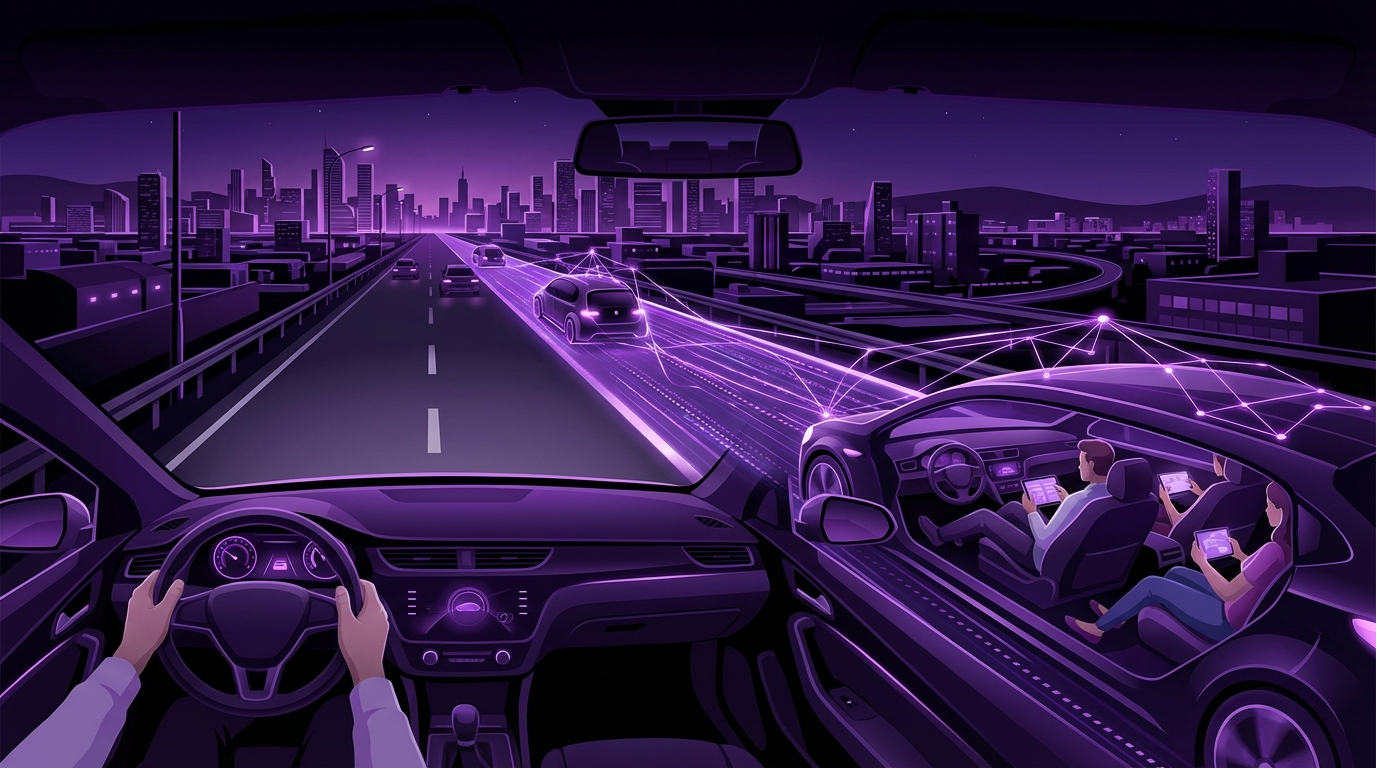
I used to think self-driving cars would either be “here” or “not here.” Like a light switch. One day we would wake up and every car would just drive itself and we would all be reading books in the back seat.
Then I started working with companies that actually build this stuff and realized it is not a light switch at all. It is more like a dimmer. You get a little more automation, then a bit more, and people keep arguing about what level we are really at.
The short answer: self-driving cars are progressing, but we are not at true Level 5 anywhere on public roads. Most cars people can buy sit at Level 1 or Level 2. A few systems, in limited areas and with a lot of constraints, reach Level 3 or Level 4. The jump from Level 2 to Level 3 is much harder than it sounds, and Level 5 is still a long way off, both technically and legally.
If you want a one-line mental model: Level 0-2 help the driver, Level 3-5 replace the driver, with Level 5 driving anywhere a human can.
Now let us break this down properly, without sugarcoating where things actually stand.
What the “Levels” of Self-Driving Actually Mean
The levels you see online (Level 1, Level 2, etc.) come from the SAE (Society of Automotive Engineers). They are a way to describe how much of the driving task is handled by the system vs the human.
Here is the key idea before we go deeper:
- Levels 0-2: The human is the driver. The system assists.
- Levels 3-5: The system is the driver. The human might help, or not be involved at all.
That single distinction removes a lot of confusion.
Now, let us walk through each level from 0 to 5, what they mean, and what actually exists on the road.
Level 0: No Automation (You Are On Your Own)
People sometimes forget Level 0 exists, because it sounds boring. No automation. You drive the car. That is it.
But Level 0 still allows things like:
- Basic warnings: lane departure warning, forward collision warning
- Blind spot alerts
- Parking sensors (beeping when you are close to an object)
The key detail: at Level 0, the car does not take over steering or acceleration or braking in a sustained way. It might nudge the brake automatically for an instant, or vibrate the steering wheel, but you are continuously responsible for every driving action.
If the system is just warning you but not continuously controlling the car, it is Level 0, even if it feels “smart.”
You still see pure Level 0 in older cars and in some low-cost models. But most new cars have at least one Level 1 feature, so the line is shifting.
Level 1: Driver Assistance (Little Bits of Help)
Level 1 is where the car helps with either steering or speed, but not both at the same time in a coordinated way.
Typical Level 1 features:
- Adaptive cruise control (ACC): The car keeps a set speed and distance from the car ahead by adjusting throttle and brakes.
- Lane keeping assist (LKA): The car gently corrects steering to help you stay in your lane.
- Park assist (basic): The car steers into a parking spot while you manage the pedals and gear changes.
If only one primary control (steering or speed) is automated at a time, independently, it is Level 1.
Table to clarify:
| Level | Who is the driver? | What is automated? |
|---|---|---|
| 0 | Human | Only warnings, no continuous control |
| 1 | Human | EITHER steering OR speed (not both as a single system) |
A lot of brands market Level 1 as if the car “almost drives itself.” That kind of messaging confuses people, but from a technical and legal standpoint, Level 1 is still just basic driver assistance.
You need your hands, your eyes, and your brain fully engaged.
Level 2: Partial Automation (What Most People Think of as “Self-Driving”)
Level 2 is where things get interesting and a bit messy in how people talk about them.
At Level 2:
- The system controls steering AND speed at the same time.
- The human driver must pay attention at all times.
- The human must be ready to take over immediately.
So the car can follow the lane, adjust speed, handle some curves, and even do basic lane changes in some systems. But you are still legally and functionally the driver.
Examples of widely used Level 2 systems:
- Tesla Autopilot and “Full Self-Driving” (despite the name, from a regulatory view it still operates as Level 2 on public roads)
- GM Super Cruise and Ultra Cruise (hands-free in many situations, but still Level 2 because you must supervise)
- Ford BlueCruise
- Hyundai / Kia Highway Driving Assist
If you have to supervise and can be held responsible for a crash while the system is on, you are not in a self-driving car. You are in a car with advanced driver assistance (Level 2).
You might notice something odd here: some Level 2 systems allow “hands-free” driving on certain mapped highways, but they still track your eyes with cameras. That is because the difference between Level 2 and Level 3 is not “hands on wheel” vs “hands off wheel.” The difference is who is legally considered the driver.
With true Level 2:
- The car is doing more work.
- You are doing less control.
- You are still doing all of the responsibility.
From a user point of view, Level 2 can feel like magic. From a liability point of view, it is still you.
Where Level 3 Starts to Change the Rules
Now we move from “the car helps you” to “the car sometimes is the driver.” This is where everything becomes harder: technically, legally, and psychologically.
Level 3: Conditional Automation (The Car Is the Driver, Sometimes)
At Level 3, the system can handle all aspects of driving in specific conditions, and during those conditions, the system is the driver.
Key features of Level 3:
- The system can perform the entire driving task within its defined operating conditions.
- The human is allowed to take their eyes off the road in those conditions.
- The system will ask the human to take over when it is reaching its limits.
This is called “conditional” because the automation works only when certain conditions are met. For example:
- Only on certain roads (like divided highways).
- Only below a certain speed.
- Only in good weather and clear lane markings.
The most cited example is:
- Mercedes-Benz Drive Pilot: Approved for Level 3 in some regions and conditions, usually in slow-moving highway traffic. While Drive Pilot is active, the car is legally considered the driver.
With Level 3, responsibility flips during operation: when the system is in control within its allowed conditions, the manufacturer becomes responsible for driving decisions, not the human.
That single shift triggers huge consequences:
- Insurance questions: Who pays when there is a crash?
- Regulatory questions: Where is Level 3 allowed? Under what rules?
- User confusion: When can I actually stop watching the road?
And there is a deeper technical challenge that does not get talked about enough: handover.
The Handover Problem (Why Level 3 Is So Hard)
Think about this scenario:
You are in a Level 3 car. Traffic is slow. The system is handling everything. You start answering messages on your phone. Suddenly, traffic speeds up, or weather changes, or there is a construction zone ahead, and the system cannot handle it. It asks you to take over.
Questions:
- How long does it take you to shift your attention from your phone to the road?
- How quickly can you understand what is going on?
- How many seconds pass before you can safely react?
Human attention is not a light switch. It does not flip instantly. If a system gives you two or three seconds to take control, that might not be enough in a complex situation.
This is part of why many experts quietly think Level 2 and Level 4 are more practical, while Level 3 creates a risk “gray zone” where the human is out of the loop but suddenly needed at the worst time.
The more the car drives for you, the worse you become at driving on short notice. Level 3 leans right into that tension.
Still, some companies go for Level 3 because they want to officially take responsibility in specific, carefully geofenced conditions. It can unlock new experiences, but it also raises the stakes if the system misjudges its own limits.
Level 4 and Level 5: Where “Self-Driving” Becomes Real
For many people, Level 4 and Level 5 are what they thought “self-driving cars” meant from the start: you sit back, the car handles it, and you are not expected to intervene.
That is roughly true, but there are nuances you need to understand.
Level 4: High Automation, But Only in Certain Places or Conditions
At Level 4:
- The system can perform all driving tasks within a defined area or under defined conditions.
- The human is not required to take over inside that operating domain.
- If something goes wrong, the system will bring the vehicle to a safe stop by itself.
The car basically says: “In this zone or scenario, I am the driver. If I reach my limits, I will safely pull over without asking you to bail me out.”
This is where robotaxis come in.
Examples on public roads (though still limited and heavily controlled):
- Waymo robotaxis in selected cities and geofenced zones
- Cruise robotaxis (where operations are not paused or restricted by regulators)
- Other pilots from companies in China and a few other regions
These systems usually have constraints like:
- Specific neighborhoods or city areas
- Specific speeds
- Weather restrictions
- Carefully mapped roads
Here is the key difference from Level 3:
| Aspect | Level 3 | Level 4 |
|---|---|---|
| Who is driver (in automation mode)? | System | System |
| Human takeover needed? | Yes, when system requests | No, system must handle safe stop |
| Operating domain | Limited, usually road type + speed | Limited, often geofenced area + conditions |
| Vehicle design can omit pedals/wheel? | Not really practical | Yes, within domain |
Level 4 is the first level where you can realistically remove the steering wheel and pedals in some vehicles. Not everywhere, but somewhere.
This is why many robotaxi services do not want a human driver on standby. Their promise is: “You sit in the back, the system does everything inside our mapped zone. If something breaks, it stops safely.”
Of course, remote support teams still monitor fleets and can give guidance in rare cases, but the core driving task is on the machine.
Why Level 4 Exists Only in Pockets
If Level 4 can actually drive, why is it only in a few places?
Because the real world is messy. And messy scales badly.
Technical and practical challenges include:
- Complex city behavior: Unprotected left turns, double-parked vehicles, unpredictable pedestrians, cyclists weaving through traffic.
- Weather: Heavy rain, snow, fog, and glare can confuse cameras and lidars.
- Infrastructure quality: Faded lane lines, strange local signage, informal rules that locals follow but never appear in a manual.
- Edge cases: Construction workers directing traffic, emergency scenes, odd road layouts that show up once in a thousand trips.
You can throw thousands of engineers at these problems and still hit new corner cases every month.
So for now, Level 4 is “locally smart.” Inside its home turf, it may drive more patiently and consistently than most humans. Outside that turf, it either runs in a degraded mode, or not at all.
Level 5: Anywhere, Anytime, No Human Driver Needed
Level 5 is the full dream: a car that can drive everywhere a human could, under all normal conditions, with no human driver at all.
Characteristics of Level 5:
- No human driver needed, ever.
- No operational limits beyond what a competent human driver could handle.
- The vehicle might not even have controls for a human driver.
This is the version people imagine when they think:
- “I will send my car to pick up my kids.”
- “I will sleep the whole way from one city to another.”
- “Cars will just drive around empty, like personal robots.”
There are no true Level 5 systems on public roads right now, in the strict sense of the term. There are only Level 4 systems that look like Level 5 inside narrow boundaries.
Why Level 5 is so tough:
- You cannot geofence “anywhere.”
- You cannot assume good maps, or clean lane lines, or consistent local rules.
- You must handle all kinds of weather, light, traffic culture, and infrastructure quality.
- You must handle long-term failures gracefully, not just short-term interruptions.
Some engineers quietly say we might never get to “pure” Level 5 in the strict standard, and instead live with very advanced Level 4 covering the vast majority of what people need.
I do not fully agree or disagree with that. I think we will get extremely capable systems, but the strict definition of Level 5 sets a very high bar.
Where Self-Driving Tech Actually Stands Right Now
Marketing often says one thing, regulatory filings say another, and user experience says something else again. Let us ground this.
What Consumers Can Actually Buy
If you walk into a dealership and buy a new car, you are almost always in Level 0-2 territory.
Broadly:
- Entry-level cars: Often Level 0 (with some warnings) or Level 1.
- Midrange cars: Commonly Level 1 or Level 2 (especially on highways).
- Premium cars: More polished Level 2, sometimes with limited Level 3 features in specific markets.
Examples:
- Tesla vehicles: Operate functionally as Level 2 with Autopilot or “Full Self-Driving” engaged. Tesla may target higher levels in the future, but regulators treat current public offerings as supervised assistance.
- GM Super Cruise / Ultra Cruise: Level 2, but good user experience on mapped highways, with hands-free in many cases.
- Ford BlueCruise: Similar category, highway-focused Level 2.
- Mercedes Drive Pilot: Limited Level 3 functionality in some markets, for specific conditions (like low-speed highway traffic).
From a buyer’s perspective, the biggest practical jump has been from no assistance to strong Level 2 systems on highways. That single shift already changes fatigue, traffic handling, and safety for many drivers.
Robotaxis and Pilot Programs
Then you have Level 4 systems, which most regular drivers never touch, because they are not for sale as personal cars.
They show up as:
- Robotaxi services in selected neighborhoods
- Autonomous shuttles in controlled environments (campuses, business parks, airports)
- Autonomous trucks on specific freight corridors with close oversight
These tend to run:
- In geofenced areas
- With heavy remote monitoring
- Under clear conditions and strong rules from local authorities
Public perception often swings between “this is already solved” and “this will never work.” Reality sits in the middle: it works in some places, fails in others, and improves slowly with every mile.
Regulation and Liability Are Catching Up, Slowly
The tech moves fast. Laws and standards do not.
Some of the big regulatory questions:
- When a Level 3 or Level 4 system is in control, who is accountable during a crash?
- How should cars display their automation status to other road users?
- What data must be recorded for incident reconstruction?
- How should cities manage mixed traffic: human drivers, autonomous vehicles, cyclists, pedestrians?
Many regions solve this piecemeal:
- Approving pilots city by city
- Limiting operations to certain hours or weather
- Requiring safety drivers at first, then allowing driverless if data looks good
There is also a political element: one high-profile crash can trigger a pause, public debate, and tighter rules, even if the long-term safety data looks positive.
Technical Bricks That Build Each Level
You can understand each level not just by legal definition, but by the tech behind it.
Sensors and Perception
A modern driver-assistance or self-driving stack typically blends some of:
- Cameras (visible light)
- Radar
- Lidar
- Ultrasonic sensors
- GPS and high-precision mapping
Higher levels usually mean:
- More sensors
- Higher-resolution data
- More redundancy (if one sensor fails, others cover)
But it is not just hardware. Perception models powered by machine learning must:
- Detect objects (cars, bikes, pedestrians, animals, road cones)
- Track movement over time
- Predict what those objects will do next
It sounds straightforward in a slide deck. It is very different when a pedestrian steps off a curb, glances at the car, then stops, then steps again.
Prediction and Planning
Once the car “sees” the world, it must:
- Guess what others will do (prediction).
- Choose its path and actions (planning).
Higher levels raise the bar:
- Level 1-2: Mostly reacting to simple triggers (car ahead slows down, lane edge detected).
- Level 3-4: Handling full traffic interactions, merges, unprotected turns, complex pedestrian flow.
- Level 5: Handling all that everywhere, including places with local driving habits that never touch a rulebook.
Good planning systems balance:
- Safety
- Comfort
- Obedience to rules
- Not being so timid that it blocks traffic
There is a weird human expectation problem here. People want self-driving cars that are safer than humans, but also not so cautious that they never cross a busy intersection. That is not an easy needle to thread.
Redundancy and Fail-Safes
As you climb the levels, you must handle failures better.
For example:
- Level 2 car loses a radar sensor: It might disengage the system and tell the human to drive.
- Level 4 car loses a sensor: It must still find a way to safely pull over without human help.
So higher-level systems tend to:
- Duplicate critical components (braking, steering, computing)
- Have backup power supplies
- Run health checks on software and hardware constantly
Moving from “assist the human” to “replace the human” is not just more AI. It is more everything: sensors, compute, safety engineering, and testing.
Common Misconceptions About the Levels
I see the same patterns in conversations, news stories, and even marketing materials. Some of them might be shaping how you think about this.
“Level 5 Is Coming Any Year Now”
You have probably heard bold predictions: “Full self-driving next year,” “All cars will drive themselves by 20XX,” and so on.
The reality:
- Progress is real: Safety features, long-distance driving assistance, and urban pilots are much better than a decade ago.
- Complexity is deeper than expected: Edge cases, mixed traffic, and scaling outside test regions keep slowing that “any year now” promise.
So, while you will see more automation every year, expecting true Level 5 everywhere in a short time frame is unrealistic. Phased deployment across regions, road types, and use cases is much more likely.
“Hands-Free Equals Self-Driving”
A big mistake is equating “hands-free” with higher automation levels.
Reality:
- You can have a hands-free Level 2 system that still requires full attention.
- You can have a Level 3 system that allows eyes-off in certain cases but still has a steering wheel.
Automation level is about:
- Who is the driver in legal and functional terms
- Who must monitor the environment
- Who carries responsibility at each moment
Hands position is just a human-machine interface choice.
“More Sensors Automatically Mean Higher Level”
Another assumption: “That car has lidar and a roof stack, so it must be Level 4 or Level 5.”
Not quite.
Sensors are ingredients. Levels are about capabilities and responsibilities. You can put a huge sensor suite on a test car and still run it as Level 2 with a safety driver.
The level is defined by:
- What the system is allowed to control
- Where and when it operates autonomously
- Whether a human must supervise
How This Might Evolve Over the Next Few Years
I will not pretend to know exact dates. Nobody does. But we can talk about reasonable paths from what we see already.
More Sophisticated Level 2 in Personal Cars
You can expect:
- Better highway automation across more brands
- Improved city-driving support in lower speed zones
- Tighter driver monitoring to prevent misuse
Cars will get better at:
- Lane changes
- Off-ramp and on-ramp handling
- Navigation-linked automation (following a planned route)
But they will still expect you to supervise.
Targeted Level 3 in Premium Models
We will likely see:
- More Level 3 systems on highways, starting at low speeds, maybe expanding slowly.
- Carefully controlled launches where laws allow manufacturers to be the “driver” under defined conditions.
The real test will be:
- How often the system hands over control
- How smoothly those handovers go
- How regulators respond after the first incidents
If the handover problem proves too nasty, some carmakers may skip Level 3 and aim at long-term Level 4 in specific modes instead.
More Level 4 in Specific Markets and Use Cases
I expect more of this:
- Robotaxis in additional cities, with slow expansion
- Autonomous trucking on dedicated highway lanes or corridors
- Autonomous shuttles on fixed routes (airports, campuses, tourist zones)
Level 4 will likely grow city by city, road by road, rather than suddenly everywhere. Think of it like a patchwork map of zones where you can “summon a car that drives itself,” alongside many regions where you still drive normally.
The story of self-driving cars for the next decade will probably be more about quiet expansion of Level 2 and Level 4, and less about one big leap to Level 5.
What This Means for You as a Driver or Buyer
You might not care about SAE documents. You probably care about what to expect from your next car or from a robotaxi you might step into.
How to Read Marketing Claims
When you see a feature, ask:
- Am I still legally the driver when this is on?
- Do I need to watch the road at all times?
- What are the limits (road type, speed, weather) for this system?
If you must supervise constantly, it is still Level 2, no matter what name it carries.
If a brand suggests you can “relax” or “take your eyes off the road,” look very carefully at the conditions. There is usually fine print that restricts when that is approved.
Using Level 2 Safely
You might be tempted to let the tech do more than it should. I have seen drivers reading, watching videos, even sleeping on highways with assistance systems on. That is not safe, and it is not what those systems are built for.
Practical habits:
- Stay engaged: Treat it as an assistant, not a replacement.
- Know how to quickly override: Practice taking control, braking, and steering from the system.
- Understand edge cases: Construction zones, sudden merges, and cut-ins can still confuse systems.
Remember, Level 2 tries to reduce your workload. It does not remove your responsibility.
Trying Robotaxis or Autonomous Shuttles
If you ride in a robotaxi or an autonomous shuttle in a pilot area:
- Pay attention to how it handles unprotected turns and pedestrians.
- Notice where it is cautious vs confident.
- Expect some awkward pauses and overly defensive actions.
The ride might feel smoother than some human drivers and awkward in other ways. That mix is normal. You may trust it more for some tasks (low-speed city driving) and less for others (complex merges).
You do not need to blindly trust or blindly fear these systems. You can approach them with the same mindset as any new tech: curious, skeptical, and observant.
Recap: Level 1 to Level 5 in Plain Language
To bring this together, here is a compact mental model.
| Level | Who is the driver? | What it feels like | Where it exists today |
|---|---|---|---|
| 0 | Human | Basic car with alerts | Older and basic models |
| 1 | Human | Cruise control OR lane help | Most modern cars |
| 2 | Human | Car can steer and control speed, but you supervise | Tesla Autopilot/FSD (current form), Super Cruise, BlueCruise, etc. |
| 3 | System (in its mode) | Eyes-off sometimes, car asks you to take over | Limited premium systems, low-speed highway use in some regions |
| 4 | System (in domain) | No human driver needed in defined zones | Robotaxis, shuttles, some freight pilots |
| 5 | System | Drives anywhere a human could | Not yet deployed on public roads |
Levels 0-2: You are the driver, with help. Levels 3-5: The car is the driver, at least some of the time, within clear limits.
Once you see it that way, the hype fades a bit and the picture gets clearer. We are not at full self-driving. We are at gradually smarter assistance, practical but limited robotaxis, and a long road between Level 4 pockets and real Level 5.