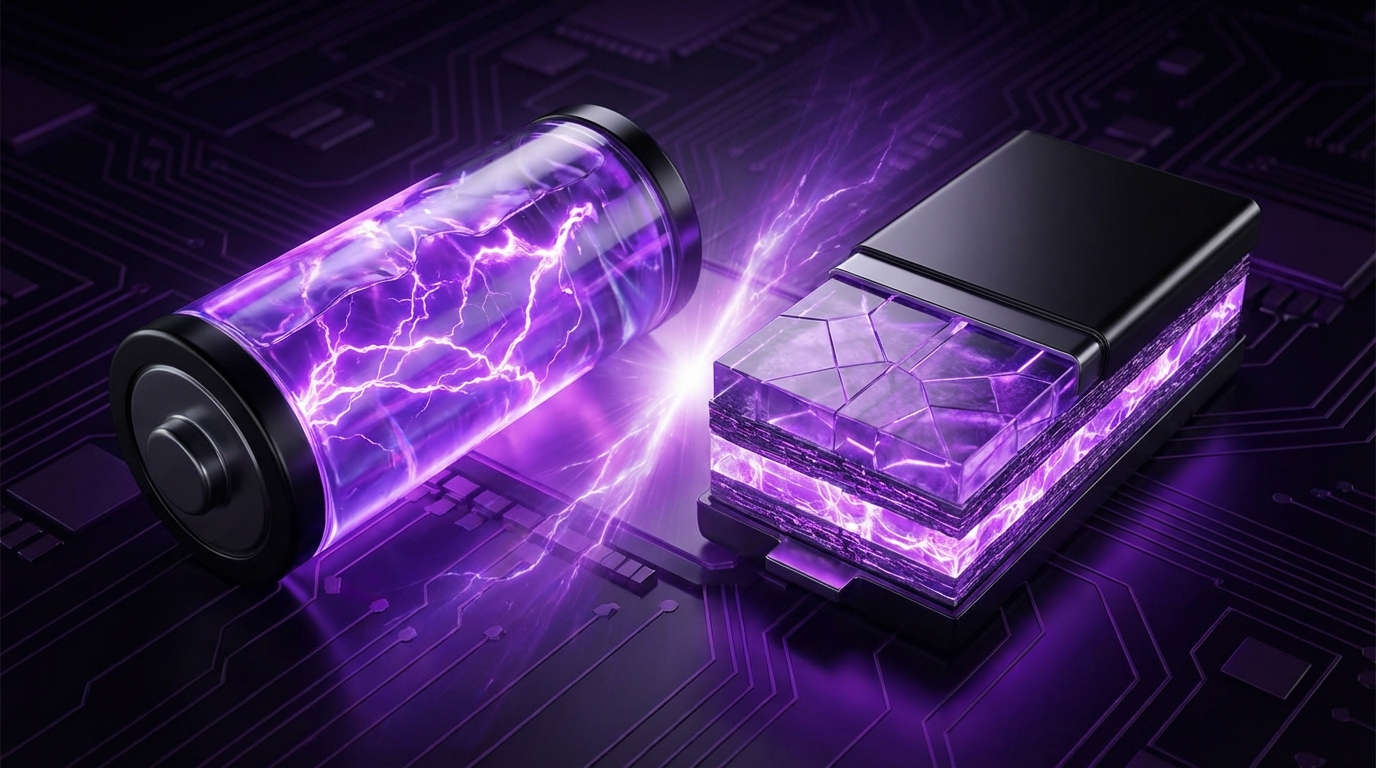
I used to think solid state batteries were just marketing material for concept cars that never ship. You know, one of those “five years away” things that somehow stays five years away for twenty years straight.
Then I spent more time reading lab papers and talking with engineers, and it clicked: solid state is real, but the story is far messier than the slogans on EV launch slides.
The short answer: solid state batteries can be safer, more compact, and higher energy than standard lithium-ion, but they are much harder to manufacture, more expensive, and not ready for mass market EVs or phones yet. Lithium-ion wins for cost, maturity, and production scale right now; solid state looks like the likely next step for high-end EVs and specialized devices over the next 5 to 15 years, if the industry can solve manufacturing, lifetime, and cost problems at scale.
What people actually mean by “solid state” vs “lithium-ion”
Most people think these are two completely separate battery families.
They are not.
“Solid state” is really a subcategory of lithium batteries. Almost every solid state cell under development is still a lithium-based cell. The big change is not the chemistry of lithium itself. It is the material that carries lithium ions between the electrodes.
Let us break this down cleanly.
Lithium-ion batteries (the kind in your phone and most EVs today):
– Have a liquid or gel electrolyte
– Use a porous separator soaked with organic solvent
– Move lithium ions through this liquid during charge and discharge
Solid state batteries:
– Replace the liquid/gel electrolyte with a solid material (ceramic, glass, polymer, or composite)
– Often change the anode from graphite to something like lithium metal or silicon-rich material
– Still move lithium ions, just through a solid path instead of a liquid
So “solid state vs lithium-ion” is slightly misleading. The more accurate comparison is:
– “Conventional liquid-electrolyte lithium-ion” vs
– “Solid-electrolyte lithium-based cells (solid state)”
Both are lithium batteries. The question is whether the electrolyte is liquid or solid, and what that change unlocks or breaks.
Why this change matters so much
A liquid electrolyte is easy to soak into electrodes and separators. It makes manufacturing simpler. It also brings problems:
– It is flammable
– It can leak, vent, or cause thermal runaway
– It needs space (and extra safety material) that could otherwise store more energy
A solid electrolyte can:
– Be non-flammable
– Allow tighter packaging
– Potentially allow lithium metal anodes, which can store far more energy per weight than graphite
That is the dream: more energy in the same volume, higher safety, and longer life. Reality is less clean.
Key differences: energy, safety, cost, and lifetime
Let us compare the two across the dimensions people actually care about.
- Energy density (how much energy per weight and volume)
- Safety and thermal behavior
- Charging speed and power
- Temperature range
- Cycle life and degradation
- Cost and manufacturability
- Where each makes sense in real products
Energy density: who can pack more energy?
Right now, top commercial EV lithium-ion cells:
| Cell type | Gravimetric energy density | Volumetric energy density |
|---|---|---|
| NMC / NCA cylindrical (premium EV) | 250 to 300 Wh/kg (cell level) | 650 to 750 Wh/L (cell level) |
| LFP prismatic (value EV) | 160 to 210 Wh/kg | 350 to 500 Wh/L |
Most solid state prototypes, depending on chemistry and test conditions, land in a similar or slightly higher range at cell level today, with claims going much higher.
Common target numbers you hear from solid state programs:
– 350 to 450 Wh/kg at cell level, sometimes more on slides
– 800 to 1,000+ Wh/L if they reach lithium metal anodes reliably
The reality in labs:
– Some coin cells hit those numbers
– Scaling to pouch or prismatic while keeping those numbers and maintaining cycle life is very hard
Solid state has more theoretical headroom on energy density, especially with lithium metal anodes, but commercial products right now barely beat the best lithium-ion, if at all.
Still, for a car, even a 30 to 50 percent boost in pack energy for the same weight is huge. Roughly:
– A 400 km EV might jump to 550 to 600 km range with a similar-size pack
– Or the automaker might shrink the pack to keep the same range, save weight and cost elsewhere, and redesign the car around it
For phones and laptops:
– A 30 percent jump can be used for either more battery life or thinner devices
– Or some mix of both, which is what usually happens
We are not there at scale yet. But energy density is the main reason major automakers keep funding this.
Safety: flammable liquid vs solid material
Liquid-electrolyte lithium-ion:
– Uses organic solvents that are flammable
– Under abuse (overcharge, internal short, crash, puncture) can go into thermal runaway
– Needs heavy safety layers: cooling systems, protective structures, fuses, vents
Solid state:
– Uses solid inorganic or polymer electrolytes, many of which are not flammable
– Reduces risk of leakage and some forms of thermal runaway
– Still can fail, but the failure path is usually slower and more contained
There is some nuance here.
– Some solid electrolytes react with moisture or electrode materials, creating side products or gas
– Dendrites (needle-like lithium growths) can still form through some solid electrolytes, causing shorts
– Pack-level design still needs protection and thermal management
Think of it this way:
Solid state does not magically remove risk. It tends to move you from “highly flammable liquid under stress” to “more stable solid system with different failure modes.”
From a safety and regulations perspective, this shift matters a lot. For home energy storage, grid batteries near residential areas, or aircraft applications, every extra layer of safety counts.
Charging speed and power
You may have seen this claim: “Solid state will give you 80 percent charge in 10 minutes.”
Sometimes that is possible in lab setups. The challenge:
– Fast charging stresses the interface between anode, electrolyte, and cathode
– With lithium metal anodes, very fast charge encourages dendrite growth
– Solid electrolytes often have high ionic conductivity but poor mechanical behavior under repeated expansion and contraction
Liquid-electrolyte lithium-ion:
– Already reaches 10 to 15 minute 80 percent charge for some EVs, with careful thermal management and anode design
– Has known degradation patterns under fast charge
Solid state:
– The best prototypes can handle fast charge under specific conditions
– Many chemistries slow down a lot at lower temperatures
– Manufacturing defects in the solid interface can become failure points when you push high currents
So the honest view:
– Solid state has the potential for fast charge with lower risk of thermal runaway
– In practice, the first commercial packs are unlikely to be radically faster than the best lithium-ion; they will probably trade some speed for life and reliability
– Over time, as materials and interfaces improve, charge speed can increase
Temperature performance
Here, solid state has an interesting advantage and a big catch.
Liquid-electrolyte lithium-ion:
– Works best in a moderate temperature window (roughly 15 to 35 °C)
– Suffers in cold; internal resistance rises, lithium plating risk increases
– Needs active thermal management in EVs to keep the pack in a friendly zone
Solid electrolytes:
– Inorganic ceramics often keep ionic conductivity at higher temperatures and can handle more heat
– Some polymer-based solid electrolytes need higher temperatures to reach good conductivity
– Many solid electrolytes perform poorly at very low temperatures, unless specially engineered
For specific segments:
– Consumer electronics: still easier to manage with conventional lithium-ion
– EVs: solid state may reduce cooling needs at high load, but low temperature charge and discharge need careful design
– Aerospace, satellites, or industrial: some solid state chemistries can handle more extreme conditions safely, which is very attractive
Cycle life and degradation
A battery is only useful if it survives many charge cycles.
Modern high-quality lithium-ion EV packs:
– Often handle 1,000 to 2,000 full cycles before dropping to 70 to 80 percent capacity
– With intelligent battery management, that can mean 300,000 to 500,000 km or more in a car
– Degradation patterns are well studied and predictable
Solid state:
– In coin cells, some chemistries show 5,000+ cycles under lab-test conditions
– When scaled to large-format cells, many see early capacity fade or interface breakdown
– Mechanical stress between electrodes and brittle solid electrolytes causes micro-cracks that grow with cycling
One of the biggest issues is the interface between lithium metal and the solid electrolyte. During charge and discharge:
– Lithium moves in and out
– The volume at the anode side changes
– Those volume swings stress the solid interface and can break contact
The lifetime story for solid state is not settled. Some data looks excellent, but the gap between lab cells and production-scale EV cells is still large.
So right now, if you need a battery for a real product that ships by the millions, lithium-ion gives you far more predictable aging.
Cost and manufacturability
This is where solid state hits a wall today.
Lithium-ion:
– Has decades of production refinement
– Uses processes like slurry coating, calendaring, stacking/winding that gigafactories already know
– Costs have fallen dramatically, with EV pack prices in many cases below 120 USD per kWh at pack level, and heading lower for LFP
Solid state:
– Often needs new materials (ceramic electrolytes, sulfides, complex polymers)
– Requires tighter control of pressure, thickness, and surface quality
– May need different manufacturing equipment or entire new production lines
Manufacturing challenges:
– Grain boundaries in solid electrolytes can raise resistance or grow cracks
– Some sulfide electrolytes are sensitive to moisture and need controlled environments
– Achieving consistent contact between solid layers at scale is hard
Costs:
– Current estimates suggest early solid state cells will cost more per kWh than advanced lithium-ion
– Long term, if yields improve and volumes grow, cost may drop, but there is no guarantee that it beats lithium-ion in all segments
If you are building a mass-market smartphone or budget EV, you are very sensitive to cost. In that case:
Conventional lithium-ion, especially chemistries like LFP, is still the sensible choice for the next several product cycles.
Types of solid state batteries: not all solids are equal
“Solid state” covers a wide range of materials. The category is not uniform.
Here are the main classes you will see in research and announcements:
- Ceramic oxide electrolytes (like LLZO)
- Sulfide electrolytes
- Polymer solid electrolytes
- Hybrid or composite solid electrolytes
Ceramic oxide solid electrolytes
Examples: LLZO (lithium lanthanum zirconium oxide), garnet-type materials.
Pros:
– High electrochemical stability window
– Good compatibility with high-voltage cathodes
– Non-flammable, thermally stable
Cons:
– Brittle and hard to process in thin, wide sheets
– Grain boundaries can have higher resistance
– Interface with lithium metal is tricky and can require extra coatings
This class often appears in academic papers with attractive ionic conductivity numbers. Turning that into large pouch cells with high yield is the real test.
Sulfide solid electrolytes
Examples: argyrodite materials (like Li6PS5Cl) and related compounds.
Pros:
– Very high ionic conductivity, close to or better than some liquid electrolytes
– Can be processed in powder form and pressed into layers
– Promising for high power applications
Cons:
– Sensitive to moisture, can generate toxic gases when exposed to humidity
– Interface stability with common cathode materials is a challenge
– Needs strict manufacturing environments
Several automotive programs focus on sulfide-based solid electrolytes because of the combination of high conductivity and potential to pair with high-capacity electrodes. But moisture handling adds complexity.
Polymer solid electrolytes
Examples: PEO-based and other polymer matrices with lithium salts.
Pros:
– More flexible and less brittle than ceramics
– Easier to process in thin films
– Potentially compatible with some existing coating equipment
Cons:
– Lower ionic conductivity at room temperature in many cases
– Often need elevated operating temperature to perform well
– Chemical stability and life vary widely with formulation
Some “semi-solid” or “gel-like” approaches blend polymers with small amounts of liquid plasticizers to balance conductivity and mechanical properties.
Hybrid and composite solid electrolytes
Many companies are now combining:
– Ceramic particles in a polymer matrix
– Multiple layers of different types of solid electrolyte
– Carefully engineered interfaces with buffer layers
The goal:
Get the good parts of multiple chemistries while hiding their weaknesses in the stack-up.
This is not simple, but it is a path toward realistic, manufacturable solid state cells that do not need a perfect single material.
Where lithium-ion still wins clearly
If you are planning products for the next 3 to 7 years, you cannot ignore the practical side.
Here is where conventional lithium-ion remains the stronger choice.
Mass-market EVs
– Cost per kWh still rules this segment
– Charging infrastructure is designed around current voltage and power ranges
– Automakers want predictable degradation and warranty behavior
For a 25,000 to 40,000 USD car, spending a large premium per kWh on solid state cells is hard to justify unless there is a very clear advantage (for example, extreme safety requirements or very limited packaging space).
LFP chemistry in particular has changed the story:
| Attribute | NMC / NCA (liquid) | LFP (liquid) |
|---|---|---|
| Energy density | Higher | Lower |
| Cost | Higher | Lower |
| Cobalt / nickel usage | Yes | None |
| Safety | Good | Very good, thermally stable |
| Cycle life | Good | Very long |
LFP is good enough for many EV ranges and helps keep prices down. Solid state has to beat this combination, not just beat older NMC packs.
Phones, laptops, and wearables
Consumer electronics care about:
– Safety
– Thinness and weight
– Cost
– Supply chain reliability
Most phone makers already squeeze a lot out of lithium-ion through:
– Optimized charging curves
– Stacked packaging
– Silicon-graphite anode blends
– Battery management algorithms that slow down aging
Swapping to solid state means:
– New suppliers
– New qualification cycles
– Unknown long-term field failure modes
You can imagine early adoption in niche devices first:
– Rugged industrial handhelds
– Specialty medical devices
– High-end cameras or drones
Mainstream phone adoption will probably lag automotive by a few years, not lead it.
Grid storage and stationary systems
It is easy to say “solid state is safer, so it fits grid storage better.” Reality is more mixed.
Grid storage values:
– Very low cost per kWh
– Long life over thousands of cycles
– Safety and low maintenance
– Ability to operate across wide temperature ranges, with moderate thermal management
Here, LFP and other lithium-ion chemistries are very competitive. And they keep improving.
For stationary storage, weight is less critical. Volume matters, but not nearly as much as in a car or plane. So the extra energy density of solid state does not matter as much.
Stationary storage might adopt solid state for safety and life reasons later, but the cost hurdle is higher and the need for high energy density is lower.
Where solid state could make the biggest early impact
So where does solid state actually make sense first?
You want sectors where:
– Extra energy density has high value
– Safety is critical
– The market can tolerate higher costs at the beginning
Premium EVs and performance vehicles
High-end EVs often:
– Compete on range and acceleration
– Have higher price points and margins
– Push heavy currents through the pack for performance
Solid state gives them:
– More range in the same space
– Or similar range with a smaller, lighter pack
– Extra safety margin under aggressive driving or track use
This is why many of the first announcements are from premium or performance segments.
It is also easier to test:
– Smaller production runs
– Customers willing to try earlier tech
– More room to design special cooling and pack structures
Aerospace and air taxis
Electric aircraft, drones, and eVTOL vehicles face a hard physics problem:
– Gravity
Every kilogram matters. A 20 to 40 percent energy density improvement hits range, payload, or both in a way that really changes what is possible.
Safety is even more critical here.
– Fire in an aircraft is catastrophic
– Regulatory rules are strict
– Redundancy is required
Some eVTOL and drone programs are experimenting with solid state cells because that combination of energy and safety is worth paying more for, at least at first.
High-end consumer and industrial devices
Think about devices where:
– You can charge a premium price
– Battery life is a major part of the value proposition
– Space is very constrained
Examples:
– Professional drones
– High-performance AR/VR headsets
– Rugged industrial tablets and scanners
– Certain medical monitoring devices
These are smaller markets, but they help boot-strap real production experience with solid state.
Recycling and environmental impact
This is an area that gets less attention in solid state hype, but it matters.
Lithium-ion recycling is still improving, but there are:
– Established collection and recycling methods
– Growing capacity in multiple regions
– Active research into higher recovery rates and lower-cost processes
With solid state, recycling must adapt to:
– Different electrolyte materials (ceramic, sulfide, polymer)
– Different layers and coating structures
– Potentially harder mechanical separation processes
The good part:
– Some inorganic solid electrolytes may be easier to handle than organic solvents
– Removing flammable liquid from the equation simplifies transport safety somewhat
The hard part:
– Many recycling processes are tuned for specific cell designs and compositions
– Mixed waste streams complicate separation and purity
For large-scale adoption, solid state will need a recycling ecosystem at least as mature as lithium-ion has now. That will lag by years.
If you work in product planning, it is easy to forget that end-of-life handling is part of the total cost picture. Regulatory pressure around that is not going away.
What this means if you build products or make tech decisions
Let me push a bit here, because this is where many teams go down the wrong path.
Relying on “solid state will fix it later” is usually a bad strategy.
If you are building EVs or mobility products
Realistic roadmap thinking:
– Short term (0 to 5 years): design around advanced liquid lithium-ion (NMC, NCA, LFP, possibly sodium-ion for some segments)
– Medium term (5 to 10 years): plan for pilot solid state options in premium models or specific variants
– Long term (10+ years): assume some mix of solid state and advanced liquid systems, with possible chemistries we do not see clearly yet
Trying to skip directly to solid state for your first or second model:
– Increases risk
– Delays shipping
– Depends on suppliers who may shift timelines
Better to design flexible pack architectures:
Make your pack architecture modular enough that you can swap cell formats or chemistries later without redesigning the whole vehicle.
That might mean:
– Standardizing voltage ranges
– Planning thermal systems that can support both current and future cells
– Designing crash structures that can handle slightly different pack geometries
If you are in consumer electronics
You probably should not bet next year’s flagship on solid state. Timelines are too tight.
More sensible path:
– Keep tuning your lithium-ion pack: anode blends, form factors, and pack integration
– Start lab testing of solid state cells with your own workload patterns (screen-on time, fast charge, camera bursts, etc.)
– Gradually validate safety and aging, then try it in a small premium niche device first
Some brands will announce “solid state” or “semi-solid” for marketing. Many of those will be hybrid approaches that still include liquids or gels. Look closely at:
– Actual energy density numbers
– Cycle life data
– Safety certification details
If you are on the infrastructure or grid side
I see some teams tempted to wait for solid state before deploying more storage.
That is usually the wrong call.
Demand for storage is growing faster than the pace of chemistry changes. If you wait, you:
– Lose experience operating large systems
– Miss cost and performance gains from current lithium-ion learning curves
– Risk being late when your competitors already have real-world data
For most grid projects now:
– Deploy proven LFP or similar chemistries
– Design in a way that future chemistry swaps are possible at container or rack level
– Keep a parallel track that monitors solid state maturity, but do not stall real deployments for it
Common myths and where the truth sits
Let us clear up a few recurring lines that I see in pitch decks and media pieces.
“Solid state is 100 percent safe and cannot catch fire”
Not true.
– Solid state removes flammable liquid electrolytes, but you still have combustible materials in electrodes and packaging
– Short circuits in dense packs can still cause local heating and failure
– Abuse conditions can push any chemistry into dangerous zones
The more honest version:
Solid state can reduce some failure modes and slow others down, which improves safety, especially under abuse or defects. It does not eliminate all risk.
“Solid state will double EV range overnight”
Probably not.
– Theoretical numbers can be 2x, but practical, early cells might deliver 20 to 50 percent more at the pack level
– Automakers may trade some of that for lower pack weight or cost
– Packaging, cooling, and safety structures still take space
Even a 30 percent real-world increase is already meaningful. Expect gradual improvements, not instant 2x jumps across an entire lineup.
“Solid state will be cheaper than lithium-ion soon”
There is no clear evidence for near-term price parity at scale.
– Material and processing costs are higher now
– Yields in early manufacturing are lower
– Capital expenses for new lines are large
Over 10 to 20 years, costs can fall, but lithium-ion is not standing still either. Cell-to-pack integration, better materials, and larger factories keep pushing its cost curve down.
“Lithium-ion is old tech; solid state is the future”
This is a bit too simple.
Lithium-ion is not static. There are:
– High-voltage cathodes
– New anode materials
– Electrolyte additives
– Sodium-ion and other chemistries feeding from similar production chains
Solid state is part of that evolution, not a clean replacement. For a long time, we will have:
– Liquid-electrolyte lithium-ion in many segments
– Solid state in niches that expand over time
– Hybrid solutions in between
How to read solid state announcements more critically
Let me give you a simple set of filters I use when looking at any “breakthrough” in this space.
1. Cell format and size
Ask:
– Is the data from coin cells, small pouches, or full-size EV cells?
– Are conditions close to real operation (current, temperature, pressure)?
Coin cell results are important but far from a commercial EV module.
2. Cycle count and conditions
Important details:
– How many cycles until what capacity drop (for example, 80 percent)?
– At what temperature and C-rate?
– Were there rest periods that make the curves look better?
A cell that does 500 cycles in the lab at gentle conditions may struggle in a real EV duty cycle.
3. Full-cell vs half-cell data
Many research papers:
– Use half-cells with lithium metal as a reference
– Show great results that do not translate directly to full cells with realistic cathodes
You want to see:
– Full-cell data with clearly stated cathode materials and loadings
– Performance that matches or improves on commercial benchmarks
4. Manufacturing readiness level
Some teams have:
– Pilot lines producing thousands of cells
– Supply agreements with automakers
– Certification programs in progress
Others have:
– Promising lab results
– No clear path to gigafactory-scale production
Both are valuable stages, but they mean very different things if you are planning a product.
5. Pack-level implications
Energy density and safety at cell level are only part of the story.
You also want to know:
– Does the pack need extra pressure systems to keep solid layers in contact?
– Does it require complex thermal management anyway?
– What is the projected pack-level Wh/kg and Wh/L, not just cell-level?
If you cannot get honest pack-level estimates, be skeptical of headline-grabbing cell-level numbers.
So, which one should you “bet on”?
If I had to oversimplify:
– For anything shipping in volume in the next few years: stick with advanced lithium-ion, and track solid state closely in the background.
– For long-term R&D: invest in solid state, but also invest in the next waves of liquid-based chemistries.
Solid state is not a magic fix. It is a serious path with real advantages and real friction.
Lithium-ion, on the other hand, is less glamorous in headlines now, but incredibly capable and still improving in ways that most product teams have not fully exploited.
If your roadmap assumes solid state solves your design problems on a fixed date, that is risky. If your roadmap ignores solid state entirely, that is also risky.
The more balanced mindset I tend to support looks more like this:
Design great products around the batteries you can actually buy and qualify today, but architect your systems so they are not locked out of better chemistries when they finally cross from lab slides to your purchase orders.