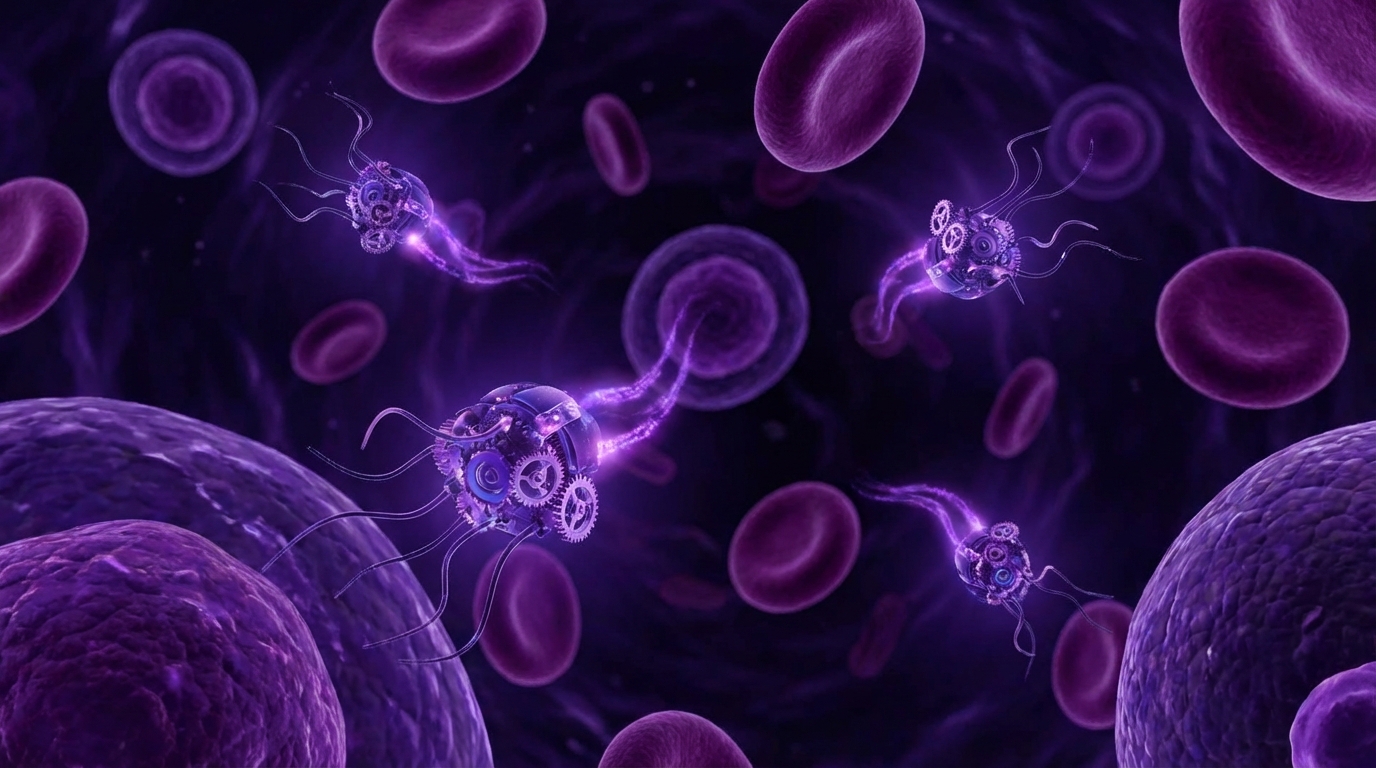
I used to think “tiny robots in your bloodstream” was just lazy sci-fi writing. Cool idea, but nothing you would ever trust with your actual heart, brain, or eyesight.
Then I started reading what researchers are doing with nanotech in medicine, and honestly, some of it already looks like early versions of that vision… and some of it still feels very far away.
The short answer: we do not have fully autonomous, self-propelled “robots” freely cruising through your veins making decisions on their own. What we do have already are engineered nanoparticles and nano-scale devices that can carry drugs, find target tissues, kill cancer cells more precisely, and act as sensors or contrast agents. Over the next couple of decades, these will get smarter, more controllable, and a bit more “robotic,” but they will still be heavily supervised by humans and biology will still put a lot of limits on what is safe.
Real nanomedicine today looks less like tiny humanoid robots and more like smart dust, engineered specks, and chemical delivery vehicles doing very specific jobs inside the body.
What “nanotechnology in medicine” actually means
When most people hear “nanorobots,” they picture little metal machines with arms and legs swimming through blood. That is not what scientists are building.
“Nano” just refers to size. A nanometer is one-billionth of a meter. A human hair is roughly 80,000 to 100,000 nanometers wide. Many useful medical tools live in the 1-100 nm range:
– DNA is about 2 nm wide
– Proteins range from a few to a few dozen nm
– Many viruses are 20-300 nm across
So nanotechnology in medicine is mostly about designing particles, shells, scaffolds, and sometimes moving devices that live at the same scale as biomolecules.
Think of nanomedicine as designing artificial “molecules with extra features” instead of building mechanical insects.
Where this fits in the body
This size range matters, because it changes how materials behave:
| Scale | Example | How it behaves in the body |
|---|---|---|
| Millimeter | Pill, stent | Seen as a foreign object, local impact, cannot enter cells |
| Micrometer | Blood cell, many bacteria | Can circulate in blood, but often caught by immune cells |
| Nanometer | Virus, protein, DNA, nanoparticle | Can slip through gaps, enter cells, interact with proteins |
At the nano scale, surface chemistry, charge, and shape matter at least as much as “what the material is made of.”
So when we talk about “robots in your bloodstream,” in real lab work that usually means:
– A particle that can carry a drug
– A shell that breaks open in response to a signal
– A magnetic bead that moves when we apply a field
– A DNA “machine” that changes shape based on certain molecules
They are “robots” in a very broad sense: they have a structure, can respond to stimuli, and can do a useful job, but they do not think.
Main ways nanotechnology is already used in medicine
The gap between hype and reality is pretty big here. But there is real tech already in clinics.
- Nanoparticle drug delivery
- Nanotech in cancer treatment
- Imaging and diagnostics with nanoparticles
- Nano-scale sensors and monitoring
- Emerging: micro/nanorobots that move and act
Let us walk through these without slipping into science fiction.
Nanoparticle drug delivery: tiny carriers, not tiny doctors
If you remember only one thing about nanomedicine, let it be this:
The workhorse of nanomedicine right now is the drug carrier: a nano-sized package that changes where and how a drug travels in your body.
You are probably already familiar with one example: mRNA vaccines.
Those vaccines use lipid nanoparticles (LNPs) to:
– Protect fragile mRNA from getting degraded
– Help it cross cell membranes
– Change how the immune system sees the payload
That is nanomedicine in real life.
Other drug delivery systems work on similar ideas:
- Liposomes: Tiny fat bubbles that carry both water-loving and fat-loving drugs. Some chemotherapy drugs are already sold this way.
- Polymer nanoparticles: Spheres built from biodegradable plastics that can slowly release drugs.
- Inorganic nanoparticles: Gold, silica, or iron oxide particles that can carry drugs and also respond to light or magnetic fields.
These are not “robots,” but they feel like a first step toward programmable behavior:
– You can tune size: to stay longer in blood or exit into tissues
– You can tune surface: to hide from the immune system or bind to a receptor
– You can tune release: to open under certain pH, temperature, or enzymes
Why drug delivery needed help
Traditional drugs are blunt tools:
– A pill dissolves in your stomach, then goes everywhere in your body
– An injection still floods large parts of your system
– Delicate biologic drugs can break down before they reach their target
Nanocarriers try to fix some of this:
| Problem with standard drugs | Nanotech approach |
|---|---|
| Drug attacks healthy and diseased cells | Attach drug to targeted nanoparticle that prefers diseased tissue |
| Drug breaks down quickly in blood | Encapsulate in protective nano shell that dissolves near target |
| Need frequent dosing | Slow-release nano depot that stays in body longer |
| Cannot cross certain barriers (like blood-brain barrier) | Design particles that trick or use natural transport pathways |
This is where the “smart” behavior starts to look robotic: trigger-based release, selective binding, environmental sensing.
But again, no decision making. Just chemical cause and effect.
Nanotechnology vs cancer: where the hype came from
Cancer is where “tiny robots” captured the public imagination. It is also where nanotech has both real wins and real disappointments.
Enhanced permeability and retention (EPR): the leaky vessel story
For years, researchers leaned on something called the EPR effect. Tumors often grow faster than they can build proper blood vessels. Those vessels can be leaky.
So the idea was:
Make chemotherapy drugs ride inside nanoparticles that are big enough to stay in normal blood vessels but small enough to leak into tumor vessels and get trapped there.
That would mean more drug in the tumor, less in healthy tissue. In practice:
– In some animal models, this effect is strong
– In human cancers, it is a lot more variable
– Tumor type, location, and patient biology change the outcome
So EPR is helpful in some situations, but not a magic targeting tool.
Active targeting: “homing” nanoparticles
Another approach is to decorate nanoparticles with ligands or antibodies that bind to markers overexpressed on cancer cells.
Example: if a certain receptor is frequent on a tumor cell and rare on a normal cell, you can try to:
– Coat particles with molecules that bind to that receptor
– Let them circulate
– Hope they stick more on tumor cells
This is active targeting. It sounds precise. In practice, several challenges appear:
– Many “tumor markers” are also present on healthy cells, just at lower levels
– Blood flow and physical barriers still limit access
– The immune system still clears foreign particles
So you get some improvement, but not the dramatic, clean targeting that early diagrams suggested.
Hyperthermia and photothermal therapy
Here is a use of nanotech in cancer that feels closer to “tools” than “drugs.”
Certain nanoparticles, such as gold nanoshells or rods:
– Preferentially absorb particular wavelengths of light
– Convert that light into heat
If you can get enough of them into or near a tumor, then:
– You shine a laser from outside the body or via a fiber
– The particles heat up locally
– Nearby cells experience thermal damage and die
This can spare some surrounding tissue. It still needs good control, imaging, and careful delivery, but it is qualitatively different from systemic chemo.
There are similar ideas with:
– Magnetic nanoparticles heated by alternating magnetic fields
– Particles that generate reactive oxygen species under light (photodynamic therapy)
You can see how stacking these functions could one day look “robotic”: seek, attach, then burn.
Imaging: making the invisible visible with nanoscale helpers
For doctors, seeing inside the body with high contrast is half the battle.
Nanomaterials add contrast to standard imaging:
- Iron oxide nanoparticles as contrast agents in MRI
- Gold nanoparticles for CT contrast and optical imaging
- Quantum dots for bright, stable fluorescent imaging in research
These particles can be tuned for:
– Brightness
– Longevity in blood
– Targeting to organs or tumors
– Clearance through kidneys or liver
Think of these like “highlighters” inside the body, making certain features stand out under specific scanners.
You can combine imaging and therapy in one system. That concept has its own buzzword, but in simple language, it just means:
– The same nanoparticle that carries a drug also signals where it is
– Doctors can track where treatment goes and maybe adjust dosing
That dual role edges toward “smart devices” instead of plain drugs.
Nanotech for diagnostics and monitoring
You do not always need tiny machines swimming in blood. Sometimes you just need nano-scale features on a chip or in a sensor.
Lab-on-a-chip with nano structures
Many modern diagnostic platforms use:
– Nano-patterned surfaces
– Nano-pores
– Nano-electrodes
These help capture:
– DNA fragments
– Proteins
– Viruses
– Exosomes
In practice, this leads to:
- More sensitive blood tests
- Faster pathogen detection
- Better liquid biopsies for cancer
A doctor might draw a small amount of blood, send it to a chip-based system, and the nano structures there improve detection limits.
This is “nanotechnology in medicine” even if nothing tiny is traveling inside you.
Nanosensors in or on the body
There are active projects around:
– Wearables with nano-engineered electrodes for better signal detection
– Implantable sensors with nano coatings that resist fouling and measure things like glucose, oxygen, or metabolites
– Swallowable capsules with sensors on their surface to monitor gut conditions
These are not free-floating robots, but rather devices that use nanostructures to interact more precisely with biology.
Often, the real benefit of nanotech is not magic, but simply “better signal, less noise” in measurement.
Are there actual “robots” in development?
This is where terminology gets fuzzy. Some research groups build things they call “nanorobots” or “microbots.” They are usually:
– Micrometer-scale, not strictly nanoscale
– Powered by chemical gradients, ultrasound, magnetic fields, or light
– Observed in controlled lab settings, not yet in routine clinical use
Magnetically controlled micro/nanorobots
Imagine:
– Tiny helical structures coated with magnetic material
– When exposed to a rotating magnetic field outside the body, they spin and propel forward in a fluid
Researchers have steered such devices in:
– Simple channels that mimic blood vessels
– Animal models for tasks like targeted drug release or clot removal
Challenges:
– Blood is not a simple fluid; it has cells, proteins, and strong flows
– The immune system sees most such devices as foreign
– Steering in a complex, three-dimensional organ network is hard
– Safety and long-term effects are not clear yet
They are promising for very specific tasks like:
– Local drug delivery inside the eye
– Clearing clots or blockages in accessible vessels
– Moving in mucus layers in lungs or gut
Still, this is not the kind of freeform robot that roams your entire bloodstream making independent choices.
Chemically propelled nanomotors
Some particles can move by:
– Breaking down fuel (like hydrogen peroxide) around them
– Generating bubbles
– Creating local gradients
These are very neat from a physics perspective, but they hit a wall for medicine:
– You do not want high concentrations of unusual fuel inside the body
– Control over direction is limited
– Translation from simple lab setups to real tissues is complex
So for now, they teach us about motion at small scales more than they treat patients.
DNA nanorobots and logic gates
This is the closest thing to “programming” behavior at the nanoscale.
DNA is not just genetic code. You can fold it into designed shapes (DNA origami) and make structures that:
– Hold a payload
– Change shape when they meet a specific molecule
– Only open when multiple conditions are met
For example:
– A DNA box that stays closed until it detects a combination of proteins that are typical of cancer cells
– Inside the box sits a drug or a signal molecule
This looks like:
– “If protein A and protein B are present, then open and release cargo.”
That is a logic gate in molecular form.
These DNA devices behave like rule-based machines: they run very simple programs written in chemistry instead of code.
The main challenges:
– Stability in real blood and tissues
– Scale of production
– Avoiding unwanted immune reactions
– Confirming precise control in live animals and humans
This line of work is quite early but philosophically closer to the sci-fi idea of nanorobots.
Where the “tiny robots in your bloodstream” image breaks down
I understand why marketers love that phrase. It sounds clear and visual. But it also hides some key realities.
The body is hostile to gadgets
Anything non-native that enters blood faces:
– Complement system activation
– Protein corona formation (proteins coating the surface)
– Capture by liver and spleen
– Possible allergic or inflammatory responses
Even very simple nanoparticles face these issues. So:
Any useful nano device in blood must survive, function, and be cleared without causing more trouble than it solves.
Humans cannot just send in swarms of metallic machines and expect the body to tolerate them for long. Most approved nanoparticles use biocompatible materials and try to break down into safe byproducts.
Navigation is really hard
Blood does not behave like a calm swimming pool for robots:
– It flows fast in arteries, slower in capillaries
– It has red and white cells, platelets, and complex shear forces
– Vessels branch constantly
Steering individual devices in such an environment over long distances is far from solved.
That is why many current systems rely less on active steering and more on:
– Chemical targeting
– Size-based accumulation
– Local injection near the site of interest
The robot story skips these constraints.
Energy and computation at tiny scales
In science fiction, nanorobots:
– Think
– Communicate
– Coordinate
At real scales, fitting:
– A power source
– A processor
– Communication hardware
into an object smaller than many viruses, that can also survive in blood, and that the body eventually clears safely, is a huge engineering challenge. We are nowhere near that level of integration.
Instead, we rely on:
– Chemical gradients as implicit “instructions”
– Simple triggers (pH, enzymes, temperature)
– External fields (magnetic, light, ultrasound)
These are clever, but limited.
Real clinical status: what is actually approved?
To keep this grounded, let us look at categories that are already used in patients.
Approved nanomedicines
You will find products such as:
- Lipid nanoparticle mRNA vaccines for infectious disease
- Liposome-based chemotherapies (for example, formulations of doxorubicin)
- Albumin-bound nanoparticles carrying paclitaxel for cancer
- Iron oxide nanoparticles used as MRI contrast or for treating iron deficiency
Common features:
– The nano part is usually a carrier or contrast enhancer
– These products go through standard regulatory pipelines
– Long-term safety is monitored, but safety records so far are generally acceptable for authorized indications
What they are not:
– Autonomous machines
– Capable of multi-step decision making
Late-stage trials and near-term candidates
Some areas that are closer to routine use:
– Targeted nanoparticles for specific tumor types
– Nano-formulated drugs that improve solubility or reduce dosing frequency
– Nanoparticle-based vaccines beyond infectious disease, for cancer immunotherapy
Regulators care about:
– Particle size distribution
– Surface chemistry
– Biodistribution (where they go in the body)
– Clearance pathways
If you imagine such a system as a “robot,” it is a very simple one.
What this means if you are in tech or product work
A lot of people in tech want to get involved with “medical nanorobots.” That impulse is understandable, but it often misses where the work really is.
Where builders can actually contribute
If you think like a product or tech person, the leverage often lives in:
- Data and modeling: Simulating nanoparticle transport, optimizing designs, predicting interactions.
- Control systems: Designing user interfaces and algorithms for external fields that steer or activate particles.
- Imaging analysis: Better interpretation of scans enhanced with nano contrast agents.
- Manufacturing: Quality control, scale-up, and reproducibility of nano formulations.
The bottleneck in nanomedicine is less “we do not have wild ideas” and more “we need reproducible, safe, tightly controlled systems that work in real humans.”
So if your focus is software, data, or systems engineering, that is where your skills might have real impact.
Where your mental model might mislead you
If you approach this like:
– “We will just build tiny drones in the body that we can program like an API,”
you are likely heading in the wrong direction.
Biology does not behave like a cloud environment:
– You do not get clean isolation; everything interacts
– Failure modes often equal harm to real people
– Versioning and rollback are not trivial once something is in the bloodstream
I would challenge that “tiny drone” mental model. A more realistic lens is:
– “We are designing special-purpose hardware that runs very basic, mostly chemical ‘firmware’ and must coexist with a complex legacy system (the human body) that we cannot change.”
Less glamorous, more honest.
Risks, ethics, and limitations
Nanotech in medicine is not just about what we can do; it is also about what we probably should not do too fast.
Toxicity and unknowns
Concerns include:
– Long-term accumulation of non-degradable materials in organs
– Unintended activation of the immune system
– Interference with normal cell processes at the molecular level
For every candidate, researchers study:
– Acute toxicity
– Chronic effects
– Genetic damage potential
– Interactions with common drugs
Still, some effects may only appear at scale or over longer times. Caution makes sense.
Privacy and control
As sensors get smaller and more capable, some questions become less theoretical:
– Who owns data coming from in-body nanosensors?
– How is it secured, and who can access it?
– Could such systems be misused for monitoring without real consent?
Right now, this is mostly ahead of where the tech is, but if you work in this area, it is not too early to design for privacy and control by default.
Equity and access
Many nano-based therapies are expensive to develop and manufacture. That can mean:
– Limited access for lower-income populations
– Concentration of benefits in certain health systems
If you are building in this area, ignoring cost and distribution is a mistake. The most helpful tools will be the ones that can actually reach large numbers of people.
So, are we heading toward tiny robots in your bloodstream?
I think it is fair to say:
We are heading toward more sophisticated nano-scale systems in the body, but not toward independent, general-purpose robots roaming freely and solving whatever they find.
Here is a more grounded timeline mindset:
| Timeframe | Realistic developments |
|---|---|
| 0-5 years | More nanoparticle drug formulations, better vaccines, improved imaging agents, early targeted therapies refined. |
| 5-15 years | More complex multi-functional particles (imaging + therapy), better DNA-based devices, some niche microbots for very specific uses (eyes, accessible vessels). |
| 15+ years | Clearer view on long-term safety, more programmable molecular systems with simple logic, slightly more autonomous behavior in constrained settings. |
Will any of this feel like “robots” in the conversational sense? Perhaps, in niche cases. But the more honest framing is:
– Smart carriers
– Molecular machines
– Externally controlled microdevices
All with tight design constraints and narrow roles.
How to evaluate claims about nanorobots in medicine
If you read or hear big promises, a quick mental checklist helps.
Five questions to ask
- What size are we talking about? True nanoscale, micrometer, or larger? How does that affect where it can go in the body?
- What powers it? Chemistry, external fields, body heat, something vague? If there is no clear answer, be skeptical.
- How is it controlled? Pre-programmed chemistry, external steering, or some proposed on-board logic? The more the claim leans on “AI inside a nanobot,” the less realistic it probably is.
- How is it cleared from the body? Broken down? Filtered by kidneys? Sequestered in organs? If this is hand-waved, that is a red flag.
- What stage is it at? In vitro (test tube), animal models, early human trials, or approved? The gulf between mouse and human is large.
Any serious nanomedicine project should have sober, technically specific answers to power, control, clearance, and stage of development.
If someone glosses over these with cinematic language, you are not hearing about current science. You are hearing a pitch.
Where curiosity is useful
I do not think skepticism should turn into cynicism. Some earlier ideas in nanomedicine overpromised, yes. But real progress has also happened.
Curious questions to keep exploring:
- How can we design particles that listen to multiple signals before acting?
- How do we model and predict nano-bio interactions more reliably?
- Can we make fully biodegradable nano devices with sophisticated behavior?
- How do we build regulatory and data systems that keep up without slowing genuine progress?
If you care about tech and medicine, that is where the interesting, less glamorous work will be.
And maybe, one day, some of that work will look a bit like tiny robots in your bloodstream. Just with fewer special effects and a lot more peer-reviewed data.