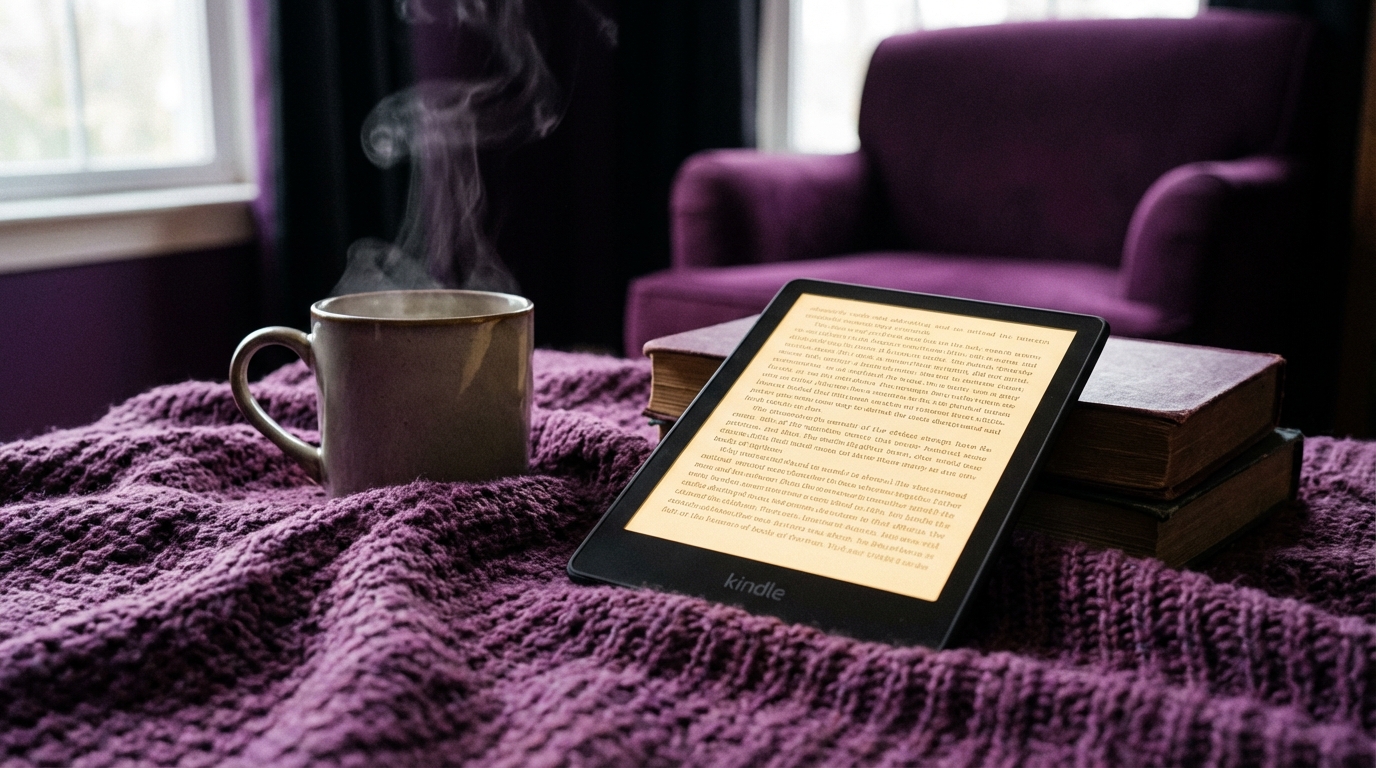
I used to think e-ink displays were a temporary bridge before “real” screens took over everything. Then I realized my eyes were burning after a day on OLED and I kept reaching for my old Kindle.
If you want the short answer: Kindles (and e-ink devices in general) are still relevant because they do three things modern tablets and phones do not do well at the same time: low-eye-strain reading, absurd battery life, and distraction-free focus. Add outdoor readability and durability, and you get a niche that LCD and OLED screens cannot replace without compromising something big.
What makes e-ink different from normal screens?
When people compare a Kindle to an iPad, they usually only think “black and white vs color” or “slow vs fast.” That is a shallow way to look at it.
E-ink works in a fundamentally different way from LCD or OLED:
- E-ink: Uses microcapsules with charged black and white particles that move when an electric field is applied. Once the particles are in place, the image stays without constant power.
- LCD: A backlight shines through liquid crystals and color filters. It needs constant power to hold an image and to keep the light on.
- OLED: Each pixel emits light. No backlight, but pixels must be powered to stay lit.
So an e-ink screen is closer to digital paper than to a TV. It reflects ambient light instead of emitting light into your eyes. That one difference explains most of its strengths and weaknesses.
E-ink is not trying to be a better tablet screen. It is trying to be a better page.
Here is a simple comparison:
| Feature | E-ink (Kindle) | LCD / OLED (Phone / Tablet) |
|---|---|---|
| Eye comfort for long reading | High, paper-like, reflective | Medium to low, bright, emissive |
| Battery life for reading | Weeks | Hours to a day |
| Outdoor sunlight use | Excellent, gets clearer with light | Poor to fair, glare and dimming |
| Video and animation | Bad (slow refresh) | Excellent |
| Distraction level | Low | High (apps, alerts, etc.) |
That is why people who actually read a lot do not replace their Kindles with iPads, even if they own both.
Why Kindles still matter when phones can “do everything”
I remember thinking: “Why am I carrying a separate device just to read books when my phone can hold the same Kindle library?” Then I checked my screen time. I was reading 5 minutes and checking messages 20.
Kindles still matter for several overlapping reasons.
1. Eye strain and comfort over hours, not minutes
If you read for 10 minutes on a phone, you will probably be fine. Two hours is another story.
An e-ink screen:
- Reflects light instead of shining it into your eyes.
- Has no PWM flicker from dimming backlights.
- Does not blast blue light into your eyes (there is some from front-lights, but it is milder and you can warm the color).
Phones and tablets:
- Use bright backlights or self-emitting pixels that your eyes have to adapt to constantly.
- Often run at high brightness in bright rooms or outdoors.
- Encourage short, intense bursts of usage rather than steady slow reading.
If your reading time is measured in hours, the screen choice stops being cosmetic and starts being physical.
This is one of those cases where your body gives the real review. If you end a reading session with dry eyes and a light headache, that is a signal. It is subtle, but some people only notice the difference after switching to e-ink for a week and then going back.
2. Battery life that behaves like a book, not like a gadget
This part feels almost boring, but it is one of the biggest reasons e-ink keeps its niche.
A typical Kindle:
- Uses power mostly when turning pages or changing screens.
- Consumes almost nothing while showing a static page.
- With Wi-Fi off and moderate reading can last several weeks on a single charge.
A typical phone or tablet:
- Continuously refreshes the screen at 60 Hz or more.
- Runs a lot of background processes and radios.
- Lasts a day with mixed use, sometimes less with heavy screen time.
If you are traveling, camping, or just trying to reduce charging fatigue, an e-ink reader feels different. It behaves like a book that occasionally drinks power instead of a screen that is always hungry.
The best thing about an e-ink device is not when it is new and shiny. It is when you forget when you last charged it and it still works.
And that small mental relief matters. You do not negotiate with the battery before starting a chapter.
3. Distraction-free reading in a world that fights your attention
This is where people underestimate Kindles the most.
On a phone:
- Messages pop up.
- Social apps compete for attention.
- The browser is one tap away if a paragraph reminds you of something.
On a Kindle:
- No social apps.
- No fast browser for real-time surfing.
- No colorful notifications every few minutes.
You can still get some basic notifications if you set them up, but almost nobody does. And that “lack of features” is the feature.
If you think you can just “stay focused” on a phone, you are competing with teams of people whose job is to break that focus. Some readers win that fight. Many do not.
A Kindle is not smarter than your phone. It simply refuses to compete for your attention, and that is why it wins for reading.
There is also something about mental context. When you pick up your Kindle, your brain starts expecting quiet, long-form content. When you pick up your phone, your brain expects bursts, pings, and quick hits of novelty. That expectation shapes how deep you read.
4. Outdoor readability and the sun problem
If you have ever tried reading a normal tablet at the beach or on a park bench at noon, you already understand this one.
With e-ink:
- More light improves clarity.
- No glare-heavy glass screen (most readers use matte finishes).
- No auto-brightness fighting the sun.
With LCD / OLED:
- The screen reflects the sun like a mirror.
- You have to crank the brightness up, draining battery.
- Sometimes it still looks washed out and hard to read.
This is the funny reality: e-ink is the only class of display that looks better under harsh sunlight than in a dark room.
If your reading life includes commutes, backyards, balconies, parks, or travel, this alone can justify keeping a Kindle.
5. Physical comfort, weight, and posture
This one gets less attention, but it affects everyday use.
Most Kindles:
- Weigh far less than tablets.
- Have a narrow bezel you can grip without touching the screen.
- Are shaped for reading in one hand for long sessions.
Phones can be one-handed, but:
- They are usually gripped vertically, not like a small book.
- They encourage short reading windows.
- They tend to pull your neck downward more sharply.
Larger tablets often work better rested on a table or stand instead of in your hand. For long-form reading in bed, on a couch, or on a bus, a light e-ink reader feels closer to a paperback.
Why e-ink is still relevant as a technology, not just for Kindles
Amazon is not the only company betting on e-ink. The tech has limitations, but those limitations are exactly what make it interesting in certain niches.
1. The power profile is uniquely suited for “slow screens”
Anywhere you do not need full-motion video, e-ink starts to look attractive:
- Note-taking tablets: Devices from reMarkable, Kobo, and others show you handwritten notes with almost no battery drop while idle.
- Information panels: E-ink dashboards for meeting rooms, price tags in stores, bus schedules.
- Wearables: Some smartwatches and phones use or combine e-ink-style displays for always-on segments.
If you need to show static or slow-changing information and battery life matters more than color saturation or animation, e-ink is hard to beat.
Any place where the content moves slower than your eyes, e-ink has a chance to win.
2. Bistability and environmental impact
Bistability means the image remains on screen without power. That changes the energy profile.
Traditional displays:
- Use constant power to keep showing a page.
- Keep backlights or pixels driven even when nothing changes.
E-ink:
- Spends energy when you change pages.
- Sips almost nothing when the page is static.
This is not just about convenience. At scale:
| Use case | Typical display | With e-ink |
|---|---|---|
| Digital shelf labels in a supermarket | Continuous power draw across thousands of labels | Energy mostly when prices change |
| Information boards in public transport | Backlight on 24/7 | Front-lit only when needed, static most of the time |
You still have to charge or power the device of course. But over years, that energy pattern can add up, especially for large deployments.
3. Color e-ink and where it actually fits
Color e-ink has been “almost there” for a long time. There are devices with color e-ink now, but they have trade-offs:
- Lower saturation than LCD or OLED.
- Slightly lower resolution (because of color filters or stacked layers).
- Slower refresh, which affects page turns and any attempt at animation.
So where does color e-ink make sense?
- Comics and manga where page-turn speed is not critical.
- Magazines with mostly static layouts and images.
- Educational material with charts and diagrams.
Kindles have slowly moved toward better contrast and smaller fonts, and there are strong hints that more color use cases will open up as the tech inches forward. But I would not expect full tablet-like performance from color e-ink anytime soon. That is fine. It does not need to compete on that axis.
Why Kindles survive in a market of all-purpose devices
This is where the business side comes in. It is easy to think: “Single-purpose devices are dead.” Phones eat everything, right?
Not quite.
1. Specialization wins when the job is narrow but deep
If all you read are short articles, your phone is probably enough. If you read dozens of books per year, the equation changes.
A Kindle offers:
- The right screen for the job (e-ink).
- The right form factor (book-like, light).
- The right software focus (books, maybe audiobooks).
You lose:
- General apps.
- Multitasking.
- Instant quick switching to messages and feeds.
For heavy readers, that trade makes sense. You sacrifice flexibility to gain comfort and focus in one specific activity.
General-purpose devices dominate broad use, but specialists survive where depth matters more than breadth.
There is a parallel with cameras. Phones replaced most point-and-shoots, but high-end dedicated cameras are still alive for people who care about that specific craft.
2. The Amazon ecosystem lock-in effect
Amazon did something strategic with the Kindle platform:
- Built a huge ebook store.
- Connected it to Kindle devices, phone apps, and web readers.
- Synced your place in a book across all of them.
If you buy books on Amazon, you stay inside that ecosystem. If you own a Kindle, that loop tightens:
- Buying a new book is trivial: one tap, it lands on your Kindle.
- Recommendations reflect your reading history.
- Prime members get extra reading perks.
This is not always good for reader freedom, of course. You are tightly coupled to a single vendor. But from a relevance standpoint, it means the Kindle is not just a piece of hardware. It is a front-end to a large distribution system.
And because the Kindle is relatively affordable compared to tablets, Amazon can treat it as a gateway to long-term content purchases instead of trying to profit heavily on the device itself.
3. Minimal upgrade pressure
Phones and laptops keep pushing new cycles. Higher refresh. More cameras. Faster processors.
Kindles evolve slowly:
- Screen resolution increased, then plateaued at comfortable “print-like” levels.
- Front-lights improved with adjustable warmth.
- Waterproofing came in for some models.
You can easily use a Kindle for 5+ years without feeling that it is outdated. That hurts short-term hardware sales numbers, but it helps the platform feel stable and trustworthy.
This slow, steady cycle keeps Kindles relevant in a different way: they are not in the same rat race as smartphones. They are more like a reading appliance.
Where Kindles fall short (and why that is okay)
To be fair, Kindles are far from perfect. Some of the frustrations are technical. Some are strategic choices.
1. Speed and responsiveness
Even the newest Kindle:
- Has slower page turns than any LCD or OLED reader app.
- Shows ghosting sometimes (faint traces of previous pages).
- Feels laggy in menus compared to a modern phone.
Part of this is the nature of e-ink. Moving those microcapsules takes time. There are tricks to speed it up, but you still feel some delay.
If you are used to 120 Hz OLED, a Kindle feels almost analog. For reading, this is actually not a big issue for most people. But for things like:
- Web browsing.
- Quick search-heavy workflows.
- Note-taking with rapid erase and redraw.
The slowness is very visible.
2. Limited openness
Kindles are heavily tied into Amazon:
- Native support focuses on Amazon formats.
- Support for EPUB and other formats historically required workarounds (though file support has improved).
- You do not get full file-system handling like you might on a regular tablet.
For casual readers who mostly buy from Amazon, this is fine. For technical readers, academics, or people who collect ebooks from multiple sources, it can feel restrictive compared to, say, a dedicated e-ink tablet from an open vendor or a regular Android device running third-party reading apps.
If you want a pure reading appliance, the focus helps. If you want a flexible reading computer, it can be frustrating.
3. Limited use cases beyond books
Amazon has been cautious about expanding the Kindle’s abilities:
- No app store full of general apps.
- Experimental browser that is quite basic.
- Note-taking that is serviceable but not a full digital notebook rival.
For some people, this is exactly the point. The Kindle does not turn into a second tablet and ruin its focus. For others who want a “do-it-all” e-ink pad, it feels underpowered compared to reMarkable, Boox, or similar.
The Kindle is not trying to be your everything device, and that stubbornness keeps it relevant for one thing: reading long-form text.
You just have to be honest about which side you are on. If you want an e-ink device that does advanced PDFs, complex annotations, and a wide variety of apps, a Kindle is not a great main device. It can still be the best “book-only” device sitting next to something more flexible.
How reading behavior keeps Kindles alive
The tech story is one part. The human habit story is another.
1. Long-form reading is different from scrolling
Short content and long content are not just different lengths. They are different activities.
Short content:
- Is often consumed while standing in lines, during short breaks, or between tasks.
- Encourages partial attention.
- Works fine on phones.
Long-form reading:
- Needs blocks of time.
- Benefits from posture and physical support (a device or book you can hold for a while).
- Often involves deeper immersion.
A Kindle is tuned for that second activity. The hardware and software tell your brain: you are reading now.
I have seen people who read hundreds of pages a week try to move all reading onto tablets for convenience. Most eventually return to e-ink for at least part of their reading. They might not always admit that the phone pulled them away from reading into notifications, but you can often see it in their usage patterns.
2. Ritual and identity
This is less technical, but it matters.
For some readers:
- Charging the Kindle on a nightstand is part of a sleep routine.
- Carrying a light e-ink device signals “I am going to read” to themselves.
- Having a separate reading gadget creates a boundary between work and quiet time.
Phones mix everything:
- Work apps.
- Messaging.
- Entertainment.
- News and stress.
Using the same object for deep rest and deep stress can confuse your own associations. A separate reading device sounds indulgent at first, but many people find that it supports better habits.
Sometimes the most valuable feature is not inside the device. It is the mental box you put that device in.
The future: will Kindles still be relevant in 5 to 10 years?
Predicting tech is always messy, and I do not think any display tech is immune to disruption. There are a few scenarios worth thinking through.
1. If phone and tablet screens keep getting “softer”
Phone makers keep adding:
- Lower blue light modes.
- Advanced anti-flicker dimming.
- Paper-like themes and reading modes.
Could a phone become “good enough” as a reader? For some people, yes. People who read maybe 5 or 10 books a year might not justify a separate device long term.
For people reading 50+ books a year, a dedicated e-ink device will likely still feel different. The key gap is not only screen comfort, but attention environment and battery pattern.
2. If e-ink improves refresh and color
E-ink manufacturers are already:
- Reducing ghosting with smarter waveforms.
- Improving color layers.
- Experimenting with partial refresh zones for quicker UI elements.
If refresh speeds reach a point where some light animation is comfortable and color improves, some mid-ground devices might emerge:
- Tablets that switch between LCD and e-ink layers.
- Kindle-like devices that run more advanced apps without feeling sluggish.
At that point, the line between “Kindle” and “e-ink tablet” might blur. But the core value stays: a screen that feels like paper when you want to read.
3. The business model angle
As long as:
- Amazon makes significant revenue from ebook sales.
- Readers prefer a simple path from store to page.
- E-ink hardware can be produced at a reasonable cost.
There is strong reason for Amazon to keep the Kindle alive.
What could threaten it?
- Drastic shifts to subscription reading where device does not matter.
- Major regulation or format shifts that break platform lock-in.
- A new kind of all-purpose device that is genuinely comfortable for long reading and beats e-ink on all key metrics.
Right now, none of these look close enough to declare the Kindle obsolete. Reading is slow and habit-based. Hardware that serves it tends to linger longer than buzzier gadgets.
How to decide if a Kindle (or e-ink device) is worth it for you
You probably do not need me to cheerlead for another device. It is better to ask a few blunt questions.
1. How many hours per week do you read long-form text?
If your answer is:
- Under 1 hour: Stick with your phone or tablet.
- 1 to 3 hours: An e-ink reader is a nice upgrade, but not essential.
- 3+ hours: E-ink starts to give real benefits in eye comfort and habit formation.
The “hours” matter more than the “number of books” because your body cares about time on screen, not just titles finished.
2. Where do you usually read?
If you mostly read:
- On a couch near an outlet.
- At a desk with a monitor.
Battery and sunlight matter less. If you read:
- On commutes.
- In parks or outdoors.
- While traveling or camping.
Then battery life and sunlight performance are a bigger deal, and a Kindle starts to look more attractive.
3. Do you struggle with digital distractions while reading?
If your honest answer is:
- “I can read on my phone for an hour without checking other apps.”
You may get less value from a Kindle. If your answer is:
- “I intend to read, but keep bouncing into social feeds or messages.”
Then a separate, limited device might help more than another productivity trick.
Sometimes the most practical “focus app” is a physical gadget that simply cannot do the distracting thing.
4. Are you comfortable with Amazon’s ecosystem?
If you prefer:
- Owning DRM-free files.
- Buying across many stores.
- Heavy PDF and technical document reading.
You might want to look at more open e-ink tablets instead of a Kindle.
If you:
- Already buy most ebooks on Amazon.
- Prefer convenience over format purity.
- Care most about fiction or general non-fiction books.
Then the Kindle fits that path well.
So, why are Kindles still relevant?
Not because they are flashy. Not because they are powerful. They are relevant because they respect a very old human activity: sitting down with long-form text and staying there.
E-ink provides:
- A screen that cooperates with your eyes instead of challenging them.
- A battery pattern that feels like paper, not like a hungry gadget.
- A context that protects your attention instead of scattering it.
- Hardware that handles sunlight and long sessions calmly.
Kindles turn that tech into a purpose-built reading tool:
- Integrated with a massive book store.
- Tuned for simplicity over features.
- Built to fade into the background while you read.
You can absolutely read everything on your phone if you want. Many people do. But if you read enough that your eyes, your focus, or your habits start to suffer, an e-ink device is not nostalgia. It is a rational correction.
And that is why, even surrounded by glowing glass, the quiet little e-ink Kindle still earns a place in a lot of bags and on a lot of nightstands.