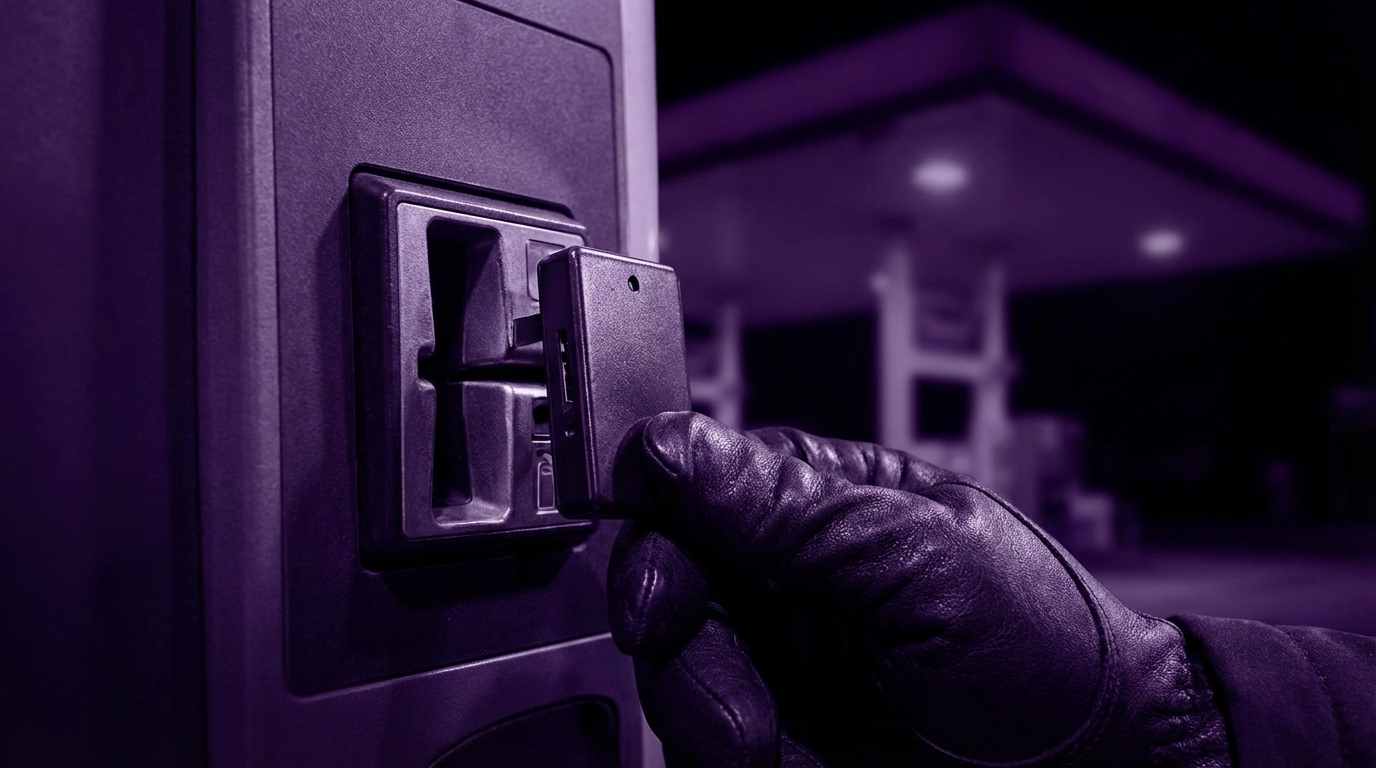
I used to think gas station scams were mostly old-school: someone shoulder surfing your PIN or swapping cards by hand. Then I started seeing actual teardown photos of skimmers pulled out of pumps, and my view of “simple” gas fraud disappeared.
Here is the simple version: credit card skimmers at gas stations are hidden devices thieves attach inside or outside the pump to capture your card data (and often your PIN). They come in many forms, from cheap overlays glued on top of readers to Bluetooth-equipped boards wired into the pump’s guts. The best defense is using chip or contactless payments, picking well-lit, busy stations, choosing pumps close to the cashier, and knowing how to spot the small clues when something on the pump looks off.
What credit card skimmers at gas stations actually are
People talk about skimmers like they are one thing. They are not. They are a family of tools thieves build, borrow, tweak, and break.
At a basic level, a gas pump skimmer is:
A device that intercepts the communication between your card and the pump, then stores or transmits that data so thieves can copy your card.
When you swipe your magnetic stripe, the pump reads:
– Your primary account number
– Expiry date
– Cardholder name (in many cases)
– Service codes and other track data
A skimmer quietly takes a copy of that data as it passes through. If the thieves also get your PIN (from a fake keypad or hidden camera), they can write your card to a blank magstripe and withdraw cash at ATMs or make in-person purchases.
What surprises people is how “normal” this all looks on the outside. The pump works. Your transaction goes through. You get gas. The receipt prints. The theft happens in parallel.
How thieves physically attach skimmers to gas pumps
The hardware side is not glamorous. It is more like basic tinkering with some electronics skills.
There are two broad categories:
- External skimmers: Devices you can see and touch on the outside of the pump.
- Internal skimmers: Devices hidden inside the pump cabinet, wired into the reader.
External overlays and fake readers
External skimmers are the ones most people know: the fake card slot clipped or glued on top of the real one.
The typical setup:
- Skimmer head: A plastic shell that looks like the pump’s native reader, containing a small magstripe reader inside.
- Battery + storage: A coin cell or small lithium battery and a flash memory chip or small microcontroller to store track data.
- Attachment: Double-sided tape, clips, or tension fit so a thief can snap it on and pull it off quickly.
The real reader still works. When you insert or swipe your card:
1. The fake reader grabs the data.
2. The pump’s original reader also gets the data and completes the transaction.
3. Your card is charged normally.
The weak point is visibility. If you compare two pumps next to each other, the fake one often looks a bit different:
– Colors slightly off
– Reader sticks out more than usual
– Wobble or looseness when you pull on it
One of the simplest checks is to gently pull on the card reader housing. Factory parts are solid. Add-ons tend to flex or move.
Sometimes thieves go further and swap the entire front panel where the reader and keypad live. In those cases, the whole area can look newer or less worn than the rest of the pump.
Fake keypads and hidden PIN capture
If the thief wants your PIN too, they need another piece of hardware.
Two main methods:
- Fake keypad overlay: A thin keypad laid on top of the real one. It has its own flexible circuit to monitor each keypress.
- Micro camera: A small camera placed above or to the side of the keypad with a clear view of your hand.
With keypad overlays, your finger actually presses two keypads at once:
– The fake one logs your PIN
– The real one sends your PIN to the pump
These overlays are usually:
– Slightly raised compared to the surface
– Less responsive or “mushy”
– Different font or spacing on the keys
Cameras can be hidden in:
– A fake “security” label
– A small bar above the screen
– A brochure holder or light fixture nearby
The camera method is less precise but easier to install, because the thief does not have to wire into anything.
Internal skimmers inside the pump
This is where the real concern sits now. Internal skimmers are boards placed inside the locked pump cabinet, between the reader and the pump’s main board.
Typical components:
| Component | Role inside an internal skimmer |
|---|---|
| Microcontroller | Reads raw track data and formats it for storage or transmission. |
| Memory chip | Stores hundreds or thousands of card swipes. |
| Power connection | Draws power from the pump’s own low-voltage rails, so no battery is needed. |
| Communication module | Bluetooth Classic, BLE, GSM, or sometimes a wired connector for later download. |
The thief gains temporary access to the pump cabinet using:
– Lost or copied keys (many pumps share key patterns)
– Poor physical security from the station
– Lock picking tools
Once inside, they:
1. Locate the cable from the card reader to the board.
2. Insert the skimmer in series (inline) or connect it to a test port.
3. Close up the pump and walk away.
From the outside, nothing looks different. The skimmer quietly logs every card until someone opens the cabinet again and inspects the wiring.
Internal skimmers are harder for customers to spot and often run for weeks. That is why criminals prefer them over simple overlays.
Technology layers thieves use in modern skimmers
The early skimmers were simple: read magstripe, store data, pick up later. That still exists. But the tech stack has grown.
Here are the main layers you see in more recent gas pump skimmer designs.
Bluetoooth skimmers that broadcast data
Bluetooth skimmers are popular, partly because they are convenient for criminals.
How they work:
- The board inside the pump has a small Bluetooth radio (often a cheap module like HC-05, HC-06, or similar).
- Every time a card is swiped, the module stores the data in memory.
- The thief parks nearby, connects to the hidden device using a phone or laptop, and downloads everything wirelessly.
Sometimes the Bluetooth device broadcasts a strange name like:
– “HC-03”
– “PUMP-01”
– “Skim-BT” (yes, some have been that obvious)
Security teams and some law enforcement units now routinely scan the air near pumps for unknown Bluetooth devices. They look for things with no obvious reason to be there.
There is a cat-and-mouse element here. As defenders look for one pattern, thieves switch to another:
– Changing broadcast names frequently
– Using low-power modes so the signal barely reaches the parking lot
– Only waking up at certain intervals or after a specific command
GSM and cellular-enabled skimmers
Instead of waiting nearby, some thieves use GSM or LTE modules to send card data over mobile networks.
Workflow:
1. Card swiped at pump.
2. Skimmer reads data and stores it briefly.
3. SIM-equipped module sends that data as SMS or over data to a remote server.
Advantages for criminals:
– No need to revisit the station.
– Less chance of physical evidence on site.
– Skimmer can be smaller, as memory requirements drop.
Downside for them is cost and complexity: each skimmer needs a SIM, some credit, and radio reception.
Keypad loggers and sniffers
When the aim is full card takeover, the PIN is the missing piece. Separate hardware may sit between the keypad and the pump’s controller.
Two approaches:
- Inline keyloggers: Small boards inserted into the cable from keypad to controller, recording every keypress.
- Firmare-level malware: Compromised firmware on pump controllers that quietly logs PINs along with card data.
The firmware route sounds like fiction, but we have seen similar things happen with ATMs and POS terminals. Physical access plus service tools can open that door.
When hardware starts to look original and untouched, the next worry is not plastic shells, but modified firmware that behaves just like the real thing while sending copies of your data elsewhere.
3D printing and custom enclosures
External skimmers used to be rough. Miscolored plastic, wrong edges, poor fit. Now thieves use:
– 3D printers
– High quality resins
– Custom molds
They often:
– Buy the same model of pump from surplus or auction sites.
– Scan or measure the original parts.
– 3D print enclosures that match almost exactly.
In some cases, you would only notice because of tiny details:
– Slightly different gloss level
– Edges that feel sharper or less rounded
– Different sound when you tap it with your nail
For casual users, that gap is almost invisible. Which is why relying only on “does it look normal” has limits.
How skimmers grab and structure your card data
To understand why these devices remain a problem, it helps to see what they are after and what they do with it.
What is on your magnetic stripe
Magstripe cards store data in machine-readable “tracks”. Skimmers mostly focus on Track 1 and Track 2.
Simple view:
| Track | Typical content |
|---|---|
| Track 1 | Cardholder name, account number, expiry date, service code, extra data. |
| Track 2 | Account number, expiry date, service code, extra security fields, no name. |
A skimmer does not have to interpret all of this in detail. It just has to copy the raw string.
That raw string can then be:
– Stored exactly as-is
– Slightly rearranged
– Encrypted for later decoding
Later, criminals use magstripe writers to imprint that data onto blank cards. ATMs and older payment terminals then see that cloned card as valid.
PIN capture and full card takeovers
If a skimmer also has your PIN, the threat shifts:
– ATM withdrawals from your debit account
– Balance transfers
– Cardless cash pickups in some systems
To get the PIN, as mentioned earlier, they rely on:
- Keypad overlays that log the key matrix.
- Inline keyloggers intercepting keypad signals.
- Cameras watching your hand and reconstructing the PIN.
When they match the logs to the card data, they group:
– Card number and track data
– Time of transaction
– PIN entry sequence
Then they can write your debit card to plastic and walk up to an ATM.
This is why covering the keypad with your hand every single time still matters. It is a simple habit that breaks the camera-based side of many skimming setups.
Why gas stations are such popular targets
If skimmers can exist on ATMs, point-of-sale terminals, and other readers, why do gas pumps get so much attention?
Several reasons stack up.
Legacy magstripe usage at pumps
Gas pumps have been slower to move to chip-only or strong contactless setups.
From a thief’s point of view:
– Magstripe is still widely accepted at pumps.
– Magstripe data is easy to copy and clone.
– Many pumps do not enforce chip, even when the card has one.
So they focus where:
– Swipe is still normal
– EMV fallback behavior is forgiving
Physical security weaknesses
Look at a typical pump’s cabinet:
– One lock on the side or front
– Thin metal doors
– Shared keys between many pumps and sites
If you obtain one of those keys, your access is broad. Or you can just exploit weak locks.
Many stations also:
– Have limited surveillance around each pump.
– Do not regularly inspect internal wiring.
– Lack tamper sensors that alert staff when a cabinet is opened.
Compared to ATM vaults or bank kiosks, it is a softer target.
Transaction volume and anonymity
Gas stations process:
– High numbers of small to medium transactions
– Traffic from non-regular customers (lots of unique cards)
For criminals, more cards in a short timeframe is better. It spreads risk across many victims and makes patterns harder to spot.
They also benefit from:
– People passing through towns where they may not notice small charges right away.
– Delays in banks linking fraud back to a particular pump.
Responsibility shift and slow upgrades
Over the past years, liability for card fraud has shifted toward merchants who do not support EMV chip at the pump. That has pushed some upgrades.
But upgrading fuel pumps is not trivial:
– Each station may have many pumps.
– Hardware and software upgrades are cost-heavy.
– Regulatory testing can be slow.
So you end up with a patchwork:
– Some pumps fully modern and chip/contactless ready.
– Others still magstripe-heavy.
Criminals aim for the weaker ones.
How to recognize a possible skimmer at a gas station
No method is perfect. But you can reduce your risk with a few habits and visual checks.
Look for physical tampering and odd details
Before you insert your card, pause for two seconds and scan:
- Security seals: Many stations place tamper-evident stickers over cabinet seams or doors. If a seal is cut, broken, or removed, be cautious.
- Loose parts: Wiggle the card reader and keypad. They should feel firmly attached, with minimal play.
- Mismatched parts: Compare your pump with one next to it. Do the card readers look identical in size, color, and wear?
- Extra plastic: Does the reader seem bulkier than usual? Are there extra slots or faces on top of the original?
Some skimmers are clean enough to pass all these checks, but many are not.
If anything on the pump feels loose, crooked, or looks newer than the surroundings, choose a different pump or go inside to pay.
Check the keypad and surrounding area
Key points:
- Press the keys. Do they feel shallow or overly soft?
- Do the key labels match the style and wear level of the rest of the pump?
- Look around for tiny holes or panels that could hide cameras, especially around the display or overhead.
If your finger presses one layer that visibly flexes on top of another, that is not normal.
Use your phone as a basic Bluetooth scanner
This is not a silver bullet, but it can help.
Steps:
- Turn on Bluetooth on your smartphone.
- Open the device discovery screen.
- Stand next to the pump and see what appears.
Suspicious signs:
– Devices with generic names like “HC-05”, “BT-Board”, random alphanumeric strings, or something that does not match any car, headset, or known hardware around you.
This check is noisy in crowded areas, but at quieter stations, an unexplained device near a pump can be a clue.
How thieves use stolen card data after skimming
Once the data is off the pump and in the wrong hands, it flows through a small economy of its own.
From skimmer to carding market
The flow usually looks like this:
1. Skimmer logs data into memory.
2. Thief connects and downloads it, or it is sent via mobile network.
3. Data is cleaned and formatted (removing read errors).
4. Bundles of card data are sold in underground forums.
Pricing depends on:
– Card type (credit vs debit, premium tiers).
– Region (some regions have weaker authentication).
– Whether PIN is included.
Cloning and cashing out
The practical side involves:
- Card cloning: Using magstripe writers to put the stolen track data onto blank plastic cards.
- Testing: Making small purchases to confirm the card still works.
- Cashing out: Bigger purchases, ATM withdrawals, or buying goods to resell.
Often:
– One group manages on-site skimmers.
– Another group specializes in data handling and card writing.
– A third group focuses on cash-out.
Breaking any part of that chain helps, which is where detection and bank fraud systems come in.
What security upgrades are changing the game
The picture is not all bad. Hardware and software upgrades at fuel stations are slowly shrinking the easy targets.
EMV chip at the pump
Chip technology does not stop someone from reading your magstripe if you swipe. The key difference is how chip transactions work:
– The chip generates transaction-specific cryptograms.
– The data is not reusable for clones in the same way magstripe data is.
When pumps enforce:
– “Insert chip if present”
– Or refuse pure magstripe for cards that have chips
Skimmers that only capture swipe data become far less useful.
Contactless and mobile wallets
Contactless payments (tap-to-pay with card or phone) reduce your exposure to the physical reader.
Benefits:
- No card sliding into a slot where a skimmer might sit.
- Payment tokens, not your raw card number, pass to the terminal.
- Extra layers like device-based authentication on phones.
This does not remove all risk, but it changes what thieves can capture.
Better pump security and monitoring
More stations are moving to:
– Individual, unique keys for pump cabinets.
– Intrusion sensors that notify staff if a cabinet opens.
– Regular internal inspections of readers and wiring.
– Anti-tamper seals that are hard to remove without damage.
Some networks also run:
– Centralized analytics on transaction patterns to flag suspicious pumps.
– Bluetooth and RF scans for unauthorized emitters on station lots.
The more often a pump is inspected from the inside, the less time a skimmer can sit there unnoticed logging card after card.
Practical ways you can protect yourself
You cannot fix a gas station’s physical security by yourself. But you can adjust how you pay and how you monitor your accounts.
Prefer safer payment methods
Here is a simple priority list ranked from safer to riskier in the context of skimmers:
| Method | Relative risk at pumps |
|---|---|
| Contactless (phone or watch) | Lower risk. Uses tokens, no physical swipe. |
| Chip card inserted at indoor terminal | Lower to medium risk. Hardware usually better protected. |
| Chip card at upgraded pump | Medium. Better than swipe, but still relies on pump’s implementation. |
| Magstripe swipe at pump | Higher risk. Main target for skimmers. |
If you must pay at the pump and the only option is magstripe, weigh the convenience against the risk.
Pick better pumps and locations
A few habits go a long way:
- Use pumps near the cashier window: Thieves prefer remote corners with less visibility.
- Choose busy, well-maintained stations: More staff presence and more regular checks.
- Avoid pumps with broken seals or visible damage: If you see anything off, move on.
You do not have to turn this into a full audit every time, but a quick scan makes sense.
Watch your accounts with intent
Technology on your side helps here.
Set up:
- Transaction alerts: SMS or app notifications for any purchase above a small threshold.
- Daily or weekly review: A quick look at recent transactions, especially small ones you do not recognize.
- Virtual card numbers: Some banks and card providers offer single-use or merchant-locked card numbers.
Fraud from skimmers often shows up as:
– Small “test” charges at random merchants.
– Unfamiliar gas purchases in other cities.
– Card-not-present charges from online shops you did not use.
React quickly when something feels wrong
If your gut says something is off at a pump:
– Cancel the transaction.
– Try another pump or pay inside.
If you later see unauthorized charges:
1. Contact your bank or card issuer immediately.
2. Ask them to flag where the first suspicious charge came from.
3. If there is a pattern of gas station charges, mention that.
Speed matters more than perfect certainty. Reporting a suspicious charge early limits the window in which thieves can keep using your card data.
What this means for business owners and station operators
If you run or advise a station, skimmers are not just a bank problem. They affect your reputation and your liability.
Physical and procedural controls
Key measures:
- Unique, high-security locks: Avoid shared keys across sites. Rotate keys when staff changes.
- Regular inspections: Schedule internal checks of readers and wiring, not only during maintenance.
- Tamper-evident seals: Place seals over access points and inspect at each shift change.
- Lighting and cameras: Good coverage of pumps, especially at edges of the lot.
Also:
– Train staff to recognize signs of tampering.
– Give them a clear procedure for what to do if they suspect a pump has been targeted.
Technology investments
Incremental upgrades help:
- EMV-capable readers at pumps.
- Contactless terminals supporting mobile wallets.
- Intrusion detection sensors inside pump cabinets.
- System logs showing when cabinets open and close.
Over time, this shifts your station from being an easy target to a harder one. Criminals tend to move on when resistance increases.
The reality: you reduce risk, you do not erase it
There is no perfect strategy that makes card skimmers vanish from your life. The technology thieves use at gas stations keeps changing: better enclosures, smarter radios, quieter attacks.
But you do control several key levers:
Use safer ways to pay, build simple habits at the pump, and monitor your accounts like someone might actually try to abuse them.
Most people do not need to become hardware experts. You just need enough awareness to:
– Avoid obvious traps.
– Decide when paying at the pump is worth the risk.
– Act quickly when something feels off.
The tech scene behind gas station skimmers is more advanced than the average person expects. That is exactly why staying slightly more informed gives you an edge.