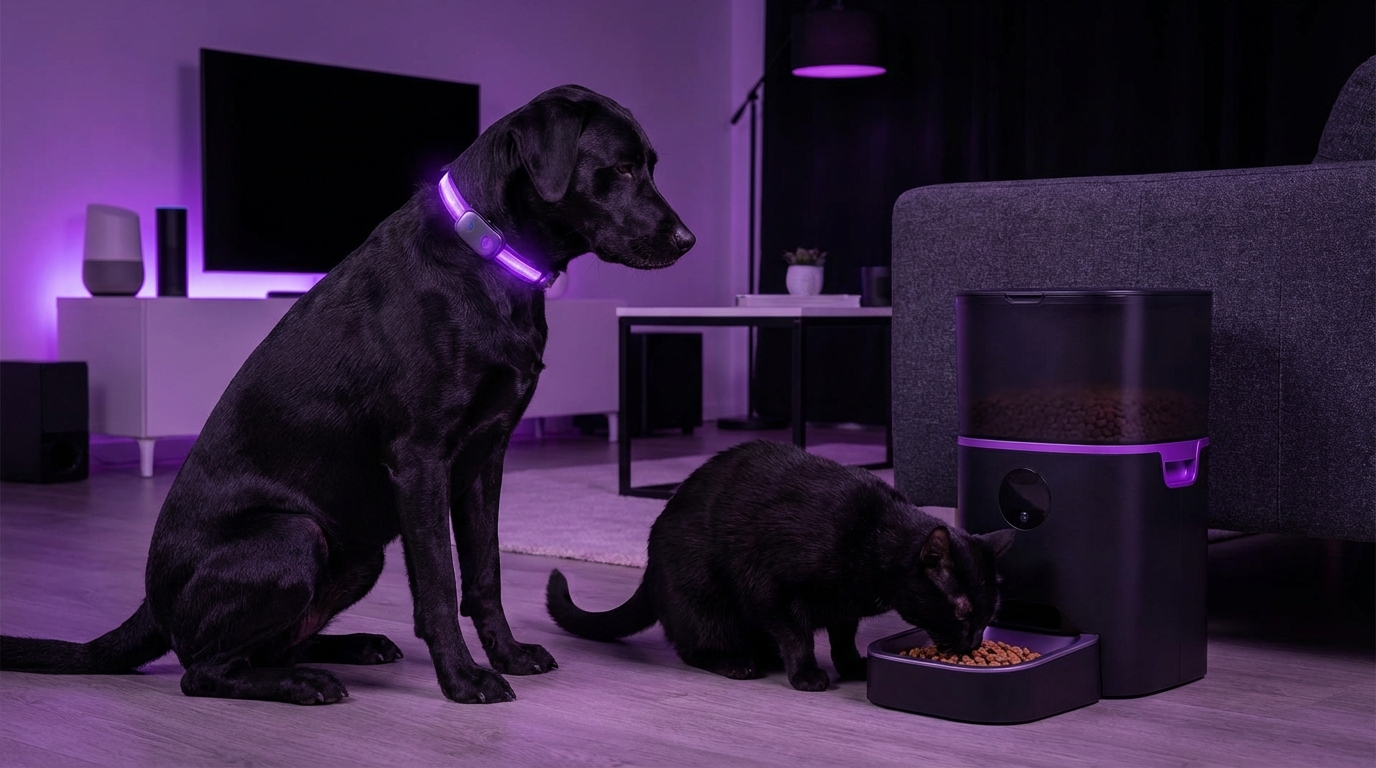
I used to think pet tech was just a fancy way to sell more gadgets to worried owners. Then I watched a friend’s cat disappear for 36 hours and saw her refresh a neighborhood Facebook group like it was her full-time job.
If you want the short version: GPS trackers help you know where your dog or cat is in close to real time, and automatic feeders help you control when and how much they eat. Both can make life easier and safer, but they are not magic. You still need training, routines, and a backup plan for power, Wi-Fi, and your own forgetfulness.
What “pet tech” really does (and what it does not)
When people say “pet tech,” they lump a lot of things together: smart collars, cameras, water fountains, automatic litter boxes, GPS trackers, feeders, and so on. It sounds impressive, but underneath, most of these products do just two things:
- Collect or send data (where your pet is, when they eat, if there is movement, etc.)
- Automate a repeatable task (feeding, tracking, alerting, opening, closing)
That is it.
The temptation is to believe that once you buy a smart collar and an automatic feeder, your pet is “handled.” You get notifications, charts, pretty graphs. It feels controlled. But technology for pets follows the same pattern as technology for people:
Pet tech reduces friction and risk, but it does not replace attention, routine, or judgment.
You still need to:
- Understand your pet’s habits and health needs
- Check that devices are working (battery, signal, Wi-Fi)
- Adjust settings as your pet ages or your situation changes
Let me walk through the two big categories in this topic: GPS trackers and automatic feeders. They solve different problems, and they fail in different ways.
Pet GPS trackers: how they actually work
Most pet GPS trackers combine two pieces of tech:
- GPS module to get your pet’s location from satellites
- Cellular or long-range radio to send that location to your phone
In practice, you have three main types:
| Type | How it connects | Best for | Trade-offs |
|---|---|---|---|
| Cellular GPS trackers | GPS + 4G/LTE network | Outdoor cats, dogs that can roam far | Monthly fee, battery drains faster |
| Bluetooth trackers (Tile, AirTag-style) | Bluetooth + nearby phones | Indoor cats, small dogs, apartment living | Short range, depends on other people nearby |
| Radio / LoRa trackers | Long-range radio signal to a base station | Rural areas, large properties | You maintain the base station, range is still finite |
So when you open the app and see your dog on a map, what has already happened behind the scenes is:
- The collar got a GPS fix from satellites.
- The tracker used its connection (cellular, Bluetooth, radio) to send coordinates to a server.
- The app pulled the latest coordinates and showed them to you.
There is delay and there is error. GPS can be off by several meters. Buildings block signals. Battery saving modes reduce how often the collar sends updates.
You are not getting a live drone view of your pet. You are getting a useful, but imperfect, approximation.
When a GPS tracker actually helps
The right way to think about a GPS tracker is: “Can this device cut down how long my pet is missing, or how far they can get before I notice?”
Some real use cases:
- Escape-prone dogs. Dogs that bolt through open doors, dig under fences, or slip out of harnesses. A tracker gives you a head start.
- Outdoor cats. You can see their usual routes and know when they are taking longer than normal.
- Dog walkers and pet sitters. You get some visibility into walks and can check that your dog is not taken somewhere unsafe.
- Travel and camping. If you are in an unfamiliar place, losing a pet is worse. The tracker gives you one more tool.
A pretty common pattern I see: owners stop worrying as much the first week, then the first time the app fails to update for 20 minutes, they realize they still need a collar with tags, microchipping, and training.
The tracker reduces panic, but only if you accept its limits.
Battery, comfort, and safety
GPS is power-hungry. You do not get “set it and forget it” for months.
You usually face a trade-off:
- Frequent updates (every 15 to 30 seconds) = better location + short battery life
- Less frequent updates (every few minutes) = longer battery life + less precise tracking
For cats and small dogs, collar weight matters. Some units are simply too heavy for a small neck. There is also the physical safety part: the collar should have a breakaway mechanism if it is meant to stay on all the time, so the pet does not get caught on something.
If the collar is uncomfortable or bulky, it will end up in a drawer. That defeats the whole purpose.
Check:
- Weight of the tracker vs your pet’s size
- Water resistance (for dogs that swim or roll in puddles)
- Charging method (clip, dock, USB) and how often you realistically will charge
If the manual says “charge every 2 days” and you barely remember to charge your own phone, that is a red flag.
GPS trackers vs Bluetooth tags vs microchips
People mix these up all the time, so let us separate them.
| Device / Method | What it is | When it helps | Key limits |
|---|---|---|---|
| GPS pet tracker (cellular) | Collar that tracks location via GPS + mobile network | Active search when your pet runs off | Needs battery and network, subscription cost |
| Bluetooth tracker (AirTag, Tile) | Small tag that pings nearby phones | Crowded areas, indoors, close range search | Range limited, relies on other users nearby |
| Microchip | Passive RFID chip under skin | Vets or shelters scanning a found pet | No GPS, no live tracking, needs someone to scan |
If budget allows, a layered approach is ideal:
- Microchip with up-to-date contact details
- Collar tag with your phone number visible
- GPS or Bluetooth tracker, evaluated on your pet’s risk level and habits
If you had to pick only one for a cat that goes outside a bit, I would start with microchipping and a physical tag. Then add GPS if escape is frequent or you are in a high-traffic area.
Costs and subscriptions
This is the part people often underestimate.
You have:
- Device cost (hardware, usually higher for cellular trackers)
- Monthly or yearly service fee (for cellular data and app services)
Over a 3-year span, the subscription often costs more than the device itself.
Be honest with yourself: will you still pay the subscription 18 months from now, or will this become a guilt-inducing icon on your phone?
If you hesitate on long-term subscription fees, you can:
- Pick a tracker with a “pause” option for months you do not need it.
- Use a Bluetooth tag for indoor tracking instead of full GPS.
- Combine traditional training and barriers (better fencing, harnesses) with tech.
I will say something a bit blunt here: if your dog keeps escaping the yard, a better fence and training give you more value than any tracker. The tech is a complement, not the fix.
Automatic pet feeders: convenience vs control
Automatic feeders feel like magic the first week: no more “Did I feed the cat already?” arguments. Dry food drops at 7 a.m., the dog spins with excitement, and everyone is happy.
Here is what they really do:
- Store a certain amount of dry food
- Release fixed portions at scheduled times (or on command)
- Sometimes track feeding history in an app
A few can handle semi-moist food or have cooling packs, but most are designed around dry kibble.
An automatic feeder is just a timed dispenser. The value comes from how you set it up and how reliable it is, not from the gadget itself.
Types of automatic feeders
There are a few common designs:
| Type | How it works | Good for | Weak spots |
|---|---|---|---|
| Gravity feeder | Food drops as bowl empties | Pets that self-regulate, short absences | No portion control, overeating risk |
| Rotating tray feeder | Covered tray with compartments that rotate on schedule | Wet food, multiple small meals | Limited total capacity, cleaning effort |
| Hopper-style automatic feeder | Food stored in a container, auger dispenses portions | Dry food, daily scheduling, remote control | Can jam, pets can sometimes shake food out |
| Microchip / RFID feeder | Feeder recognizes specific pet by chip or tag | Multi-pet homes, special diets | Higher price, some pets fear the moving lid |
The biggest upgrade from a basic bowl is portion control. Instead of one huge heap in the morning, you can split your pet’s daily amount into smaller meals.
Why schedule and portion matter more than the gadget
Weight gain in pets often sneaks up slowly. An extra handful of kibble here, a treat there, plus human food. After a year, your cat is heavier, and it feels like it happened “suddenly.”
An automatic feeder can help because it:
- Makes feeding consistent
- Removes your mood from the process (no “I feel bad, have extra food”)
- Gives you data: same portions, same times, every day
But that only works if the portion size you program is correct in the first place.
Automatic feeders do not know your pet’s ideal weight. They only know the number of seconds or “cups” you enter.
You still have to:
- Check food packaging and vet guidance for feeding quantity
- Measure what the feeder truly dispenses (many people find that “1 portion” is not what the manual says)
- Adjust over time, especially for older or less active pets
If you think of the feeder as a tool that sticks to whatever strategy you decide, it becomes much more useful.
Power, Wi-Fi, and reliability
Smart feeders that connect to apps add extra failure points:
- Power outage
- Wi-Fi disconnects
- App bugs or server issues
You want to know what happens when things fail. Some designs keep the schedule stored locally in the feeder, so even if Wi-Fi dies, food still drops. Others rely on the cloud for everything.
Ask or check for:
- Battery backup, not just USB or wall power
- Local schedule storage
- Jam detection or alerts (though this is still not perfect)
My view is simple here:
If you will be away and rely on the feeder as the only food source, you still need a human to check on your pet at least once a day.
Not because technology “cannot be trusted,” but because jammed food, sick pets, water spills, and accidents happen. A feeder solves timing, not oversight.
Automatic feeders in multi-pet homes
This is where things get interesting.
If you have:
- One cat that eats slowly and one that bolts food
- One dog on a special diet
- A pet that steals food from another’s bowl
Then an automatic feeder can help you separate access.
Microchip or RFID-based feeders open only for specific pets. The lid stays shut for others, so one pet cannot raid someone else’s portion. This is especially helpful for:
- Senior cats on kidney diets
- Pets that need medication mixed with food
- Households with both cats and dogs
There are caveats:
- Shy pets may be scared of the lid movement at first.
- Very determined pets sometimes learn to sneak in over a shoulder.
- Tall dogs can still knock things over if they lack training.
Tech helps enforce rules you already try to set, but it does not replace training. If your dog regularly bullies your cat away from food, you still need to work on that behavior, not just buy more devices.
How GPS trackers and feeders work together (and where they do not)
On the surface, GPS trackers and automatic feeders address totally different parts of pet care: location vs nutrition.
There is a subtle connection though: both are about consistency and visibility.
- Trackers give you visibility into where your pet tends to go.
- Feeders give you control and consistency over what and when your pet eats.
From a health and safety angle, this combination can be strong:
- You know your cat’s feeding times and can see if their movement patterns suddenly change.
- You can spot when your dog stops going to the yard or starts roaming farther after a diet change.
A sudden shift in either food habits or roaming distance can signal stress, illness, or boredom.
The real power is not the gadget, but the pattern you notice when something suddenly looks different.
Some apps try to tie these data points together into “wellness scores.” I am not a fan of leaning too hard on a single number. I prefer asking simpler questions:
- Is my pet eating roughly the same amount, at the same pace?
- Is my pet roaming a lot more or a lot less without a clear reason?
- Does my pet look and act healthy: coat, energy level, behavior?
If technology helps you notice these changes earlier, it is doing its job. If it distracts you with charts but you ignore real-world signs, that is a problem.
Common mistakes people make with pet tech
I see the same patterns repeat with both GPS trackers and feeders.
1. Treating devices as a replacement for supervision
Owners assume:
- “I have a tracker, so my dog can roam more freely.”
- “I have a feeder, so I can stay out longer without arranging help.”
There is a temptation to relax too much once you bought the tech.
Think of these devices as safety nets, not as reasons to raise the tightrope.
If you already struggle to walk the dog, play with your cat, or arrange checks when you travel, tech will not fix that. It only reshapes where the risk sits.
2. Not testing failure scenarios
Most people do not:
- Simulate a power outage with the feeder full.
- Let the tracker fully drain to see how long charging actually takes.
- Check app notifications on a different phone or after reinstalling.
It feels a bit paranoid in the moment, but this is the kind of small test that saves your weekend later.
Run simple checks:
- Unplug the feeder while you watch it. Does it keep time? Use backup batteries?
- Put the tracker on an item and walk around your neighborhood. How accurate is the live mode?
- Close the app and see what notifications you still get.
If the device only works perfectly when Wi-Fi is strong, battery full, and servers happy, then in real life it will fail more than you expect.
3. Ignoring the pet’s personality
Not every pet adapts quickly to gadgets.
Some examples:
- A noise-sensitive dog may panic at the sound of kibble dropping.
- A nervous cat may freeze when the feeder lid opens.
- Some pets hate wearing collars, let alone heavy tracker units.
You might need a slower introduction:
- Start with the feeder turned off, just use the bowl for regular meals.
- Place the collar on for short supervised periods before you attach the tracker.
- Offer treats near the device, pair sounds with positive experiences.
If your pet seems consistently stressed around the tech, that is not a good trade-off. Lower stress and simpler setups sometimes beat fancy gear.
How to choose: practical questions to ask yourself
Rather than listing brands, it is more useful to ask the right questions before you buy anything.
Questions for GPS trackers
- How likely is my pet to escape or roam far?
- Indoor-only, low risk: maybe a Bluetooth tag or nothing.
- Outdoor, near roads or woods: a GPS tracker can be worth the cost.
- Do I have good cellular coverage where I live and walk?
- No coverage = fancy hardware that goes blind.
- Realistically, how often will I charge another device?
- If the answer is “rarely,” choose long battery models with slower updates.
- Am I okay with a subscription for several years?
- Add up 2 to 3 years of fees and see how that feels.
If most answers lean toward “I will not keep up with this,” then you might be better served by better tags, microchipping, and training before you add a tracker.
Questions for automatic feeders
- Is my main problem timing, portion control, or travel?
- Timing: basic schedule feeder is fine.
- Portion control: look for precise dosing and measurement.
- Travel: you need battery backup and a human backup plan.
- What kind of food do I use?
- Dry kibble opens up more options.
- Wet food needs trays, ice packs, or very short absence windows.
- Do I have multiple pets with different diets?
- If yes, microchip or RFID feeders might be worth the extra money.
- Am I able to clean and maintain another appliance regularly?
- If you already ignore your coffee machine, a complex feeder might not fare better.
I know this sounds a bit critical. That is on purpose. Pet tech is at its best when it fits your real habits, not your idealized version of yourself.
Balancing tech with simple habits
You can absolutely use both GPS trackers and automatic feeders and still keep a grounded, simple routine.
A balanced setup might look like this:
- Dog with GPS collar that you charge every Sunday and Wednesday, kept near your keys so you remember.
- Automatic feeder for your cat, with two meals a day set up, plus a small manual evening snack that keeps you engaged.
- Basic analog backup: hand-written feeding instructions for a neighbor, harness hung near the door, microchips registered and checked once a year.
The goal is not to have the “smartest” home. The goal is a pet that is healthy, safe, and relaxed, with a routine you can sustain.
Sometimes this means buying fewer devices and using them more thoughtfully. Sometimes it means accepting that you would rather invest in training classes or a stronger fence than another subscription.
Tech can help, but it works best when it supports habits you already care about, not when it tries to stand in for them.