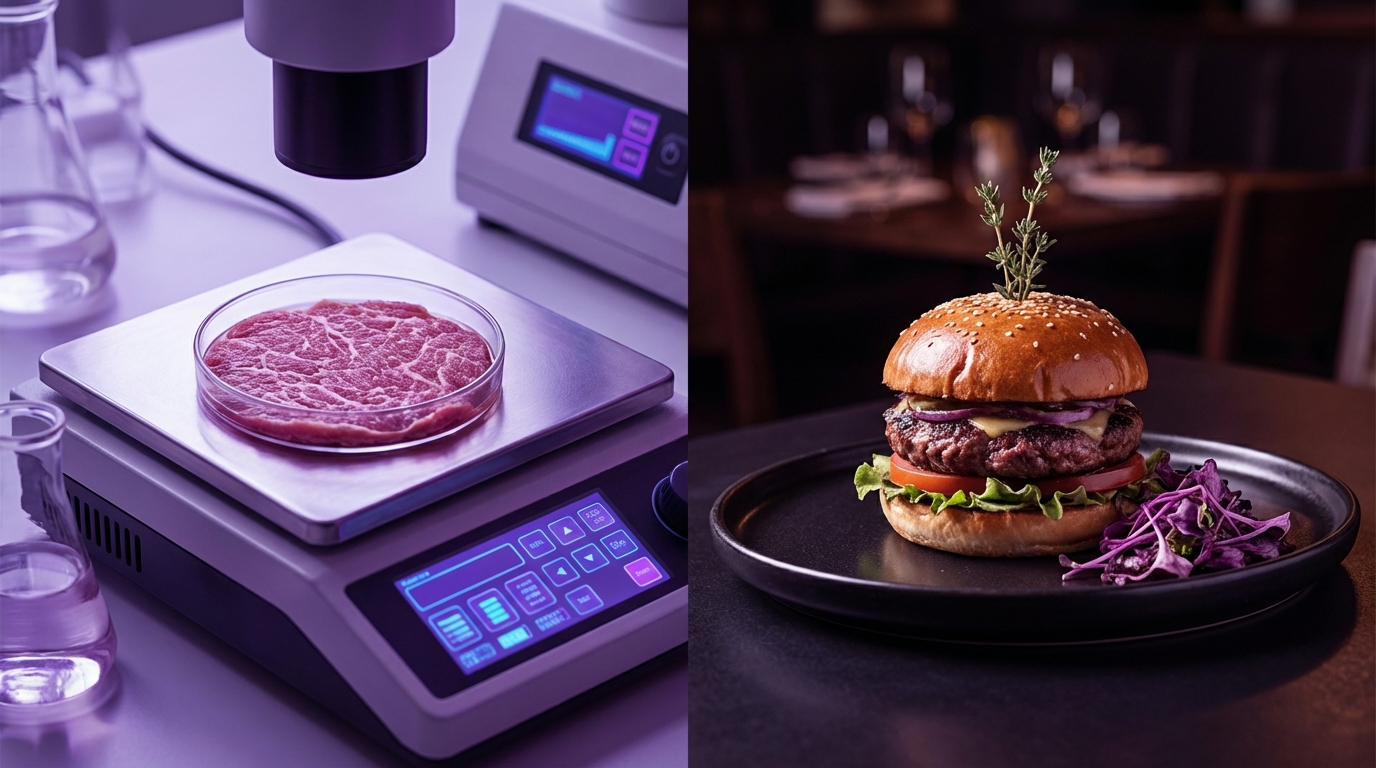
I used to think lab-grown meat was a marketing trick. Something that looked great in investor decks, but would never actually make it to a normal dinner plate.
Then I tasted it. And it was good. Not perfect. Not cheap. But good enough that I stopped joking about it and started paying closer attention to the science behind it.
The short version: Lab-grown meat (often called cultured or cultivated meat) is real meat grown from animal cells in bioreactors instead of on an animal. The science is solid: start with a tiny sample of cells, feed them nutrients, grow them in controlled tanks, then harvest the tissue. Taste varies by product and process, but when it is done well, it tastes very close to conventional meat, because at the cellular level it actually is meat. The big challenges now are cost, texture for larger cuts, and scaling production, not basic feasibility.
Lab-grown meat is not fake meat. It is real animal tissue grown in a different environment with the help of biotechnology.
The core science behind lab-grown meat
Let us walk through how this works step by step, without getting lost in jargon.
Step 1: Where do the cells come from?
Every lab-grown meat product starts with real animal cells. No cells, no meat.
Producers usually start with one of three types of cells:
- Muscle stem cells (satellite cells): These live inside muscle and repair it when you exercise or get injured. They naturally want to grow into muscle fibers, which is exactly what you want for meat.
- Mesenchymal stem cells: These are more general and can turn into muscle, fat, or connective tissue. Useful if you want that nice mix of lean and fat.
- Induced pluripotent stem cells (iPSCs): These are reprogrammed cells that can, in theory, become almost any cell type. They are flexible but harder to manage.
A small biopsy is usually enough. A vet takes a tiny piece of muscle from a live animal under anesthesia. No slaughter. That sample might be a few millimeters wide, but inside it are millions of cells with the capacity to grow.
From that small biopsy, scientists isolate the cells that can divide many times. Then they create what is called a “cell line” that keeps growing as long as you feed it and keep it healthy.
One biopsy can provide starting material for a massive amount of meat, at least in theory. The bottleneck is not the number of cells but the process around them.
Step 2: What do the cells eat?
Cells do not grow out of thin air. They need:
- Water
- Amino acids (from proteins)
- Glucose or other energy sources
- Vitamins
- Minerals (like sodium, potassium, calcium, magnesium)
- Growth factors (signal molecules that tell cells to divide or mature)
This mix is called “cell culture medium.” Early on, many labs used something called fetal bovine serum (FBS), which comes from cow fetuses. It works well for cell growth, but it is expensive, variable, and definitely not cruelty free.
Companies in cultured meat are moving away from FBS toward fully defined, animal-free media based on:
- Plant-derived proteins and amino acids
- Recombinant growth factors (made by microbes in big tanks, not harvested from animals)
- Vitamins and minerals from standard chemical suppliers
Growth factors are a major cost driver. They work in tiny concentrations, but they are complex molecules. So a lot of innovation is in:
- Finding ways to make cells less dependent on expensive growth factors
- Engineering cells to produce some of their own signals
- Recycling media instead of throwing it away after one use
If you care about cost or environmental impact, this “feed” is where a big chunk of the battle happens.
Step 3: The bioreactors (the “lab”)
Once you have cells and food, you need a controlled place for them to grow.
This is where bioreactors come in. A bioreactor is basically a sterile steel tank with:
- Temperature control
- pH control
- Oxygen supply
- Agitation (mixing) to keep things even
If you have seen pictures of craft beer fermenters, you already have the right mental model. These tanks just carry animal cells instead of yeast.
There are a few main designs for cultured meat:
| Bioreactor type | What it is good for | Limitations |
|---|---|---|
| Stirred-tank | Growing lots of cells in suspension for minced meat products | Shear stress can hurt delicate cells |
| Fixed-bed / packed-bed | Growing cells on surfaces or beads, better for some lines | Harder to scale and monitor evenly |
| Perfusion systems | Continuous removal of waste and supply of fresh media | More complex hardware and control |
| Scaffold-based systems | Structured tissue and better texture | More steps, more complexity, usually higher cost |
The idea is to grow cells in two general phases:
- Proliferation phase: Cells divide rapidly and increase in number.
- Differentiation phase: Conditions change, growth slows, and cells mature into muscle fibers, fat cells, etc.
Getting this right is both biology and process engineering. You can think of it a bit like managing a sourdough starter and then shaping bread, just with more sensors and more stainless steel.
Step 4: Structure, scaffolds, and texture
Ground beef is easy compared to a steak. A burger just needs small pieces of muscle and fat. A steak needs:
- Long aligned muscle fibers
- Fat distributed in a specific pattern (marbling)
- Connective tissue that gives resistance when you chew
Cells in a liquid tank do not naturally arrange themselves into a steak. Left alone, they form clumps, not organized tissue.
This is where “scaffolds” come in. A scaffold is a 3D structure that cells can attach to and grow on, a bit like a trellis for a plant:
- Scaffolds can be edible (like plant fibers, alginate, or gelatin) so they end up in the final meat.
- They can be aligned to encourage muscle fibers to grow in one direction.
- They can have channels for nutrients and oxygen.
There are a few strategies:
- Decellularized plant structures: For example, spinach leaves with the plant cells removed, leaving only the vascular network. Animal cells grow on that structure.
- 3D printing: Print scaffolds that mimic the pattern of muscle and fat. In some cases, print the cells and scaffolds together.
- Extrusion: Use methods similar to plant-based meat, but add cultured cells to create fibers.
The more structured the product (think steak, chicken breast, fish fillet), the more complex the scaffolding and growth process becomes.
For now, many companies focus on:
- Nuggets
- Meatballs
- Ground meat blends
These products still benefit from scaffolds, but they do not require perfect marbling or long continuous fibers.
Does lab-grown meat really taste like meat?
This is the part people care about the most. And it is where marketing often gets ahead of reality.
The honest answer: The best products taste very close to conventional meat in simple dishes, especially when used in mixed or processed formats. Pure, thick cuts are harder.
What creates meat flavor?
Flavor and texture come from a few key factors:
- Muscle proteins: Myosin, actin, and other proteins that change during cooking.
- Fat composition: The types of fatty acids affect flavor release and mouthfeel.
- Connective tissue (collagen): This breaks down into gelatin when cooked slowly.
- Maillard reaction: The chemical reactions between amino acids and sugars when meat is seared.
Cultured meat has the same basic muscle proteins if the cells are real muscle cells. That part is straightforward.
The trickier parts are:
- Getting the right type and amount of fat.
- Triggering the same flavor development during cooking, which depends on how the tissue is structured and how much it has matured.
What people report when they taste it
If you read independent tasting reports from early trials and approved products, the pattern is fairly consistent.
For ground or mixed products:
- Taste is very similar to chicken or beef in common dishes.
- Texture can be slightly softer or more uniform.
- Flavor can feel “cleaner,” since there is less variation compared to farm-raised animals.
For more structured cuts:
- Visual appearance is still not perfect. Fibers and marbling look a bit artificial at times.
- Chew can lack the full “bite” of a mature animal muscle, especially in early prototypes.
- Juiciness is decent, but depends heavily on how fat cells are incorporated.
When the science and cooking are both done well, most people who try cultured meat in blind tests either cannot tell the difference or describe it as “slightly different, but still meat.”
The interesting thing is that some people like that “slightly different.” The cleaner taste and low variability can feel more controlled. But it can also feel less “wild” for people who enjoy that.
Why taste can vary a lot between companies
Not all lab-grown meat is built the same way. Differences include:
- Cell type: Some use more fat cells, others mostly muscle.
- Media composition: Nutrient mix can affect fat profile and minor flavor compounds.
- Maturation time: Longer maturation can improve flavor but raises cost.
- Scaffold materials: These can affect texture, especially if they stay in the final product.
You can think of it a bit like wine. Same grape species, but soil, climate, and process change the flavor. For cultured meat, the “soil and climate” live in the media and bioreactor protocol.
How safe is lab-grown meat?
If you are going to eat something grown in a tank, you probably want to know how safe it is.
The safety profile of cultured meat has a few key points.
Microbial contamination
Traditional meat can carry bacteria like Salmonella, E. coli, or Campylobacter from the animal’s gut or processing environment.
Cultured meat is grown in sterile conditions. The cells themselves do not carry those pathogens. That does not mean risk is zero, but the risk profile is very different.
Controls usually include:
- HEPA-filtered air and clean rooms
- Sterile media and equipment
- Monitoring for microbial contamination in real time
If contamination is detected in a tank, the batch is discarded. That sounds wasteful, but it is better than sending it to market.
Genetic changes and cancer concerns
People sometimes worry: “If these cells keep dividing, could they be cancer-like? And if I eat them, does that affect me?”
Here is the short answer:
- Some companies use genetic modification to make cells grow better. Others do not.
- Any genetic changes are in the cells themselves. Your digestive system still breaks those cells down into amino acids and fats. It does not copy their DNA into your cells.
- Eating cells with some cancer-like properties is not a new thing. Meat from animals also contains cells that have experienced many divisions, and your body still digests them as food.
Regulators look at cell lines, media, and final products to check for:
- Unexpected toxins
- Allergens
- Residual chemicals from processing
The cancer question sounds scary, but from a biological standpoint, digested meat cells do not transfer their growth behavior into your body.
Regulatory approvals so far
A few regulators have already reviewed and approved cultured meat products for limited sale.
To date, approvals have usually come with:
- Detailed review of production methods.
- Limits on batch sizes and distribution at first.
- Ongoing monitoring requirements.
This does not mean everything on the market is perfect, but it does mean regulators are treating cultured meat more like a food plus a biotech product, not just a novelty.
Environmental impact: better, but how much better?
There are strong claims around environmental benefits: lower emissions, less land use, less water use. Some of these are realistic, others are still hypothetical.
What we know from life cycle studies
Life cycle assessments (LCAs) try to look at the full chain:
- Media production
- Electricity for bioreactors
- Facility construction
- Packaging and transport
Most early studies show:
- Lower land use than beef, sometimes by a large margin.
- Lower direct methane emissions because there are fewer cows emitting gas.
- Energy use that can be quite high, depending on how efficient the bioreactors and media production are.
If the electricity mix is clean (more renewables, less coal), cultured meat can have a strong greenhouse gas advantage. If production runs mostly on fossil fuels, the benefit shrinks.
Water use is usually lower than beef, but often in the same order of magnitude as some plant proteins. It is not zero, because media production and facility cleaning require water.
The honest caveat: scaling changes the math
Pilot plants and small batches are almost never energy-efficient. Large facilities can improve:
- Heat integration
- Media recycling
- Automation
The biggest environmental gains probably show up when facilities reach industrial scale and run on cleaner energy. Until then, the numbers remain sensitive to many assumptions.
If someone claims cultured meat will solve climate on its own, that is unrealistic. It can be a helpful part of a broader shift that also includes:
- Less food waste
- More plant-based food
- Better farming practices
Cost and production challenges
This is where most of the hard work is happening now. The biology works. The question is: Can it work at a cost and scale that makes sense?
Where the costs sit
Cost drivers fall into a few buckets:
- Media: Nutrients and growth factors can be very expensive.
- Bioreactors: Large, sterile stainless steel tanks are not cheap.
- Facility: Clean rooms, air handling, and quality control labs add overhead.
- Labor and quality systems: Skilled staff and compliance with food and biotech regulations.
Here is a simple way to think about it:
| Element | Typical impact on cost | Path to reduction |
|---|---|---|
| Media ingredients | Largest ongoing cost | Better formulations, cheaper growth factors, recycling |
| Bioreactor hardware | High initial capital | Scaling, standardization, borrowing designs from pharma/yeast industries |
| Energy | Significant but variable | Process efficiency, cheaper clean power |
| Quality / compliance | Non-trivial ongoing cost | Automation, more mature regulatory pathways |
Early cultured meat was famously expensive. That is normal for any new biotech process. Prices have dropped with better cell lines, better media, and better scaling, but they still are not comparable to conventional chicken.
Why you mostly see hybrid products
One pattern you might have noticed: When cultured meat shows up commercially, it is often blended with plant proteins.
There are good reasons for that:
- Plant-based bulk is cheaper and provides texture.
- Cultured fat or muscle can add aroma and flavor that plant products struggle to match.
- Hybrids let companies reach price points that are less shocking.
If you think this is “cheating,” I understand the reaction. But from a product strategy perspective, it makes sense. It is similar to how some early electric cars were plug-in hybrids before going fully electric.
Scaling vs quality
As companies push toward bigger bioreactors, they run into tradeoffs:
- Large tanks can be more cost-effective per unit of meat.
- But they are harder to keep uniform in terms of oxygen, nutrients, and shear stress.
That can affect:
- Cell health
- Batch consistency
- Texture in structured products
Big is cheaper per kilogram, but small is easier to control. Bridging that gap is where a lot of process engineering effort goes today.
In other words, there is no free lunch. Better prices often press against quality and repeatability, at least until processes mature.
How lab-grown meat compares to plant-based and conventional meat
To really understand where cultured meat fits, you need to compare it on a few axes.
Side-by-side comparison
| Aspect | Conventional meat | Lab-grown meat | Plant-based meat |
|---|---|---|---|
| Source | Animals raised and slaughtered | Animal cells grown in bioreactors | Plants (soy, pea, wheat, etc.) |
| Texture potential | Full range: minced to whole cuts | Good for minced; working toward full cuts | Good for minced-like; harder for realistic steaks |
| Flavor realism | Baseline reference | Very high potential, but not consistent yet | Improving, but still different for many people |
| Animal welfare | High animal use | Low animal use (small biopsies, some egg or serum inputs depending on process) | No animal raising or slaughter |
| Environmental footprint | High for beef, lower for chicken / pork | Moderate now, could be lower as tech matures | Generally lowest |
| Price (today) | Lowest at scale | Highest | Mid to slightly higher than some meats |
Each option has tradeoffs. So if you are expecting cultured meat to replace everything fast, that is not realistic.
Where cultured meat makes the most sense first
A few niches look especially well suited early on:
- High-margin restaurants: Chefs who want to offer something new and can justify a higher menu price.
- Regions that import most of their meat: Places with limited farmland but strong biotech infrastructure.
- Specialty products: Foie gras, certain types of seafood, or meats with high ethical concerns.
As costs come down, mass-market burgers, nuggets, and mixed dishes are the logical next step.
Common misconceptions about lab-grown meat
I want to address a few beliefs that keep coming up, because they tend to distort the discussion.
“Lab-grown meat is artificial and full of chemicals”
Meat is a complex chemical mixture either way. So is bread. So is an apple. The question is not “does it contain chemicals” but “which ones, at what levels, and how were they produced.”
Cultured meat uses:
- Animal cells
- Nutrients that exist in normal food (amino acids, sugars, vitamins, minerals)
- Growth factors that your body also produces internally
You can argue about how natural the process feels, but from a composition standpoint, it is not inherently more synthetic than many processed foods already in supermarkets.
“It will instantly replace factory farming”
No. That is not how food systems change.
Even if the tech worked perfectly tomorrow, you still have:
- Supply chains to build
- Consumers to convince
- Regulations to harmonize between countries
- Costs to bring down to realistic levels
Meat consumption globally is massive. Cultured meat, at least for a long time, will be part of a mixed approach with conventional and plant-based options.
If you are looking for a single silver bullet, you will be disappointed. If you are open to a series of smaller, compounding improvements, cultured meat can play a real role.
“If it is grown in a lab, it is always unsafe”
Labs are where we also:
- Develop vaccines
- Produce many food enzymes
- Make vitamins and supplements
The “lab” label sounds scary, but much of your existing food spends time in stainless steel tanks under controlled conditions already.
The question is less “lab vs farm” and more “how well is the process controlled and regulated.”
What this means for you as a consumer or creator
Let me end with something a bit practical.
If you are a consumer
If you get the chance to try lab-grown meat, a few small suggestions:
- Know what format you are trying: Nugget, burger, steak, or hybrid. Expectations should match the format.
- Pay attention to context: Is it fried, sauced, deep in a complex dish, or served simple with salt and pepper?
- Notice your own bias: If you expect it to taste bad or strange, that will color your experience. Same if you want it to be perfect.
You do not have to like it. But if you can put your “tech hype” filter on low and your “curious taster” filter on high, you will get a clearer view.
If you work in food or tech content
If you write or build products in this space, I would be careful about two traps:
- Over-selling: Claiming cultured meat is already cheap, widely available, and flawless.
- Over-fearing: Painting it as a Frankenstein project that will poison everyone.
Reality sits between those extremes:
The science behind lab-grown meat is credible and improving. Taste can be very good in some formats. The main hurdles now are cost, texture for complex cuts, and scaling in a way that keeps both quality and environmental gains.
If you keep that frame in mind, your content and your own decisions around this tech will likely age better than most hype cycles.