I used to think flying cars would just show up one morning and change everything overnight. Then I started talking with people actually building eVTOLs, and realized this is less like an iPhone launch and more like building a new kind of city from scratch in the sky.
Here is the short answer: you will start to see limited flying taxi services with eVTOLs in a few cities between 2026 and 2030, mostly as short, premium airport transfers or point‑to‑point shuttles. Widespread, everyday, Uber-level access in many cities is more of a 2035+ story, and that is assuming regulators, safety records, charging infrastructure, and public acceptance all go reasonably well.
What exactly are eVTOLs and why do people care?
Let us clear up what we are even talking about before we jump into timelines.
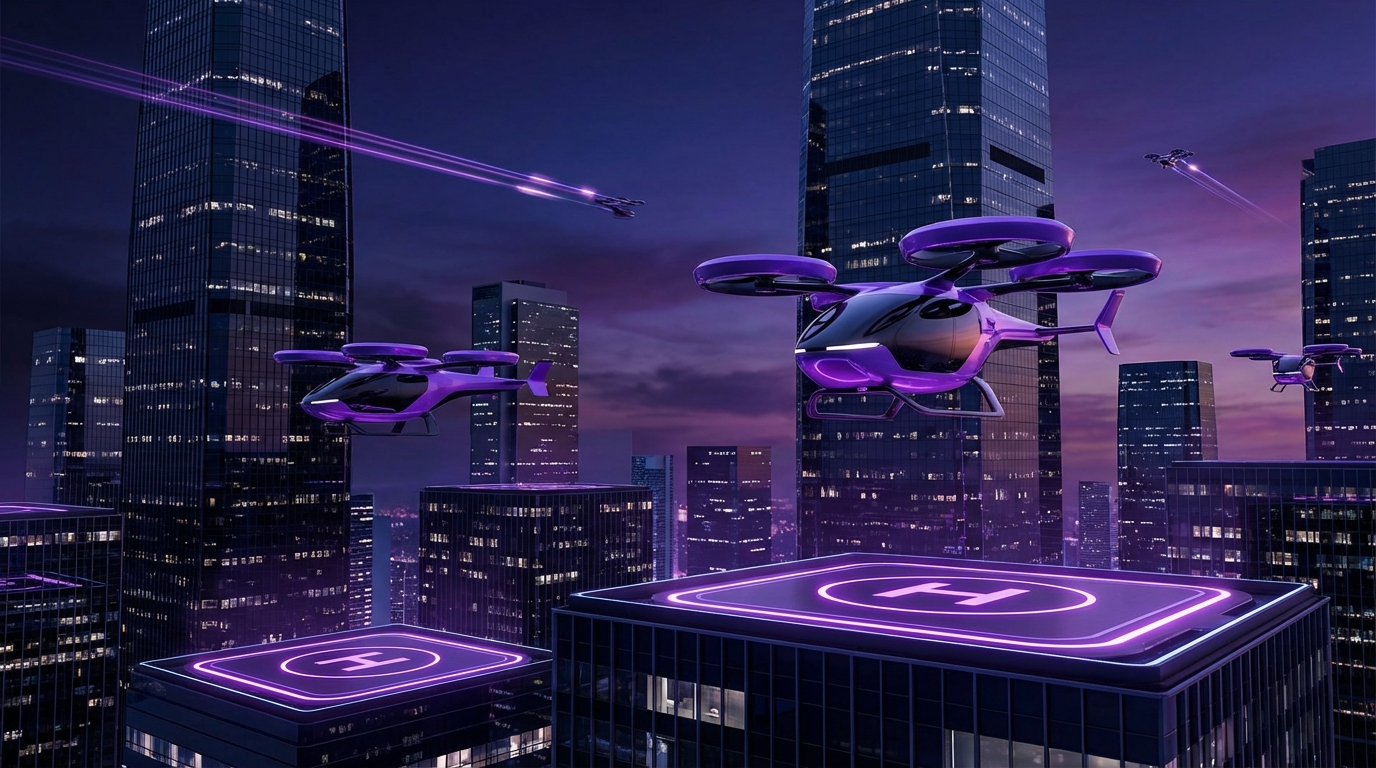
eVTOL stands for “electric vertical takeoff and landing” aircraft. Think of something that looks like a cross between a helicopter and a big drone, powered by batteries or hybrid systems, with multiple small rotors instead of one big blade.
They are built to:
- Take off and land vertically like a helicopter
- Fly like a small airplane once in the air
- Run on electricity (fully or mostly) rather than jet fuel
So when people say “flying taxis,” most of the time they mean eVTOLs running short hops across a city or metro area, booked via an app, with scheduled or on‑demand routes.
The real product is not the aircraft. It is a new transportation network that happens to be three‑dimensional.
That network touches:
- Aircraft design and certification
- Battery tech and charging
- Air traffic management
- Ground infrastructure (so‑called “vertiports”)
- Regulation, insurance, and public trust
Every one of those needs to work for flying taxis to feel normal, not like a stunt.
How far along are eVTOL companies right now?
Let us break this into three simple buckets: technology, certification, and business models.
1. Technology readiness
On the tech side, we are much closer than many people think, and also not as close as some press releases suggest. A bit contradictory, but that is how frontier tech works.
Here is a basic snapshot of some well‑known players:
| Company | Country | Aircraft | Status (tech side) |
|---|---|---|---|
| Joby Aviation | USA | Joby S4 (4-passenger eVTOL) | Full‑scale prototypes flying, multiple test campaigns, pre‑production units under build |
| Archer Aviation | USA | Midnight | Full‑scale prototype testing, transition flights completed |
| Lilium | Germany | Lilium Jet | Prototype flights, transitioning to type‑certifiable design |
| Vertical Aerospace | UK | VX4 | Prototype testing, flight envelope expansion |
| EHang | China | EH216 (2‑seat, pilotless) | Received limited type certification in China for certain uses |
So planes are flying. That part is not science fiction any more.
The limiting factor is less “Can we keep this thing in the air for 20-30 minutes?” and more:
- Can we do it safely thousands of times per year?
- Can batteries support daily operations at a reasonable cost?
- Can maintenance keep up without crazy downtime?
Battery energy density is still a hard limit. Most first‑generation eVTOLs will be:
- Range: about 20-40 miles with reasonable reserves
- Speed: roughly 100-180 mph
- Turnaround: charging within 10-40 minutes depending on design and use case
The first real flying taxis will not be “go anywhere in the city from anywhere in the city.” They will be short, fixed routes where distance and charging can be tightly controlled.
2. Certification and regulation
This is where timeline questions get real.
Two main regulators set the tone:
- FAA in the United States
- EASA in the European Union
They have been creating special paths for eVTOLs, but they still treat these as aircraft that carry people, not as gadgets.
Some rough points:
- Type certification: proving the aircraft design is safe
- Production certification: proving you can build that design consistently
- Operating certification: proving you can run a commercial air service
Companies like Joby and Archer are fairly deep into FAA certification programs. Their public statements usually target first commercial operations around 2025-2026 in very limited settings, often in partnership with airlines or mobility platforms.
Should you trust those dates? Partially.
Regulatory projects tend to slip by 2-5 years, especially for a new category. We saw this with drones, we saw it with commercial spaceflight, and we have seen it with new aircraft types for decades.
If you hear “flying taxis for everyone in 2026,” dial that back. Think “early services in a few places, for a few routes, if all goes fairly well.”
3. Business models and partnerships
Right now most eVTOL stories look like this:
- Aircraft startup builds the vehicle
- Big airline or mobility platform signs MOUs or purchase agreements
- City or airport authority offers to host test routes
Some examples:
- Joby with Delta for airport transfers
- Archer with United Airlines
- Lilium with regional operators in Europe
These deals help with credibility, but they do not guarantee real, scaled operations. They do show one thing though: first use cases will likely be:
- Airport to city center
- Rich suburb to airport
- Business district to business district
That positioning matters for “when will we have flying taxis” because it shapes who sees them first and how fast they spread.
Realistic timeline: when will you actually ride one?
Instead of a single date, it helps to think in phases. Because your answer changes a lot based on where you live and what “have flying taxis” means to you.
Phase 1: Pilot services and demos (2024-2030)
We are already seeing early pieces of this phase:
- Test flights at small airports
- Demonstration rides for officials and media
- Regulators flying as passengers to assess safety
Between 2026 and 2030, you can expect:
- Commercial routes in a handful of global cities
- Highly controlled corridors with strict airspace rules
- Tickets priced closer to helicopter rates than rideshare
Think:
- New York area: Newark or JFK to Manhattan heliport style routes
- Los Angeles: airport to certain high‑income zones
- Dubai, Singapore, maybe a Chinese mega‑city: central hubs to airports
These will probably:
- Have professional pilots on board
- Fly only in good weather conditions at first
- Operate during limited hours
Phase 1 is not about mass access. It is about proving safety, building noise data, and ironing out operations so regulators and insurers feel comfortable with the next step.
If you live in a major aviation or tech hub and have some budget, you might ride one around the late 2020s. If you live in a smaller city, you will probably only see them in the news.
Phase 2: Early networks and niche commuting (2030-2035)
If early services have strong safety records and no major accidents, regulators will slowly relax rules, and cities will start to allow more vertiports.
During this phase, expectations that are reasonable:
- Several cities per region with at least a small eVTOL network
- Route expansions beyond only airport transfers to business districts and perhaps a few high‑density residential hubs
- Ticket prices dropping, but still mainly for business travelers and high‑income commuters
You may also see:
- Hybrid models: scheduled shuttles plus some on‑demand routing
- More automation in flight, but still with a pilot (or at least a safety pilot)
- Better batteries, pushing effective ranges closer to 50-80 miles on some designs
Noise will be a huge factor here. eVTOLs are quieter than helicopters in many phases of flight, but they are not silent. People notice persistent high‑frequency noise much more when it is overhead and frequent.
Cities that have strong community pushback could slow or block network expansion. So, ironically, a lot of this phase is politics.
By 2035, in tech‑forward large cities, flying taxis can feel normal for a certain group of people, while still feeling distant for most others.
Phase 3: Broader availability and partial automation (2035-2040+)
Talking beyond 2035 always includes a fair bit of guesswork, but let us stay grounded.
For eVTOL taxis to feel as normal as rideshare cars, several things need to mature:
- Fully certified autonomous or highly automated flight for at least some routes
- Integrated digital air traffic systems that can safely manage thousands of eVTOL flights per day above a city
- Standardized, widely deployed vertiports at malls, office parks, and transit hubs
- Battery cycles that can handle high usage without constant replacements
There is a decent path to see:
- Mid to late 2030s: frequent, semi‑affordable flying taxis in top global cities
- 2040s: more routine regional air mobility with eVTOLs or successors, between nearby cities
But for low‑income riders, suburbs far from major airports, or smaller towns, flying taxis might remain rare for quite a long time. This will not roll out evenly.
The big roadblocks to flying taxis
Timelines rarely slip because of one big issue. They slip because of a stack of medium‑sized issues.
1. Safety and public trust
Air travel is very safe. Helicopters, on the other hand, are safe most of the time, but accidents draw a lot of attention. Now imagine several hundred small aircraft buzzing regularly above a dense city.
Regulators worry about:
- Loss of power over a city center
- Software failures in flight control
- Battery fires on board or during charging
- Mid‑air conflicts with drones, helicopters, or other eVTOLs
Manufacturers respond with:
- Redundant motors and batteries
- Glide or autorotation capabilities in some configurations
- Extensive test and simulation data
The first serious eVTOL accident in a commercial setting will shape timelines more than any marketing plan ever could.
If the first decade of operations stays largely incident‑free, adoption can move relatively fast. If there are a few high‑profile failures, expect long pauses, re‑certification, and public pushback.
2. Battery performance and lifecycle
Battery tech is improving every year, but not at the fantasy levels some people like to project.
Key constraints:
- Energy density: how much energy you can pack per kilogram
- Charge cycles: how many times you can fast‑charge before degradation
- Thermal management: keeping packs safe under heavy use
Airlines make money when planes fly a lot. If an eVTOL needs long charging time or frequent battery replacements, the economics can fall apart quickly.
Some aircraft will use swappable battery packs. Others will lean on fast charging with heavy cooling systems. Both choices add operational complexity.
And of course, the grid has to support dozens or hundreds of high‑power chargers at vertiports. That means:
- Upgrading local electrical infrastructure
- Managing peak power use
- Working with utilities, which takes time and permits
3. Air traffic management
Flying one eVTOL between two points is easy. Flying thousands over a complex city while sharing airspace with:
- Commercial jets on approach and departure
- Helicopters
- Medical flights
- Drones for delivery and inspection
is hard.
New systems are being proposed, often under terms like “U-space” in Europe or advanced air mobility corridors in the US. They rely on:
- Continuous digital tracking of every vehicle
- Automated deconfliction and rerouting
- Standard communication protocols
These are not just technical problems. They are governance problems. Multiple agencies need to agree on standards, software, and enforcement.
Until this is solved at a city or region scale, most flying taxi services will remain quite restricted.
4. Vertiports and local politics
Aircraft can be certified and ready, and still have nowhere to land.
Vertiports require:
- Land or rooftop rights
- Zoning approvals
- Noise studies
- Fire codes for battery systems
- Integration with ground transport
A city that wants to move fast might pre‑zone several sites, integrate them into transport planning, and support early pilots. A city that is more cautious might run multi‑year consultation processes and limit operating hours.
Your local city council and neighborhood groups might delay flying taxis more than any missing piece of technology.
This is where some of the hype goes wrong. It is easy to build a demo vertiport on a private site. It is hard to get dozens of approved, practical vertiports where people actually want to start and end trips.
5. Economics: who pays and who rides?
For operators, the basic equation looks like:
| Levers | What they affect |
|---|---|
| Aircraft cost and lifespan | Amortized cost per flight hour |
| Battery replacement cycles | Ongoing maintenance and parts cost |
| Pilot salaries | Operating cost per flight, especially early on |
| Vertiport fees and grid costs | Ground operations cost |
| Load factor (seats filled) | Revenue per flight |
If pilots stay mandatory in each aircraft for 10-20 years, costs stay high. If autonomy can safely remove or centralize pilots, costs drop, but regulatory complexity goes up sharply.
In the early years, do not expect flying taxis to be cheap. They will likely compete more with premium ride services or private car plus parking costs than with buses or regular metro tickets.
Scenarios: optimistic, realistic, and skeptical
It helps to frame three broad scenarios. None of them will match reality perfectly, but they show the range.
Optimistic scenario
- Regulators move faster than expected without major delays
- Battery improvements keep pace with roadmaps
- No serious accidents in early commercial operations
- Public enthusiasm outweighs local noise complaints
In that world:
- 2026-2027: first paying passengers on short routes in several big cities
- 2030: visible networks in a dozen or more metropolitan areas
- 2035: some routes priced similar to premium rideshare
You might book an eVTOL ride from the airport to a central transit hub in a major city as casually as you book a car today.
Realistic middle scenario
This is where I think we land.
- Certification timelines slip by a few years for many players
- One or two early accidents trigger temporary slowdowns but not a full stop
- Cities are selective: some push hard, some resist strongly
- Batteries improve, but costs per seat mile remain higher than ground rideshare through the 2030s
Timeline in that world:
- Late 2020s: very limited commercial flying taxi operations in a small number of cities
- Early to mid 2030s: moderate adoption in hubs that lean in (Dubai, Singapore, maybe parts of the US, Europe, East Asia)
- Beyond 2035: eVTOL taxis are common enough in those hubs that travelers know them, but they are not an everyday habit for most residents
In the realistic scenario, flying taxis feel more like a premium niche service for at least 10-15 years, not like a mass commuting method.
Skeptical scenario
Here is where things go wrong:
- Multiple high‑profile accidents seriously reduce public trust
- Regulatory bodies respond with much stricter rules and long reviews
- Economic returns are weaker than investors hoped, leading to consolidation and bankruptcies
- Noise, visual clutter, and safety concerns lead cities to restrict vertiports and flight corridors
In that world:
- You still get eVTOLs, but more as specialized aircraft for cargo, medical transport, or remote area service
- Flying taxis exist, but remain rare and heavily restricted
I do not think this scenario kills the entire concept, but it could delay mainstream flying taxis by a decade or more in many places.
What about fully autonomous flying taxis?
This is where hype really gets ahead of reality.
The idea of a pilotless eVTOL that you just hop into after tapping an app is appealing. But there are layers of complexity:
- Onboard autonomy: the aircraft must handle takeoff, landing, navigation, and emergency procedures without a human pilot
- Ground control: there will likely still be remote supervisors monitoring multiple aircraft
- Regulatory acceptance: authorities must be convinced not only that the software works in normal cases, but that it fails in predictable, safe ways
Autonomy for cars is already a struggle, and that is with a road network, lane markings, and a lot of historical data. Air autonomy has some advantages (fewer obstacles) but the stakes of failure are higher.
Fully autonomous flying taxis at scale in dense cities are more of a 2040+ discussion than a 2030 one.
Before that, we are likely to see:
- High levels of automation with a pilot still seating in the cabin, similar to current airliners but with more tasks handled by software
- Remote assistance models where one human oversees several aircraft that fly mostly on their own
The autonomy question can become the single biggest unlock for cost reduction, but it will face heavy scrutiny.
How eVTOLs might actually fit into city transport
One mistake is to think of eVTOLs as a direct replacement for cars. They are more of an extra layer on top of existing systems.
Some likely patterns:
1. Airport connectors
This is the most obvious use case.
- High value: travelers with time‑sensitive flights
- Predictable demand patterns: mornings and evenings
- Clear start and end points: airports and central transport hubs
If you have ever sat in traffic on the way to a major airport, the idea of a 7‑minute eVTOL hop instead of a 60‑minute car ride is attractive, especially for business travelers.
2. Business district to business district
In some cities, traffic between main business clusters is painful. A small network of vertiports on top of key office complexes could serve premium commuters and corporate accounts.
Tickets here might be bundled into corporate travel programs rather than bought by individuals.
3. Regional connectors
Imagine:
- Short hops between nearby cities that are 50-100 miles apart
- Connections from city hubs to smaller regional airports
Some eVTOLs or hybrid VTOL aircraft could take roles that turboprops play today, but with shorter noise footprints and smaller landing infrastructure.
This is further out, but it is where the tech gets interesting beyond just “city taxis.”
4. Special cases
You will likely see eVTOLs used more quickly and widely for:
- Medical response and organ transport
- Disaster response in areas with damaged roads
- High‑end tourism (scenic city flights, resort transfers)
These use cases can build safety records and operational experience before mass market rides pick up.
Will eVTOLs really reduce traffic on the ground?
Short answer: not for a long while, and not by very much.
The limiting factors are:
- Aircraft capacity: first‑gen eVTOLs have 3-6 passenger seats
- Turnaround time: charging, loading, preflight checks
- Airspace density: safe separation limits how many can fly over one area at once
Even with an optimistic growth curve, the total number of daily eVTOL passengers in a big city will likely be tiny compared with bus, metro, and car traffic through the 2030s.
For at least the next 10-15 years, eVTOLs are more about time savings for specific riders than about structural congestion relief for everyone else.
The main impact on traffic might be indirect:
- Influence on urban planning and where high‑value developments cluster
- Pressure to improve connections between vertiports and existing public transport
So if your main question is “When will flying taxis fix my commute traffic?”, the honest answer is: do not wait for them to do that.
How should you think about eVTOLs if you work in tech or business?
You are probably not going to start an eVTOL company. Those slots are filled, heavily funded, and very specialized. But there are several adjacent areas where this shift opens opportunities.
1. Software and data infrastructure
Flying taxis need:
- Scheduling and routing systems
- Demand prediction models
- Pricing engines
- Fleet management and maintenance tracking
- Real‑time monitoring and telemetry dashboards
A lot of this looks like advanced fleet tech mixed with aviation constraints. Think of it as a niche blend of airline operations, rideshare logic, and IoT.
2. Mapping and digital twins
eVTOL operations rely on:
- High‑resolution 3D maps of cities
- Accurate building and obstacle data
- Simulation of traffic flows in both air and ground
Companies working on digital twins for cities, 3D mapping, and simulation will find customers here. This is also linked to smart city tools in general.
3. Vertiport tech and services
Vertiports are essentially micro‑airports:
- Passenger check‑in and security
- Charging infrastructure management
- Ground crew coordination
- Emergency systems
There is room for:
- Software that runs vertiports more smoothly
- Energy management platforms for high‑load charging sites
- Design and build firms that specialize in modular vertiport layouts
4. Policy, compliance, and risk
Whenever new tech meets strict regulation, people who can translate between engineers, lawyers, and policymakers are valuable.
Areas that need support:
- Safety case documentation
- Data privacy and tracking rules for aircraft and passengers
- Insurance modeling
If you are thinking about your career, these are spaces where early involvement can compound over time as the sector matures.
So, when will “we” have flying taxis?
If by “we” you mean “anyone, anywhere on the planet”: that is already starting in a limited sense with test services and early commercial pilots in select cities over the next few years.
If “we” means “most people in major cities can choose a flying taxi as a realistic option at least some of the time”:
- Expect early access in a few big cities between 2026 and 2030
- Expect growing but still niche access through the early to mid 2030s
- Expect wider, more routine access only after strong safety records, better batteries, more automation, and a lot of city‑level political work
The future here is less “sudden sci‑fi moment” and more like the slow roll‑out of rideshare: invisible, uneven, and then one day you realize it is part of the background.
If you are excited about eVTOLs, that is fine. Just do not anchor on the most optimistic press release. Anchor on the boring stuff: certification reports, vertiport permits, safety data, and how willing your local government is to let aircraft operate low and often over dense neighborhoods.
That gap between excitement and paperwork is where the real timeline for flying taxis lives.