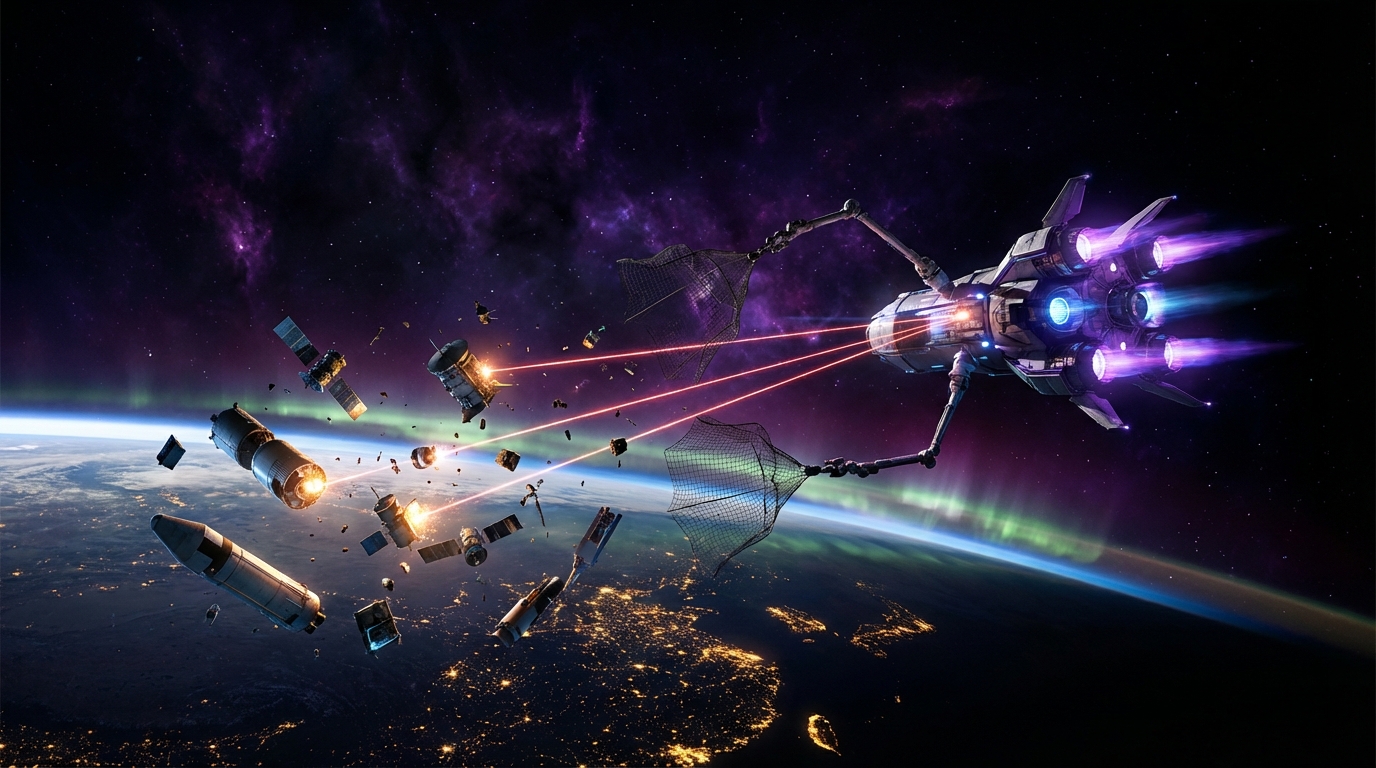
I used to think space was basically empty. Just stars, a few satellites, and a lot of nothing in between. Then I started looking into orbital data and realized low Earth orbit is starting to look more like a junkyard than a pristine void.
Here is the short version: space debris is a growing safety risk for satellites, astronauts, and future missions, and the only real way forward is a mix of smarter satellite design (so hardware dies cleanly), better tracking and maneuvering, plus active cleanup tech like magnetic tugs, nets, harpoons, drag sails, and laser nudges. No single gadget will “clean space”; the solution is layered and a bit messy.
Why space debris is a real problem, not a sci‑fi plot
The basic story is simple: we have launched things into orbit for more than 60 years, and we rarely brought them back down. Every dead satellite, spent rocket stage, and broken bolt that stays up there adds to a growing cloud of debris.
Some quick grounding:
- Over 30,000 tracked objects larger than about 10 cm are in orbit (those are just the ones large enough to track well).
- Hundreds of thousands of smaller fragments down to 1 cm exist, and models suggest millions of even smaller pieces.
- Even a 1 cm fragment can strike with the energy of a hand grenade at orbital speeds.
That last point tends to surprise people. In low Earth orbit, objects move at roughly 7 to 8 km per second. At those speeds, a paint chip can punch a crater in a window. The International Space Station has already had visible pitting and small impacts.
At some point, debris can trigger a chain reaction. One collision creates fragments, those fragments hit more satellites, and things start to spiral. Scientists call this a “Kessler syndrome” scenario. We are not there yet, but some orbit shells are crowded enough that the risk is no longer theoretical.
If we keep launching without changing how we retire and remove objects, some orbits can become too hazardous to use reliably.
So the real question is: what tech can reduce debris, and what tech can actually remove it?
To keep this clear, I will break space cleanup into two broad buckets:
- Tech that prevents new debris from forming.
- Tech that removes or neutralizes existing debris.
Both matter. A lot.
Tech that prevents new debris
Most companies want to launch more satellites, not fewer. So regulations alone are not enough. The hardware itself has to behave better.
Here are the main approaches.
1. Design-for-demise and controlled reentry
One of the simplest ideas: do not leave your stuff up there.
That sounds obvious, but historically many satellites and rocket stages were not designed with end-of-life in mind. They just ran out of fuel and stayed in orbit for decades.
Design-for-demise aims to change that: build satellites so they burn up almost completely in the atmosphere at the end of their lives.
This involves:
- Using materials and structures that reliably break up and vaporize on reentry.
- Reducing dense components that can survive to the ground.
- Planning fuel reserves to execute a controlled deorbit burn.
There are two main end-of-life paths:
| Orbit type | Preferred end-of-life action | Goal |
|---|---|---|
| Low Earth orbit (LEO) | Deorbit into atmosphere | Burn up completely, no long-lived debris |
| Geostationary orbit (GEO) | Boost into “graveyard orbit” | Move junk out of the busy GEO ring |
For GEO satellites, the atmosphere is too thin to help. So operators perform a final burn to move them a few hundred kilometers above geostationary orbit into a “graveyard” band, where they are less of a collision risk.
This is not perfect, because that graveyard can become cluttered as well, but the geometry is less sensitive. The main congestion and collision risk is in commonly used paths, like popular LEO shells or the precise GEO ring.
Making end-of-life maneuvers mandatory for large satellites is one of the simplest, highest-impact policy levers we have.
2. Passivation: making dead spacecraft safe
A lot of debris is not from direct collisions, but from things exploding in orbit.
Old rocket stages had leftover fuel, pressurized tanks, and batteries that could rupture years after a mission. When they did, they shattered into clouds of fragments.
Passivation is the practice of “defusing” a spacecraft or rocket stage at the end of life.
Key actions include:
- Venting leftover propellant so tanks are empty.
- Discharging batteries and disabling charging circuits.
- Releasing any stored pressure in lines and tanks.
This sounds boring. It is not a fancy robot with a laser. But it directly cuts down the risk of random explosions that create many small, hard-to-track fragments.
Space agencies have already adopted passivation standards for new missions. The challenge is getting every private operator to comply and verifying that they actually did.
3. Built-in collision avoidance and smarter operations
Tracking and avoidance used to be mostly the job of governments. That is changing quickly.
Today, we have:
- Ground-based radars and telescopes that track large objects.
- Catalogs updated by agencies, shared with operators.
- Automated conjunction warnings (predictions of close approaches).
Satellites can also help themselves:
- Onboard propulsion for small orbit changes when a collision is predicted.
- Autonomous maneuver planning, especially for large constellations.
- Improved navigation for more accurate orbit predictions.
Here is where software matters a lot. A single satellite can be managed manually. Ten thousand in a mega-constellation cannot. You need systems that:
- Ingest tracking data from multiple sources.
- Score collision risk in real time.
- Decide which satellite should move, by how much, and when.
And this is where some operators are still playing catch-up. There have already been cases where two companies disagreed about who should move, or who had better data.
Cleaning up orbit is not only about sci‑fi robots; it is also about dull but critical scheduling software and shared tracking standards.
There is also a minimum standard emerging: if you put something large into LEO, you should either remove it within 5 years of end of mission or design it so the atmosphere does that job within 25 years.
That 25-year guideline used to be the standard. Some regulators are pushing for 5 years for new satellites, because 25 years is too long when you are about to launch tens of thousands of them.
4. Self-disposal hardware: drag sails and propulsion modules
Suppose you run a small satellite mission. You may not want to build complex propulsion systems into every unit. But you still need a way to get them down.
Self-disposal hardware tries to solve that.
Two common approaches:
- Drag sails: Thin, lightweight sails that deploy at end of life to increase atmospheric drag and speed up reentry.
- Simple propulsion modules: Small plug-in units with just enough propellant and control to deorbit or lower the orbit.
Drag sails are interesting because they use physics you cannot turn off. At altitudes under roughly 800 km, the thin atmosphere slowly pulls satellites down. If you increase cross-sectional area with a sail, you speed this up dramatically.
There are already experimental missions where nanosatellites deployed drag sails and reentered in a few years instead of decades.
That said, drag sails require reliable deployment at the right time. If the deployment system fails, you still have a piece of junk.
Propulsion modules are more flexible, but more complex and expensive. They also need fuel margins and strict controls to avoid new explosion risks. So they connect back to passivation practices.
5. Standardized docking features for future cleanup
This one is less mature, but really helpful: design satellites today so future “tow trucks” can grab them more easily tomorrow.
Think of:
- Standard grappling points or docking plates.
- Markers that computer vision can track easily.
- Known mass properties and attachment diagrams shared publicly.
Right now, many older satellites are not cooperative targets. They tumble, have no handles, and were not built to be grabbed.
Every satellite launched without a clear idea of how to grab it later is another hard problem for future cleanup missions.
Some companies building active removal vehicles are pushing for these standards because they know how hard their job will be otherwise.
Tech that removes existing debris
Prevention alone is not enough. There are already thousands of dead satellites and large fragments up there.
Cleaning them up requires active debris removal (ADR). This is where the “cool technology” usually enters the discussion.
Let us break down the main families of tech.
1. Robotic “tow trucks” for large, cooperative targets
The easiest targets are:
- Big satellites (hundreds to thousands of kilograms).
- Upper rocket stages with known shapes and orbits.
- Objects that are not spinning too fast.
For these, one of the most promising approaches is a robotic servicer that can:
- Rendezvous with the target.
- Match its orbit and relative motion.
- Grab it using a robotic arm or docking mechanism.
- Either deorbit it or move it to a graveyard orbit.
This is basically “space tug” technology. It builds on earlier work for satellite servicing and refueling.
Key tech pieces:
| Component | Role |
|---|---|
| Guidance, navigation, control (GNC) | Accurate rendezvous and proximity operations |
| Robotic arms or grappling devices | Physically secure the target |
| Propulsion system | Change orbits with large mass attached |
| Onboard vision systems | Handle uncertain orientation and small relative motion |
Several missions are bringing this into real hardware:
- Demonstrations of docking with spent rocket stages.
- Servicing missions for communication satellites.
- Prototypes tested by space agencies and private operators.
The economic angle is tricky. A single mission that removes one piece of debris is expensive. To make this work commercially, you want a servicer that can remove or refuel multiple satellites during one mission.
There is a tension here. From a safety point of view, clearing the largest objects first gives the biggest reduction in future collision risk. From a business point of view, you want paying customers.
Sometimes those goals align. Sometimes they do not.
2. Nets, harpoons, and other capture systems
Not every target will be cooperative. Some will tumble rapidly. Some will have irregular shapes that make docking risky.
So researchers tested more aggressive capture methods:
- Nets: A small chaser satellite deploys a net that wraps around the target and cinches closed.
- Harpoons: A pointed device shoots into a solid part of the target and attaches via tether.
- Tethers: Cables that can connect the target to a deorbit device.
These ideas have moved beyond pure concepts. There have been real in-orbit demonstrations of net capture. Harpoons have been tested in lab and partial space simulations.
Each approach comes with tradeoffs:
| Method | Pros | Challenges |
|---|---|---|
| Nets | Works with irregular shapes, does not need precision docking | Risk of partial capture and loose fragments, requires careful deployment |
| Harpoons | Fast engagement, can grab from some distance | Risk of shattering fragile surfaces, requires solid impact point |
| Tethers | Useful for momentum exchange and drag devices | Potential for new entanglement hazards if not managed well |
The more aggressive the capture method, the more careful you must be about creating new fragments while cleaning up old ones.
In other words, a clumsy harpoon mission that cracks a satellite into hundreds of shards can leave you worse off than before.
So these methods require precise modeling, simulation, and gradual testing, from small controlled targets to bigger and more complex ones.
3. Magnetic and electrostatic tugs
Some satellites already carry magnetic components, like reaction wheels and magnetorquers, which interact with Earth’s magnetic field. Many have ferromagnetic materials in their structure.
This creates an interesting opportunity: use magnetic forces to capture or at least “nudge” debris without a hard physical clamp.
Concepts include:
- Magnetic “dog” that attaches to ferromagnetic surfaces.
- Electromagnets on a servicer that attract the target slightly, enough to hold position.
- Electrostatic forces between charged surfaces for gentle binding.
These methods are highly sensitive to distance and orientation, and the forces involved are small. But for slow, controlled operations, they might reduce the risk of bouncing or misalignment during docking.
They make the most sense for servicing satellites that are designed with these systems in mind. For random legacy debris, it is more hit-and-miss.
Still, as a segment of “cooperative debris” emerges, magnetic docking or electrostatic gripping could become standard features.
4. Lasers for debris nudging
Lasers sound like science fiction weapons, but the main concept here is more subtle: use laser light to exert a tiny but steady force on debris and slowly change its orbit.
There are two main variants:
- Ground-based lasers: Powerful laser stations on Earth track debris and fire short bursts that slightly change its velocity.
- Space-based lasers: Small platforms in orbit with less atmosphere to deal with, targeting specific fragments.
There are two mechanisms at play:
- Photon pressure (very small, usually too weak for practical use on large objects).
- Laser ablation, where the surface material is heated enough that a tiny amount evaporates, creating a micro-jet that alters orbit.
In practice, the focus is on using short pulses of laser energy to nudge smaller, dangerous fragments. Over time, those nudges can lower the object’s perigee enough that atmospheric drag handles the rest.
Some key challenges:
- Precise tracking of very small objects in real time.
- Energy and focusing limits, especially through the atmosphere.
- Safety questions: at what point does a laser look like a weapon?
Laser nudging is one of the few concepts that might scale to thousands of small objects without putting a spacecraft next to each one.
But politically, it is tense. High-powered, precise lasers aimed into orbit raise military questions. Any country building such systems has to convince others they are not anti-satellite weapons.
That is one reason progress is cautious.
5. Drag augmentation devices for existing debris
Earlier we talked about drag sails on new satellites. A similar idea can be applied to old debris: attach a device that increases drag and lets the atmosphere do the cleanup.
Three main variants:
- Attachable drag sails: A servicer docks with the target, attaches a sail package, and moves away.
- Aerobrake structures: Rigid or semi-rigid plates that increase cross-sectional area.
- Tethered devices: Long tethers that interact with Earth’s magnetic field or drag to slow the system.
Here the servicer does not need enough fuel to deorbit the target completely. It just adds a “brake” and lets nature work over a period of months to years.
Tradeoffs:
| Approach | Timescale | Main concern |
|---|---|---|
| Direct deorbit with propulsion | Days to weeks | High fuel cost, fewer targets per mission |
| Drag augmentation devices | Months to years | Long period where object still exists, but in decay |
In practice, we probably need both. Some high-risk objects should be removed quickly. Others can be put on a path to reentry with passive systems.
6. Atmosphere-like shells and very low Earth orbit operations
Not everything that helps is a direct cleanup mission. Some emerging tech keeps satellites low enough that they burn up automatically after their short mission.
Very low Earth orbit (VLEO), roughly 200 to 400 km, is gaining interest. At these altitudes, atmospheric drag is higher, so any satellite without continuous propulsion comes down quickly.
This pushes satellite design in new directions:
- Highly efficient propulsion to fight drag during the mission.
- Materials that handle more atomic oxygen and heating.
- Aerodynamic shaping to manage drag and stability.
Some VLEO platforms behave like airplanes in extremely thin air, using lift and drag in their orbit management strategies.
The space debris benefit: if a satellite in VLEO fails, it naturally reenters in a short timeframe. That reduces long-lived debris in higher, more stable orbits.
There is also research into using artificial “atmosphere-like” layers or plumes for targeted debris removal. For example, releasing very small amounts of gas at certain altitudes to increase drag locally for selected debris clouds.
That concept is still early and sensitive, because you do not want to disturb active satellites.
The data and software stack behind debris cleanup
Hardware gets most of the headlines, but none of this works without accurate data and strong software infrastructure.
Think of four layers:
| Layer | Role |
|---|---|
| Detection | Spot objects and measure their orbits. |
| Cataloging | Maintain up-to-date lists of objects and their states. |
| Prediction | Simulate orbital evolution and potential conjunctions. |
| Decision | Plan maneuvers, cleanup targets, and mission sequences. |
1. Tracking and sensors
To clean up debris, you need to know where it is, how it moves, and what it looks like.
Tracking sources include:
- Ground-based radars, especially for LEO objects.
- Optical telescopes for higher orbits.
- Space-based sensors that observe from orbit.
Different sensors offer different strengths:
- Radar sees objects regardless of sunlight, but has resolution and range limits.
- Optical systems depend on lighting and weather, but can detect faint objects.
- Space-based assets can avoid atmospheric distortion and see both LEO and GEO better.
Data from all these sources flows into shared catalogs. Today, the largest public catalog is often associated with US military tracking, but more civilian and commercial networks are growing.
That creates a separate challenge: data fusion and consistency across multiple sources with different accuracy and coverage.
2. Orbital prediction and conjunction analysis
Once you have positions and velocities, you need to predict where objects will be in the future. That is not trivial over long periods, because:
- Earth’s gravity field is not perfectly uniform.
- Atmospheric drag changes with solar activity.
- Objects sometimes maneuver without public notice.
Software tools have to:
- Propagate orbits with realistic physical models.
- Update predictions as new measurements come in.
- Scan millions of potential pairs for close approaches.
Accurate conjunction predictions are the backbone of both collision avoidance and smart debris removal campaigns.
False alarms waste fuel and time. Missed conjunctions risk real collisions.
So there is a constant push for better models, better drag forecasts, and more transparency about planned maneuvers.
3. Mission planning for debris removal
Active debris removal missions are logistically complex. A servicer that can visit multiple targets must choose:
- Which objects to remove first.
- What path minimizes fuel and time.
- How to balance safety impact versus mission cost.
This looks a lot like the “traveling salesman” problem but in orbital mechanics. You are not just deciding order; you are solving for continuous trajectories and burns.
Planning tools consider:
- Each target’s orbit, mass, and tumbling behavior.
- Servicer capabilities and fuel limits.
- Regulatory constraints and timelines.
Over time, we will likely see:
- Standard APIs for debris catalogs.
- Commercial services that score debris by risk.
- Optimization engines that propose candidate mission plans automatically.
I realize this sounds very technical. But this layer decides whether a debris removal business can make money and whether it removes the right objects.
Regulation, economics, and why tech alone is not enough
We could build perfect cleanup systems and still not fix the problem if no one pays for them.
There are three drivers that need to work together:
- Regulation and international agreements.
- Insurance and liability.
- New business models for on-orbit services.
1. Rules about end-of-life and active removal
Space is global. Debris from one country’s launch can hit another country’s satellite.
That makes unilateral rules tricky but not impossible. Individual launching states can require:
- Passivation of upper stages and satellites.
- End-of-life plans in mission proposals.
- Demonstrated deorbit capabilities for certain orbits.
Some agencies and regulators are already tightening standards. For example, reducing the allowed post-mission lifetime in LEO from 25 years to something closer to 5 years for new satellites.
There is also discussion about:
- Obligations to remove failed, large satellites.
- Shared funding mechanisms for debris that has no clear owner.
- Standards for sharing tracking data and planned maneuvers.
Absent real enforcement, these remain recommendations. But licenses and launch permissions are powerful tools. If launch providers or regulators say “no end-of-life plan, no launch,” behavior changes quickly.
2. Insurance, liability, and real financial risk
Right now, if your satellite hits someone else’s, fault is very hard to assign. Orbits are complex, data can be incomplete, and debris clouds make attribution messy.
Over time, as tracking improves, so will the ability to say:
- Which object triggered a collision cascade.
- Which operator ignored repeated warnings.
- Which mission design carried obvious long-term risks.
Insurance underwriters will react. They can:
- Charge higher premiums for satellites without end-of-life removal capacity.
- Offer discounts for missions that comply with best practices and cleanup standards.
- Refuse coverage for missions that do not meet basic debris risk requirements.
That financial pressure can push companies toward better tech faster than a conference statement.
Once insurers price debris risk into policies, cleanup tech shifts from “opt-in good citizenship” to “basic cost of doing business in orbit.”
3. Business models for orbital services
Satellite servicing, refueling, and debris removal all share one thing: they are expensive to start and depend on a healthy customer base.
Some possible revenue sources:
- Contracted removals of specific high-risk debris pieces, paid by agencies or operators.
- Refueling and life-extension services that keep existing satellites working longer.
- Shared “debris credits” markets, where operators fund cleanup that offsets their launches.
Here is where I disagree with some optimistic takes. I do not think a generic, free-market “debris credit” system will just appear and solve this on its own. The incentives are not clean enough, and the data is too technical for a casual marketplace.
Instead, I expect:
- Targeted public funding for early debris removal missions that show capability.
- Closed deals between major operators and servicer companies.
- Gradual integration of removal obligations into launch or spectrum licenses.
The technology is evolving faster than the legal frameworks. So there will probably be some awkward years where everyone agrees debris is bad, but nobody wants to pay to clean up things they do not “own.”
Technical and ethical challenges no one has solved fully
It is tempting to treat every new debris concept as a clear win, but some serious questions remain.
1. Dual-use concerns
Any technology that can grab, tow, or disable a dead satellite can, at least in theory, do the same to a live one.
Robotic arms, capture nets, lasers, and tugs all fall into this category. This creates:
- Military suspicion about other nations’ cleanup systems.
- Risks of misinterpretation if a servicer maneuvers near another asset.
- Need for clear transparency and notification protocols.
This does not mean we should avoid these tools. But it means technical design, mission profiles, and public communication need to consider perception, not just physics.
2. Ownership and consent
Who owns a dead satellite? Legally, usually the launching state or original operator. Can another party remove it without consent?
Areas that still feel murky:
- Old satellites from companies that no longer exist.
- Objects launched decades ago under different legal norms.
- Debris fragments that no one can reasonably identify.
There is a tension here. Waiting for perfect legal clarity can stall useful cleanup. Acting too fast can create diplomatic disputes.
The tech to pull a dead satellite out of orbit might arrive before the legal right to do so is clearly defined.
So some of the most practical early missions will target “friendly” debris: objects owned by the same country or company funding the cleanup.
3. Risk of cleaning badly
Every active debris removal mission adds something new to orbit during operations:
- At least one servicer spacecraft.
- Fuel, thruster plumes, mechanical moving parts.
- Potential failure modes at every capture and release event.
If a servicer fails and becomes debris itself, or drops a target in an unstable configuration, we can worsen the problem. A few failed missions would set back public support.
This is why many programs follow a staged approach:
- Start with simple targets in controlled environments.
- Move to more complex, tumbling objects as systems prove reliable.
- Continue to treat mission reliability as part of debris mitigation, not a separate metric.
What a realistic path forward looks like
If I try to zoom out, the most plausible way we actually “clean up” orbit is not a single tech breakthrough. It is many small shifts, in parallel.
Something like this:
- Every new satellite has a credible end-of-life plan: propulsion, drag sail, or a low orbit that guarantees reentry.
- Passivation and collision-avoidance standards are enforced by regulators and insurers.
- Tracking networks become more accurate and more open, reducing missed conjunctions.
- One or two commercial servicer platforms prove they can remove or refuel multiple satellites affordably.
- Agencies fund focused campaigns to remove the highest-risk large debris pieces, using tugs, nets, or drag devices.
- Shared standards for docking, grappling points, and visual markers make future cleanup easier.
- Laser nudging and VLEO mission designs quietly reduce small-fragment and long-lived debris over time.
None of this is as neat as a single “space vacuum cleaner” that fixes everything. But space technology rarely works that way. It is more incremental, with a lot of engineering tradeoffs that are boring up close and very significant over decades.
And somewhere between those tradeoffs and the physics, we either end up with usable orbits for the next century or a slowly closing shell of high-speed junk.
Personally, I think the tech is getting good enough that we can solve this. The harder part is coordinating many actors who all share the same orbital neighborhood, but do not always share the same incentives.