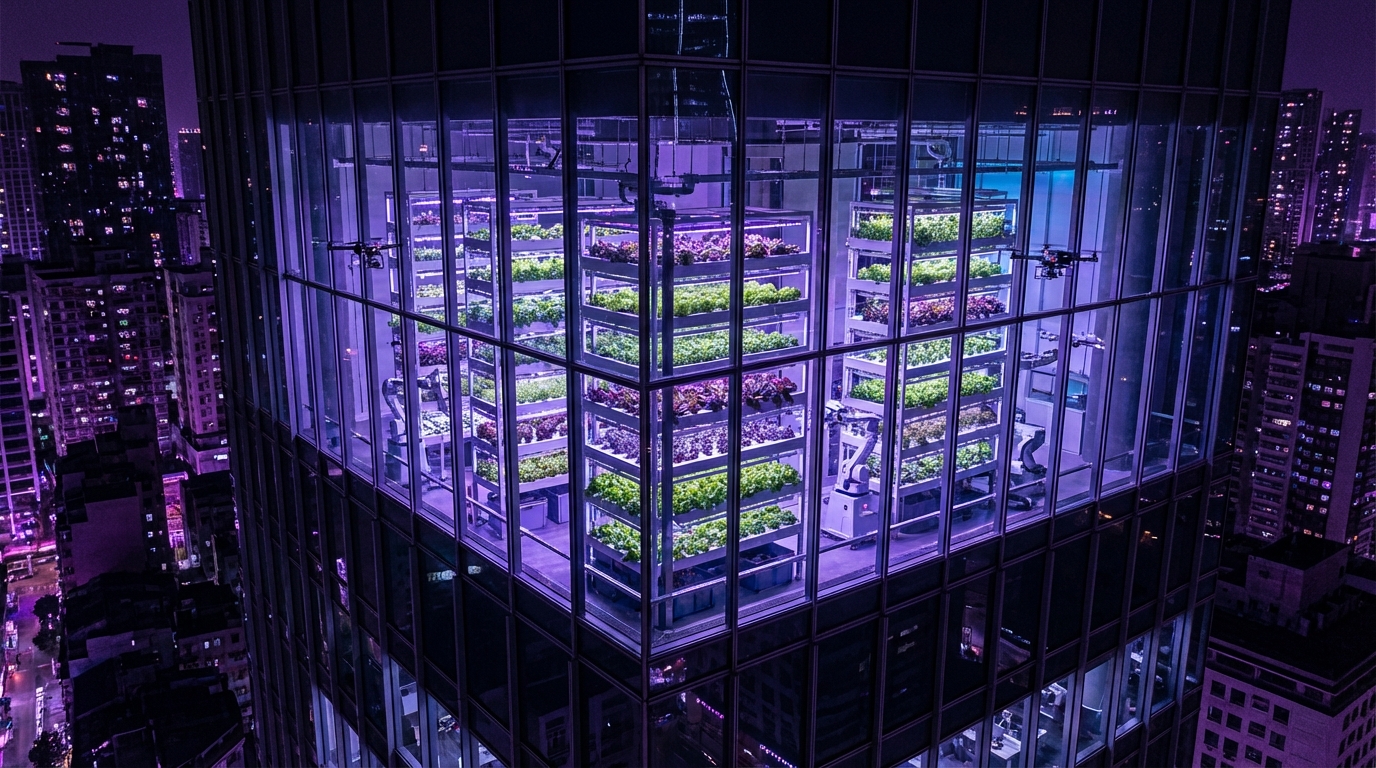
I used to think vertical farming was just a fancy way to grow lettuce under purple lights. Cool for Instagram, not very serious for feeding millions of people. Then I started looking at the numbers, the tech stack, and what is happening with climate and land use, and my view shifted pretty quickly.
Here is the short version: vertical farming will not “solve” the food crisis by itself, but the technology already solves very specific parts of it: fresh produce near cities, water use, pesticide reduction, and resilience when weather goes wild. The real power comes when you combine vertical farms with traditional farms, better logistics, and smarter policy rather than expecting stacked containers to replace wheat fields.
What problem is vertical farming actually solving?
When people say “food crisis,” they mix several different problems into one phrase. That leads to unrealistic expectations and a lot of hype.
Let us separate things a bit:
- Calories (grains, roots, staples)
- Nutrition (vitamins, minerals, fresh produce)
- Access (getting food where people live, at the right price)
- Stability (resilience against climate, war, trade shocks)
- Environmental limits (water, soil, emissions, land use)
Vertical farming is strong in some of these areas and weak in others.
Vertical farms are fantastic for reliable, high-quality fresh produce near cities. They are terrible, at least right now, for bulk calories like wheat or rice.
If you expect vertical farming to give you cheap rice for billions of people, you will be disappointed. If you look at it as infrastructure for fresh food that takes pressure off land, water, and imports, the picture looks very different.
The core idea behind vertical farming
Vertical farming is simple in theory: grow crops in stacked layers indoors, control almost every variable, and use software and sensors instead of weather and seasons.
Most vertical farms combine these five elements:
- Controlled environment: Enclosed rooms or containers where temperature, humidity, and CO₂ are managed.
- Artificial lighting: Mostly LEDs tuned to the wavelengths plants use best.
- Soilless growing systems: Hydroponics, aeroponics, or aquaponics.
- Automation and robotics: For seeding, moving trays, harvesting, and packing.
- Data and control software: Sensors, cameras, and algorithms that constantly adjust conditions.
The big trade-off is obvious: you swap sunlight for electricity, and open fields for capital-intensive buildings and hardware.
The tech stack behind vertical farming
This is where it gets interesting. If you look closely, a vertical farm is more like a data center with plants instead of servers. Everything is driven by technology decisions.
1. Lighting: where most of the energy goes
LEDs are the heart of a vertical farm. For a long time, they were too expensive and too power hungry. That is why older projects failed.
Now we have:
- High-efficiency LEDs that convert more electricity into usable light.
- Spectrum tuning so you can give plants more red or blue light at different growth stages.
- Dimmable zones where light levels adjust to plant density and time of day.
Every small improvement in LED efficiency directly reduces operating cost and emissions. This one component can make or break the business case.
There is still a hard limit here. Light for photosynthesis needs energy, and physics does not negotiate. So even with perfect LEDs, staple crops with low margins and high energy needs are hard to justify in a vertical setup.
2. Growing systems: hydroponics, aeroponics, aquaponics
Most commercial vertical farms pick one main growing method, sometimes mixing two.
| System | How it works | Strengths | Weaknesses |
|---|---|---|---|
| Hydroponics | Roots in nutrient water, often in channels or troughs | Simple, proven, high yields, easy automation | Water quality must be monitored very closely |
| Aeroponics | Roots hanging in air, sprayed with nutrient mist | Low water use, high oxygen to roots, rapid growth | More complex, sensitive to pump or nozzle failures |
| Aquaponics | Fish waste feeds plants, plants clean water for fish | Produces fish and plants, closed-loop appeal | Complex balancing act, harder to scale uniformly |
Many farms favor hydroponics because it is less fragile than aeroponics at scale. For a food system, reliability often beats theoretical best performance.
3. Climate control: HVAC, CO₂, and airflow
If LEDs are the muscles, climate control is the nervous system.
Vertical farms need to:
- Keep temperature in a tight range for each crop.
- Manage humidity so leaves stay healthy but diseases struggle.
- Control CO₂ levels to boost growth but stay safe for workers.
- Move air so heat and moisture do not form hotspots.
Cooling is not just about comfort. LEDs and electronics generate heat that must go somewhere. If the farm uses a lot of power, the cooling load grows too.
Plenty of early farms underestimated HVAC complexity and cost. They hit their plant growth targets and still could not make money because energy and cooling bills were too high.
This is where integration with building design and local climate matters a lot. A vertical farm in a cold region can use outside air for cooling more easily than one in a hot, humid city.
4. Automation, robotics, and computer vision
Labor is one of the largest operating costs in agriculture. Vertical farms move as much work as possible to machines.
Common automation pieces:
- Seeding machines that place seeds into trays or plugs.
- Conveyor or shuttle systems that move trays through growth stages.
- Robotic arms or gantries for harvesting and packaging.
- Automated nutrient dosing systems.
On top of that, farms add sensors and cameras:
- Multispectral cameras to check leaf health.
- Machine learning models to detect diseases or nutrient issues early.
- Yield prediction models to match supply to demand.
A lot of this looks similar to what you see in warehouses or factories. The difference is that the “product” is alive and reacts to small changes.
5. Software and data: the “OS” of the farm
Vertical farming software is usually a mix of:
- Environment control (setpoints for light, temperature, humidity, CO₂).
- Recipe management (growing profiles for each crop variety).
- Production planning (how many trays to seed, harvest scheduling).
- Traceability (which batch went where, compliance records).
The key idea is “grow recipes”: parameter sets that define the life of a plant inside the farm.
Once a crop recipe is encoded in software, you can repeat the same conditions in any facility that has compatible hardware. That is the real reason people compare vertical farms to data centers.
Better data and models do not just make plants grow faster. They reduce waste, smooth operations, and let farms adjust output based on demand patterns.
How vertical farming tackles parts of the food crisis
Let us go back to those five food crisis dimensions and map them.
1. Calories vs fresh produce
Vertical farms are strong in:
- Leafy greens
- Herbs
- Microgreens
- Some berries
- Some vine crops (tomatoes, cucumbers, peppers) in hybrid greenhouses
They are weak in:
- Wheat, rice, maize
- Potatoes, cassava, yams
- Soy and other big field legumes
From a calorie angle, that looks bad. Most human energy intake still comes from grains and roots grown outdoors.
But from a nutrition and health angle, it matters a lot. Many emerging food crises are not only about not having enough calories. They are about:
- Micronutrient deficiencies
- Lack of fresh, affordable produce in cities
- Seasonal gaps in supply
If vertical farms can provide consistent fresh produce year round, near big population centers, they support health without competing with field farms for land.
2. Access and urban demand
Huge numbers of people live in or near cities now, and that number keeps rising. Urban demand has some clear patterns:
- Preference for fresh, washed, ready-to-eat products
- Sensitivity to food safety and pesticide residues
- Limited space for traditional farming
Vertical farms fit right into this pattern.
When you can grow lettuce 10 kilometers from the supermarket instead of 1,000 kilometers away, you cut transport costs, shrink spoilage, and reduce dependency on long supply chains.
And because the environment is controlled, farms can deliver:
- Predictable size and quality (good for retailers).
- Low or zero pesticide use (good for marketing and health).
- Consistent year-round supply (no “off season”).
This does not fix hunger in rural regions directly. But it does free up transport capacity and cold storage for other foods, and it lets cities rely a bit less on imported produce.
3. Stability and climate resilience
Traditional farms face:
- Unpredictable rainfall and drought
- Extreme temperatures and heat waves
- Flooding and storms
- New pests and diseases spreading into new regions
Yield variability is a serious issue. Governments and aid agencies struggle to plan when production jumps around.
Vertical farms are not immune to risk. They face:
- Energy price spikes
- Grid failures and blackouts
- Hardware failures and software issues
Still, their output is much less tied to weather. Once you have stable power and a functioning facility, you can run production like a factory.
From a resilience view, vertical farms are like backup generators for fresh food. They do not replace the grid, but they keep critical systems running when things go wrong.
In regions with frequent crop failures, even a few urban vertical farms can cushion price spikes for greens and herbs. That might sound small, but price shocks in fresh food can trigger unrest in fragile economies.
4. Water use and local resources
Traditional irrigated farms can lose:
- 30 to 60 percent of water through evaporation and runoff.
- Additional water through leaks and inefficient channels.
Vertical farms often claim water savings of 90 to 95 percent compared to open-field systems for the same crops.
Where does the saving come from?
- Closed loops: water stays inside pipes and containers.
- Condensation recovery: humidity from plant transpiration is captured and reused.
- Precise dosing: nutrients and water go straight to roots.
In water-stressed regions that import a lot of produce, growing high-value leafy greens indoors can cut “virtual water” imports.
But there is a catch.
Water is only part of the resource equation. You trade water use for energy use. In some places that swap makes sense. In others, it does not.
5. Environmental impact and land use
Clearing land for new farms often means cutting forests or draining wetlands. That hits biodiversity, carbon storage, and local climate.
Vertical farms aim to:
- Grow more food per square meter of land footprint.
- Reduce or eliminate harmful pesticides and herbicides.
- Lower fertilizer runoff into rivers and oceans.
Here is where the numbers get interesting.
| Factor | Traditional field (leafy greens) | Vertical farm (leafy greens) |
|---|---|---|
| Yield per m² per year | 1x | 10x to 20x |
| Water use per kg | High | Very low |
| Pesticide use | Common | Near zero |
| Energy per kg | Low to moderate | High |
If the electricity mix is heavy in fossil fuels, the carbon footprint per kilogram can be worse in a vertical farm. If the facility runs mostly on renewables, the picture improves a lot.
So vertical farming can reduce pressure on land and chemicals, but that benefit is only real if the energy question is addressed.
Where vertical farming fits into a global food strategy
I do not think it is helpful to ask “Will vertical farming feed the world?” That sets the bar wrong.
A more realistic question: “Where does vertical farming make sense as part of a wider system?”
Use case 1: Urban and peri-urban produce hubs
This is the obvious one. Put vertical farms:
- Near big cities and ports
- Integrated with supermarkets and food distribution centers
- In repurposed warehouses or purpose-built facilities
Benefits:
- Fresh greens with very short supply chains.
- Reduced spoilage and waste.
- Jobs in high-density regions.
- Less need for refrigerated trucks over long distances.
This model is already running in places across North America, Europe, Middle East, and parts of Asia.
Use case 2: Harsh climates and import-dependent regions
Some regions struggle to grow fresh produce at scale:
- Very hot or very cold climates
- Extremely limited arable land
- Water scarcity issues
These regions often import a large slice of their food, which creates:
- Price vulnerability
- Security concerns
- High transport emissions
Vertical farms in these locations:
- Reduce dependency on imports for sensitive categories.
- Lower perishable goods loss in transit.
- Give governments more control over food reserves.
Energy cost is still a limiting factor, but many of these places invest heavily in solar and other renewable power sources. That can line up well with vertical farm energy needs.
Use case 3: R&D and plant “software”
There is a quieter role vertical farms play: they act as research platforms.
Because you can control nearly everything, vertical farms are perfect for:
- Breeding new varieties for flavor, nutrition, or growth rate.
- Testing how different light recipes change plant traits.
- Exploring new crops for indoor production.
Results do not stay indoors. Some knowledge goes back to field farming:
- Better understanding of how plants react to stress.
- Insights on nutrient-use efficiency.
- Improved seed lines that perform better outdoors too.
You can think of vertical farms as “compilers” for plant genetics. They help you translate genetic potential into predictable, repeatable outcomes.
That is not very visible to consumers, but it supports the broader food system.
Use case 4: Emergency and resilience infrastructure
This one is less discussed, but I think it is important.
Imagine:
- A region hit by repeated drought and crop failures.
- Ports closed or limited by conflict.
- Transport disruption after extreme storms.
Vertical farms alone will not cover full food needs, but they can:
- Keep supply of nutrient-rich greens running in a crisis.
- Support hospitals, schools, and key institutions.
- Stabilize at least one visible part of the food system.
Combined with grain reserves, conventional farms, and trade agreements, they add a layer of redundancy.
The hard problems and limitations of vertical farming
If this sounds almost too balanced so far, let me push back a bit. There are still serious problems.
Energy and economics
Energy cost is the biggest structural challenge.
Key points:
- Lighting and HVAC can make up more than half of operating cost.
- Profit margins on fresh produce are thin.
- Retailers push for low, predictable prices.
If power prices spike or remain high, many vertical farms struggle.
We have already seen high-profile failures where beautiful facilities could grow excellent lettuce but not at a price that retailers, or consumers, accepted.
A few ways farms try to deal with this:
- Long-term electricity contracts.
- On-site solar plus battery storage, when space and policy allow.
- Heat recovery systems tied into nearby buildings or district heating.
- Targeting premium segments (food service, specialty retail) before going mass-market.
Long term, the economics improve if:
- LEDs and equipment prices continue to drop.
- Software improves yield and reduces waste.
- Renewable power gets cheaper and more abundant.
But right now, many business models remain fragile.
Crop diversity and diet mismatch
Another issue is crop range. Human diets are diverse. Vertical farms are not, at least not yet.
Most facilities grow a narrow band of plants:
- Lettuces
- Basil, mint, coriander, parsley
- Microgreens
Some farms experiment with:
- Strawberries
- Tomatoes
- Chilies and peppers
- Specialty herbs and edible flowers
But these often serve high-end markets first, not food-insecure households.
If we talk about a “food crisis,” we cannot ignore:
- Staple commodities
- Affordable protein
- Long shelf-life items
Vertical farming does not map neatly to those needs yet. Protein-rich crops indoors are an active research area, but far from mainstream.
Capital and inequality
Building a vertical farm requires:
- Expensive hardware and construction.
- Technical skills for design, operation, and maintenance.
- Access to finance with a tolerance for risk.
Regions that face the worst food crises often have:
- Limited capital access.
- Unreliable power infrastructure.
- Fragile institutions and policy environments.
That gap means many early vertical farm deployments cluster in wealthy regions, even though food insecurity is more severe elsewhere.
One partial counter to this trend is smaller, modular systems:
- Container farms
- Community-scale vertical greenhouses
- Open-source control platforms
But it is still early, and the economic models are not always clear.
How technology can make vertical farming more relevant
So far I have been mostly descriptive. Let me shift slightly to what needs to happen for vertical farming to matter more for the food crisis, not just for urban salad supply.
1. Smarter integration with energy systems
Right now, many farms treat energy as a cost line, not a design parameter.
A more strategic approach:
- Co-locate farms with renewable power plants or large solar rooftops.
- Time-shift lighting schedules to match off-peak or surplus power periods.
- Use predictive control to turn farms into flexible loads that support the grid.
If a vertical farm can adjust light intensity or timing without hurting yield, it can “soak up” extra clean power when it is available and reduce draw when the grid is stressed.
This requires deep integration between:
- Farm control software
- Local grid management systems
- Energy market signals and pricing
It is a tech problem, but also a policy and business problem.
2. Broader crop research
If vertical farming stays stuck at lettuce and basil, its macro impact will stay small.
We need:
- Breeding programs aimed at indoor traits: compact size, fast cycles, flavor, nutrient density.
- Experiments with legumes, leafy beans, and other protein-supporting crops.
- Exploration of culturally important vegetables in different regions, not just Western salad staples.
This is slow work. It needs:
- Public research funding
- Private sector trials
- Open sharing of at least some results to avoid siloed progress
I do not believe we will grow wheat vertically at scale anytime soon. But I do think there is room to expand into more meaningful categories than lettuce alone.
3. Open standards and shared “plant recipes”
Right now, many vertical farming companies treat their grow recipes as proprietary secrets. That makes sense from a business angle, but it slows system-level learning.
Imagine if:
- There were shared baselines for how to grow key crops indoors.
- Regional variants were documented and available.
- Researchers and small growers could build on that library.
We have open source software; it would be healthy to have some open source plant knowledge for controlled environments too.
This does not mean companies give away everything. But some standardization would lower entry barriers and reduce repeated mistakes.
4. Hybrid systems with conventional agriculture
I sometimes hear a strange “either/or” framing: either we invest in vertical farms or in traditional farms. That feels wrong.
Better questions:
- Which crops make sense indoors vs outdoors in a given region?
- How can indoor production smooth seasonal peaks and troughs for outdoor partners?
- Can vertical farms contract with field growers to share risk and supply stability?
Practical examples:
- Grow seedlings indoors and transplant to fields for faster, more uniform crops.
- Use indoor farms to hold breeding lines and produce seeds under perfect conditions.
- Let outdoor farms focus on grains, roots, and broad-acre crops while indoor farms cover sensitive leafy produce.
Technology here is not just hardware. It is also about software that coordinates supply and demand between these systems.
What this means for “solving” the food crisis
I do not agree with the idea that vertical farming by itself is some silver bullet. That narrative is not just wrong, it can be harmful. It can pull attention away from:
- Soil health on existing farms
- Food waste reduction
- Better storage and logistics in low-income regions
- Policy reforms and trade rules
But I also do not agree with the dismissive view that vertical farming is a gimmick for rich cities.
Here is a more honest framing:
Vertical farming is a technology suite that, if deployed thoughtfully, can take pressure off land and water, bring reliable fresh produce closer to people, and provide a layer of resilience in an increasingly unstable climate.
It helps with:
- Nutrition and quality, not bulk calories.
- Urban access, not rural self-sufficiency.
- Water conservation and pesticide reduction, if energy is handled well.
- Climate resilience for parts of the food basket.
It struggles with:
- Energy and capital costs.
- Staple crops and cheap calories.
- Equitable deployment in the poorest regions.
The technology story here is not about more impressive LEDs or robots alone. It is about how all of this integrates with energy systems, logistics, policy, and traditional farming.
If we treat vertical farming as one tool among many, accept its limits, and design around them, it can make a real, measurable dent in parts of the food crisis. If we expect it to replace fields and farmers, we will waste time, money, and trust.